Operations | Monitoring | ITSM | DevOps | Cloud

The Place Where Modern Operations & Technology Come Together

The latest News and Information on Containers, Kubernetes, Docker and related technologies.
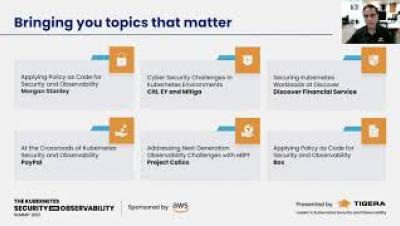
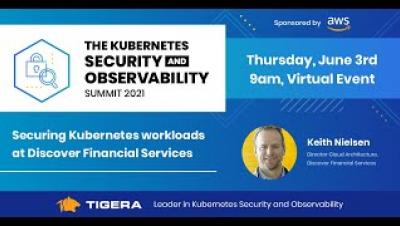
Securing Kubernetes workloads at Discover Financial Services
It’s a daunting task starting down the path to securing your workloads running on Kubernetes in the Cloud. There are no shortages of vendors with great tools in the Cloud security space. There is a multitude of domains that must be accounted for, along with internal challenges in bringing an organization along into new ways of thinking. This talk will focus on Discover’s Cloud security journey, with an overview of how the program has evolved over the last 4 years, key capabilities & concepts that have been embraced and challenges faced.
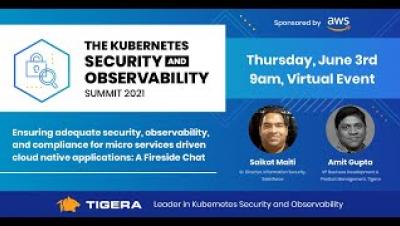
Ensuring adequate security, observability, & compliance for cloud native applications
Containers, Microservices, and cloud-based applications have revolutionized the way companies build and deliver products globally. This has also changed the attack surface and requires very different security strategies and tools to avoid exposure to sensitive information and other cyber attacks. Regulatory compliance has also evolved making it ever so important for companies to adapt to this new paradigm.
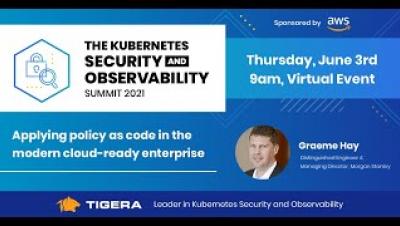
Applying policy as code in the modern cloud-ready enterprise: Graeme Hay, Morgan Stanley
Join us as we look at the advantages, but also the practical challenges, of applying modern, policy-as-code ("PaC") approaches in a modern cloud-ready enterprise. This talk will show how Morgan Stanley is drawing upon years of experience in its own proprietary implementation of PaC in its approach to embracing today's ideas. We will look at a diverse set of considerations from GitOps as a method to applying PaC in modern software development and deployment to enforcement of best practices and compliance in the Cloud.
The Crossroad of Security & Observability in Kubernetes: A Fireside Chat
Security as an afterthought is no longer an option and must be deeply embedded in the design and implementation of the products that will be running in the cloud. It is increasingly more critical for many security teams to be almost, if not equally, knowledgeable of the emerging and rapidly evolving technology. Join Manish Sampat from Tigera, as explores the topic in detail with Stan Lee from Paypal.
Observations from the field: Best Practices for Securing your Kubernetes Clusters
Security is critical for your Kubernetes-based applications. Join this session to learn about the security features and best practices for safeguarding your Kubernetes environments.
Upgrading DevSecOps with compliance automation - Bryan Langston, Mirantis
Compliance automation is a commonly overlooked area of Kubernetes observability. The question is: how do you automate compliance to a security framework that isn’t well understood by DevSecOps teams to begin with? This lack of understanding contributes to mismanaged compliance efforts and in a worst-case scenario, audit exposures and organizational risk. This talk will walk through an example of how to 1) map compliance controls to specific Kubernetes technical configuration 2) automate the assessment of those controls 3) visualize the assessment results. DevSecOps teams will better understand how to incorporate compliance automation alongside security automation.
Building secure and observable Kubernetes platforms for scaled software delivery
"Companies of various sizes are building their applications on Kubernetes because it provides significant operational benefits like autoscaling, self-healing, extensibility, and declarative deployment style. However, the operational benefits are only a starting point down the path of building a secure and observable platform that enables the continuous delivery of application workloads. This session shows how to build a fully operational platform, leveraging platform-oriented building blocks to address network security and observability.
Exploring intrusion detection techniques in cloud native environments - Garwood Pang, Tigera
As more production workloads migrated to the cloud, the need for Intrusion Detection Systems(IDS) grew to meet compliance and security needs. With the number of workloads in each cluster, IDS needs to be efficient to not take up the shared resources. Techniques such as packet inspection and web application firewalls provide a solid defense against threats and by leveraging the cluster's network control pane, we are able to selectively choose vulnerable workloads and provide an easy way to trace back to the origin of the attack.
Service Mesh, Observability and Beyond - Sheetal Joshi, AWS
Congratulations! You’re now cloud-native with microservices. No more legacy monoliths. However, troubleshooting takes time, debugging is difficult, and security is scary. How can you scale your organization without losing an understanding of your environment? Services mesh is here to help! It gives you the observability of connected services and is easier to adopt than you might think. Come and learn service mesh concepts, best practices, and key challenges.