Operations | Monitoring | ITSM | DevOps | Cloud

New: Optimize Slow Queries with Enhanced Database Visibility in Splunk Observability

Databases have always been the backbone of applications – both web and enterprise. Now, more than ever before, you need to know not just overall statistics about your database, but you must identify how database performance interacts with the network, operating system, servers, configuration, and even third party dependencies.

Dashboard Studio: New Features Highlighted At .conf21

I am very excited that this year’s.conf21was the first.conf where we got to showcase Dashboard Studio, which has come built-in with every Splunk Enterprise and Splunk Cloud Platform release, since 8.2 and 8.1.2103, respectively. I am even more excited to share a packed list of new features in the 8.2.2109 release, which coincides with.conf21! This blog post will highlight a few capability areas we've been heavily focused on that will help you do even more with your dashboards.

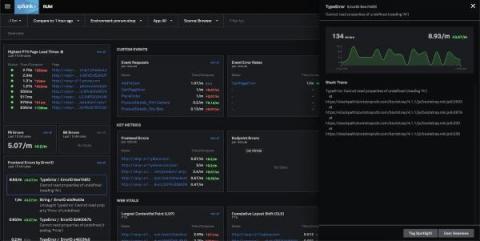
Splunk RUM troubleshoots customer-facing issues faster to deliver better user experiences

With Splunk RUM you can quickly navigate from high-level page performance to the source of an issue itself, across your entire architecture for full-stack, end-to-end visibility. A critical component in the Splunk Observability suite, Splunk RUM offers NoSample^TM^, full-fidelity data capture with support for OpenTelemetry - meaning you’ll find root cause without switching monitoring tools, with more context across your distributed systems.

Activating Connected Experiences in 60s

Looking to get started with Splunk Mobile and Connected Experiences? You’ve come to the right place. This video will show you all the steps you need to take to deploy Connected Experiences to your entire organization. If you’re using SAML, no worries. MDM, it works! Come one, come all and learn to unlock the power of Splunk Connected Experiences in your own organization.

Reducing the Carbon Footprint of the Manufacturing Industry with the Power of Data

As the world watches the UN Climate Conference unfold in Glasgow, the manufacturing industry is under increased pressure to reduce its CO2 emissions. Companies are stepping up to the challenge, but much more remains to be done to keep climate change under control. Digitalization is part of the solution. The Power of Data has much to offer such as environmentally friendly manufacturing, efficient logistics, improved building and energy management and optimized renewable energy production.

Why Use OpenTelemetry Processors to Change Collected Backend Data

When managing distributed environments, we find ourselves challenged with looking for different ways to understand performance better. Telemetry data is critical for solving such a challenge and helping DevOps and IT groups understand these systems’ behavior and performance. To get the most from telemetry data, it has to be captured and analyzed, then tagged to add relevant context, all while being sure to maintain the security and efficiency of user and business data.

A CI/CD Template for Terraform

Continuous integration (CI) makes the cycle from design to code to building artifacts seamless and consistent. Continuous delivery (CD) makes delivery of that artifact to an environment the same every time. But, what about the actual environment the artifact is running in? Is it the same every time? That’s a hard thing to guarantee — unless you take advantage of an Infrastructure-as-Code (IaC) approach. This post explains how to use Infrastructure-as-Code to improve CI/CD.

DevOps Release Management Best Practices

Because DevOps practices can bring great speed and reliability to the software delivery lifecycle, release management can seem daunting. But, the improved visibility and collaboration brought about by DevOps can also help with the release management process. While the general concept of release management doesn’t really change between ITIL (IT Infrastructure Library) and DevOps, there are a few ways that the process differs.