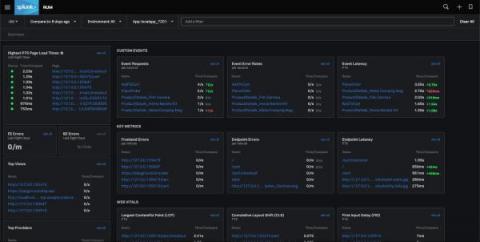
For application developers and service owners who build and troubleshoot modern enterprise software, resolving production issues requires identifying poor performance across multiple networks, operating systems, servers, configs, and third party dependencies. When the problem is the code itself, code profiling helps identify service bottlenecks by periodically taking CPU snapshots, or call stacks, from a runtime environment.
Many companies in Asia Pacific (APAC) were caught in a digital tailspin when Covid-19 hit, sacrificing security practices in their hurry to adjust to the new reality of remote work. Two years on, hybrid work is still the norm as the pandemic continues and seems to be a new way of life moving forward. Catalyzed by the coronavirus, firms big and small are now adopting cloud technologies as we tread deeper into a new data age.
To quote the UK National Data Strategy: Splunk is an advanced data platform that delivers right-time analytics from diverse data sets and that enables organisations to ask questions of all their data. It can be used to mitigate cyber security risk, improve performance, increase reliability and observe what is happening in the cloud.
Developing modern applications is harder than ever, with microservices and cloud deployment models making it harder to get things working than ever before. However, anyone who’s deployed an application knows that that’s just the beginning of the work. The biggest part comes later: ensuring it works correctly, with maximum efficiency and great performance.
Many of you may have seen our State of Data Innovation report that we released recently; what better way to bring data and innovation closer together than through Machine Learning (ML)? In fact, according to this report, Artificial Intelligence (AI)/ML was the second most important tool for fueling innovation. So, naturally we have paired this report with a new release of the Machine Learning Toolkit (MLTK)!
Some things just go better together. Like barbeque and blues, sunsets and beaches, cheese and fine wine — hey, even software and superheroes go better together! That’s why in this blog we are going to look at why IT Operations and Observability just go better together, through a superhero analogy. Enter the Dark Knight himself — Batman! He will represent observability. IT Operations will be represented by Lucius Fox.