Operations | Monitoring | ITSM | DevOps | Cloud

Everything You Need to Know About Synthetic Testing

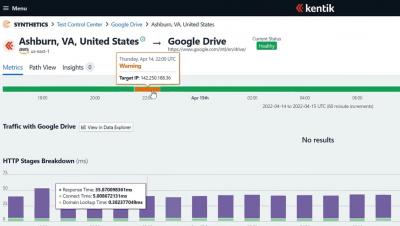
Part two of a three-part guide to assuring performance and availability of critical cloud services across public and hybrid clouds and the internet Monitoring your user traffic is critical for knowing the quality of the digital experience you are delivering, but what about the performance of new cloud or container deployments, expected new users in a new region, or new web pages or applications that don’t have established traffic? This is where synthetic testing can be invaluable.

Using Kentik Synthetics for Your Cloud Monitoring Needs

The final post of a three-part guide to assuring performance and availability of critical cloud services across public and hybrid clouds and the internet Kentik Synthetics adds integrated, autonomous, pervasive performance test telemetry to our market-leading network traffic analytics and observability platform, the Kentik Network Observability Platform. For modern clouds, proactive synthetic monitoring can no longer be delivered as a standalone tool.

Kentik takes network observability to KubeCon 2022

If you’re an engineer trying to fix real problems with your apps, looking at just one small part of the picture isn’t going to cut it. This is why Kentik is so focused on helping you understand what’s going on beyond single k8s instances, and it’s a big part of what network observability is all about. This was Kentik’s message at Kubecon 2022, which was a memorable event for us.

Solving for cloud/multi-cloud network complexity

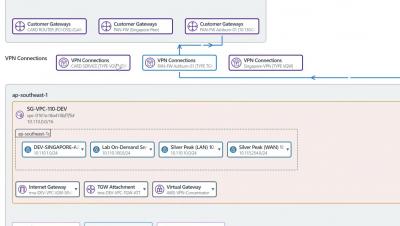
Networking in multi-cloud / hybrid cloud / data center environments continues to grow in complexity and so does the inherent challenge of monitoring traffic and resource utilization. Join industry expert and podcaster Eric Wright as he leads a discussion with Kentik and Alkira about observability practices and methods for network, cloud, virtualization, and application ops teams. What you’ll learn.

Are you a network observability champion?

At Kentik, we pride ourselves as innovators and thought-leaders for network observability. “Kentik is network observability” is more than a slogan for us. It’s an idea that informs our product roadmap and guides our problem-solving with customers. We’ve done a lot to explain network observability to prospects.

Kentik Market Intelligence just increased its IQ - introducing KMI Insights!

Early this year we launched Kentik Market Intelligence (KMI). If you missed it, KMI enumerates transit and peering relationships as well as produces rankings based on the volume of IP space transited by ASes in different geographies. Using tables and charts, KMI offers a global view of the internet out-of-the-box without any configuration or setup. KMI uses public BGP routing data to rank ASes based on their advertised IP space.

Insight and reliability through continuous synthetic testing in Kubernetes

Kubernetes has become the de facto standard for cloud-based applications. As companies migrate more and more workloads, ensuring reliable connectivity and performance are critical not just for user applications but also for the cluster itself. In this article, we will discuss how augmenting your system monitoring with in-cluster synthetic testing can give you proactive indicators that something might be headed for trouble.

Managing the hidden costs of cloud networking - Part 2

In the first post of this series, I detailed ways companies considering cloud adoption can achieve quick wins in performance and cost savings. While these benefits of the cloud certainly remain true in theory, realizing these benefits in practice can be increasingly difficult as applications and their networks become more complex.

Kentik Kube extends network observability to Kubernetes deployments

We’re excited to announce our beta launch of Kentik Kube, an industry-first solution that reveals how K8s traffic routes through an organization’s data center, cloud, and the internet. With this launch, Kentik can observe the entire network — on prem, in the cloud, on physical hardware or virtual machines, and anywhere in between.