Should you start your application with a monolith or microservices architecture? Learn about how to answer to this question on our new video in the Well-Architected series.
Distributed tracing simplifies identifying and troubleshooting the components slowing down applications built in a microservices or distributed architecture.
A web application isn't much use if it isn't running. We hand in our neckbeard cards and copy+paste our way out of the problem. Last episode, we configured NGINX to act as a reverse proxy for our Asp.Net Core application. We tested our setup by manually running the .Net Core app from an SSH session. Today we'll fix that stop-gap step by running our application as a service with systemd. We'll add the new service by running a few tasks in Ansible.
Looking to implement SRE principles or to better understand how to optimize the reliability of your services? Yuri Grinshteyn covers the basics of Service Level Indicators and Service Level Objectives and how to use Service Monitoring to implement SLO Monitoring and alerting.
Today, a vast majority of companies are working with multiple cloud providers. But moving IT operations to the cloud has significant consequences they need to deal with. Discover how Broadcom helps customers to manage critical workloads in multi-cloud environments, simplifying and accelerating the deployment of new business services.
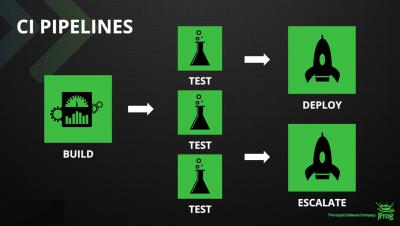
Learn how to optimize your complete end-to-end development and delivery process by using JFrog Pipelines. In this webinar we share a real-life demo of an application lifecycle from Dev to Production. Join us to learn how JFrog Pipelines helps you easily create smart, event-driven workflows across your tools and teams to help you improve the quality and velocity of your releases, and scale your CI/CD adoption across the organization.
In this webinar, you will learn how to leverage JFrog Xray to enable DevSecOps. We will also cover security topics such as circle of trust, security between locations, security replication, access tokens, and auditing.