Operations | Monitoring | ITSM | DevOps | Cloud

How to Write Runbooks Your On-Call Team Actually Uses

Most engineering teams have on-call runbooks. Very few have on-call runbooks that anyone opens during an actual incident. The document exists, it was written with good intentions during a quiet sprint, it is linked from a wiki page called "Operations", and when the pager fires at 3 in the morning the responder ignores it completely and starts guessing in a terminal instead.

Monitor HTTPS and SVCB Records with DNS Check

DNS Check now supports monitoring HTTPS records and SVCB records, DNS record types 65 and 64, both standardized in RFC 9460. They tell a client how to connect to a service rather than only where it is: which HTTP versions the endpoint speaks, which port it listens on, which addresses it can start connecting to, and which keys it needs for Encrypted ClientHello, all before it opens a connection.

Database Branching Explained: How It Works and When to Use It

Database branching solves a strange mismatch in modern development: code gets its own branch, but the database often doesn’t. Developers can work independently in Git, then end up sharing the same development database, waiting for a fresh copy, or trying not to break each other’s schema changes. The result is a lot of database sprawl.

More Power for .NET Developers: New Releases Across dotConnect and Entity Developer

We are excited to announce a new wave of updates across our.NET data connectivity and ORM product portfolio, delivering enhanced security, broader platform support, modern SQL Server compatibility, AI-ready capabilities, and productivity improvements for.NET developers.

Hybrid cloud management: 6 challenges IT teams need to solve in 2026

In 2026, a hybrid cloud is no longer something organizations are working toward; it's already where they are. According to Forrester's The State Of Cloud Series 2026, the vast majority of enterprises across major markets, including the United States, India, Australia and New Zealand, Canada, and the Asia-Pacific region, are running some form of a hybrid cloud, combining public cloud platforms with private infrastructure, colocation data centers, and sovereign cloud providers.

Introducing Spike's new look: designed to scale.

Today, we are introducing Spike’s new logo, a new website, and honestly, a new identity from the ground up. This is very exciting day for all of us at Spike. More companies are being built today than at any other point in history. Small teams are making big products. And no matter the size of the team, every single one of them needs reliability. Reliability should not be a second-class citizen for any company, no matter where they are in their journey.

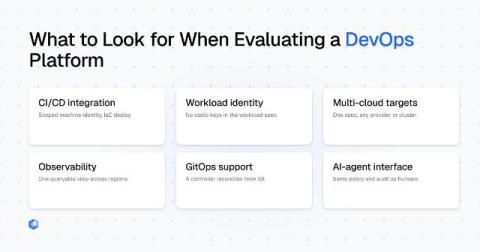
What to Look for When Evaluating a DevOps Platform

DevOps platform feature lists increasingly look alike. CI/CD, multi-cloud, observability, GitOps, and AI-friendly automation can all appear as checkboxes while the implementation burden still falls on your team. The useful signal appears when you ask how each capability actually works, what evidence a vendor can show, and which parts your team still has to build. Can pipelines authenticate with a scoped machine identity? Can workloads reach cloud APIs without static keys?

Build incident response workflows with Datadog Bits Chat

See how Bits Chat turns a natural-language request into an automated incident response workflow. In this demo, Bits Chat builds a workflow that investigates a monitor alert, identifies whether a recent deployment caused the issue, rolls it back when appropriate, and sends a summary to Slack.

Reliability Is the Test Agentic NetOps Has to Pass

It is 2:14 a.m. An agent has correlated a latency spike to an asymmetric routing condition and is ready to reroute traffic away from the affected path. The plan looks right. The only question that matters to the on-call SRE is whether to let it run, and that question is not really about the agent. It is about whether the picture the agent reasoned from is complete enough to trust at 2 a.m. with production on the line.