Operations | Monitoring | ITSM | DevOps | Cloud

How to embed Grafana dashboards into web applications

Note: This post originally published in October 2023 and was updated in May 2026 to include new methods and options for embedding Grafana dashboards. Grafana dashboards are powerful and flexible tools for observing applications and infrastructure, so it’s no surprise we get a lot of questions from the community about how to embed them into their web applications.

Why Some Roles Care About Open Source & Why Others Don't: 4th Annual Observability Survey | Grafana

Note: We're happy to share that since the recording of this video, OpenTelemetry *has* graduated from the CNCF! SREs, developers, and CTOs say open source is essential to observability. Engineering managers and directors? Not so much. Grafana's 4th annual observability survey — 1,363 responses — reveals a split inside the same orgs that's worth a conversation.

AI-assisted testing, extensions updates, and more: k6 2.0 is here

For years, teams have relied on k6 to take a more proactive approach to performance testing, ensuring they can catch issues early and deliver more reliable user experiences. That approach has helped make k6 one of the most widely used performance testing tools in the open source community today, with more than 30k stars on GitHub. Last year, we introduced k6 1.0, a major release that brought TypeScript support, native extensions, revamped test insights, and production-grade stability guarantees.

Eliminate noisy log lines with Adaptive Logs drop rules

Most platform and observability teams have logs they know are noise. These could be throwaway health check logs, forgotten DEBUG logs, or verbose INFO logs from little used services that only serve to inflate your bill. Regardless of what they contain and why they're there in the first place, the hard part is getting rid of them. Centralized teams want to easily and quickly prevent these logs from being ingested, without having to work with toilsome infrastructure change management to do so.

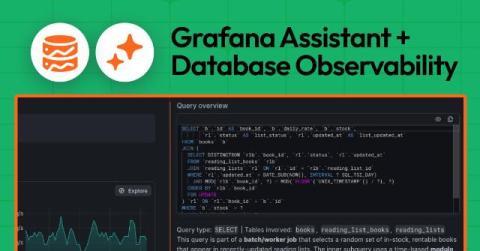
Troubleshoot performance issues faster with the new Grafana Assistant integration for Database Observability

So your database is slow. Now what? Grafana Cloud Database Observability already gives you visibility into your SQL queries with RED metrics, individual execution samples, wait event breakdowns, table schemas, and visual explain plans. But visibility is just the starting point. You can see that a query's P99 latency spiked, but what should you do about it? You can see wait events like wait/synch/mutex/innodb firing, but what does that actually mean?

Get Observability in the Terminal, for You and Your Agents: gcx

The way you write code is changing, which means the way you observe your systems and respond to issues needs to change, too. Engineers today spend much of their day working via command line, as agentic tools like Cursor and Claude Code have become highly effective at handling many day-to-day engineering tasks. This greatly accelerates code generation, but it doesn't solve for the context switching that comes when you have to jump into another tool that's not part of this new, faster workflow.