Operations | Monitoring | ITSM | DevOps | Cloud

This Month in Datadog - February 2026

On the first episode of This Month in Datadog in 2026, Jeremy covers how you can protect agentic AI applications with AI Guard, stay up to date and collaborate during incidents with five Incident Management releases, and ship software with confidence using Feature Flags. Later in the episode, Kevin spotlights Datadog Data Observability, which enables you to detect data quality and pipeline issues early.

Data Observability, AI Guard, Feature Flags, Ambassador program, and more | This Month in Datadog

See how you can ensure trust across the data life cycle in February’s episode of This Month in Datadog. Join us for a spotlight of Datadog Data Observability, which enables you to detect data quality and pipeline issues early, as well as remediate those issues with end-to-end lineage. Plus, we cover: Protecting agentic AI applications from real-time threats with Datadog AI Guard Staying up to date and reducing steps to collaborate with five new Incident Management releases Releasing software with confidence using Datadog Feature Flags.
Enable end-to-end visibility into your Java apps with a single command

Achieving end-to-end observability for applications is a top priority for organizations today, but instrumenting for both frontend and backend monitoring can be a significant hurdle. What complicates matters is that the SREs and DevOps teams responsible for deploying monitoring tools typically don’t own frontend code or have the context needed to safely modify it.

Measure and improve mobile app startup performance with Datadog RUM

Mobile app users form opinions quickly. A slow or inconsistent startup experience can frustrate them before they reach the first screen, increasing the likelihood that they abandon the app or fail to complete key actions such as signing up or making a purchase. However, app teams often lack reliable signals that explain why startup performance varies, making it difficult to improve the user experience.

Evaluating our AI Guard application to improve quality and control cost

This article is part of our series on how Datadog’s engineering teams use LLM Observability to build, monitor, and improve AI-powered systems. Organizations are building AI agents that help users automate work, analyze data, and interact with complex systems through natural language. As these agents become more capable, they also become more complex and exposed to risks such as prompt injection, data leaks, and unsafe code execution.

Identify untested code across every level of your codebase

As organizations scale their services and adopt AI-assisted coding, code changes are landing faster and in greater volume than ever before. While this powerful new practice is accelerating the pace of development, it is also increasing the likelihood that untested code may slip into repositories without detection. What makes this problem even worse is that most teams have no reliable way to know which code is covered by tests.

How to write annotations in Kubernetes with JSON for Datadog Autodiscovery | Datadog Tips & Tricks

Pod annotations in Kubernetes with invalid JSON syntax can prevent Datadog Autodiscovery from detecting integrations, resulting in missing metrics and gaps in monitoring. Watch this video for a step-by-step process to write annotations: Note: This video focuses on Datadog Autodiscovery v2 syntax.

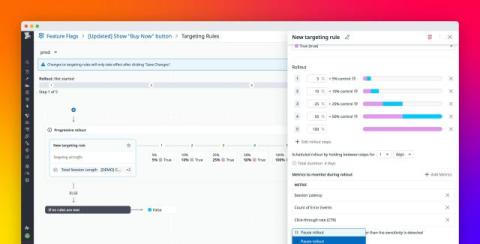
Make use of guardrail metrics and stop babysitting your releases

Modern CI/CD pipelines have automated the hard work of building, testing, and deploying our code. But for many teams, that’s where the automation stops. The most critical part of a release, turning a new feature on for real users, is still a stressful, manual process. An engineer cautiously ramps up traffic to 5%, then 10%. The whole team stares at dashboards, trying to see if anything breaks. If something does, they scramble to manually roll back.

Improve performance and reliability with APM Recommendations

SREs and application developers rely on telemetry data to understand and improve their systems. As organizations scale and evolve, those systems generate an ever-growing volume of metrics, logs, and traces. But more data alone does not make it easier to improve performance or reliability: Identifying meaningful optimizations still requires careful investigation and analysis.

Monitor Fortinet FortiManager performance in Datadog

As enterprises scale, teams often find it harder to identify user-reported issues. Software-defined wide area networks (SD-WANs) can make it easier to add branch offices, but they can also make it more challenging to distinguish connectivity degradation from changes in application behavior. FortiManager provides a centralized control plane for Fortinet Secure SD-WAN and reduces operational complexity.

Improve test coverage across codebases with Datadog Code Coverage

As codebases grow across many different services, it becomes harder to see what test suites actually cover. AI-assisted development and faster release cycles increase the volume of changes landing in repositories, raising the risk that untested code will make it through to production. To maintain a high standard, teams need clear and scalable visibility across repositories, consistent testing standards, and a way to catch blind spots before they reach users.

Move fast, don't break things: Consistent testing standards at scale

Moving quickly is essential for modern engineering teams, but speed without guardrails can introduce hidden risks in testing. As organizations scale, teams often define and apply coverage standards inconsistently across services and repositories. What qualifies as “acceptable coverage” in one project may be completely different in another. Without automated enforcement, untested code can slip through reviews.

Surface and remediate runtime posture issues with Workload Protection Findings

Threat detection and runtime posture monitoring are related but different jobs. Security teams already rely on Datadog Workload Protection to detect threats in real time across hosts and containers. But the actions that lead to those detections (file manipulation, process execution, network calls, or kernel activity) can be indicative of compromise or simply of risky behavior—like running compilers in production containers.

Make faster, better product decisions with Datadog Product Analytics

Product managers (PMs) need to make fast, confident decisions about what to build, fix, and improve based on user behavior within their application. But in practice, collecting the user insights they require is rarely straightforward. Recent updates to Datadog Product Analytics address this challenge. Product Analytics adds structure to autocaptured data and makes analysis easier to interpret, reuse, and share, helping PMs move from questions to answers without relying on SQL or engineering.

Protect agentic AI applications with Datadog AI Guard

Organizations are increasingly using agentic AI applications powered by large language models (LLMs) to automate analysis, decision-making, and operational workflows. As these AI agents take on more responsibility, they gain access to internal tools and services and can interact with them in unintended ways.

Trace Google Pub/Sub workloads in Cloud Run with Datadog

Event-driven systems are great at decoupling services, but they also make incidents harder to untangle. A single user request can turn into dozens (or thousands) of messages, multiple consumers, retries, and delayed acknowledgments. If your tracing only tells you that a message was sent or received, you still have to guess which upstream request produced the message, whether a batch publish fanned out cleanly, and where queue time is accumulating.

How to optimize JavaScript code with CSS

When to use JavaScript or CSS in frontend projects is a matter of continued debate among many frontend developers. JavaScript is often the default choice for frontend development, as it offers a robust collection of libraries custom-made for creating advanced UI features, such as data-based visualizations or complex animations. But JavaScript also comes with tradeoffs, particularly when it comes to performance, accessibility, and code complexity.

How Okta keeps 99.99 percent uptime with #datadog

How do you maintain 99.99 percent uptime across thousands of Kubernetes hosts and multiple cloud providers? Okta engineers explain why observability is critical to keeping authentication and authorization services running at scale. Watch how Okta uses Datadog to bring metrics, logs, and traces into a single view, speed up root cause analysis, and reduce time to mitigation while controlling costs.