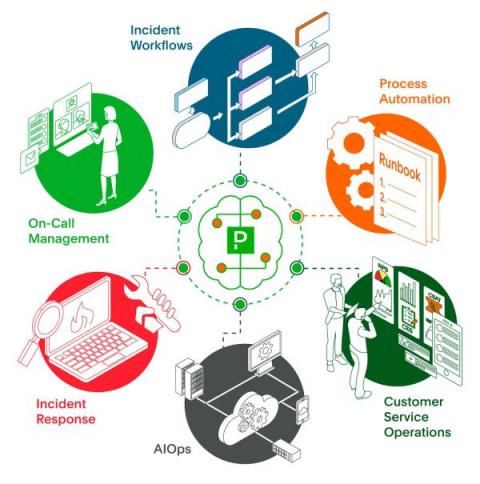
We’re excited to announce a new set of updates and enhancements to the PagerDuty Operations Cloud. Recent development and app updates from the product team include PagerDuty® Process Automation, our Partner Integrations and App Ecosystem, as well as Community & Advocacy Events updates. We continue to help customers automate everywhere to optimize cloud operations and reduce the amount of issues escalated to other teams.
Service ownership, a DevOps best practice, is a method that many companies are pivoting towards. The benefits of service ownership are varied and include boons such as bringing development teams much closer to their customers, the business, and the value being delivered. The “build it, own it model” has tangible effects on customer experience, as developers are incentivized to innovate and drive customer-facing features that delight.
In today’s digital world, organizations are constantly undergoing change. They’re moving to the cloud and rolling out DevOps at scale—all in the name of driving innovation. But moving from a monolith to microservices can lead to applications becoming increasingly distributed. When problems arise, customers don’t care how many teams and services you have, or how complex your architecture is. They only care that your services work when they need them to.
PagerDuty has an Early Warning System (EWS) model which helps the Customer Success and Sales departments ascertain the wellness of existing PagerDuty customers based on product usage and external business factors. This Early Warning System model has become critical infrastructure and the first line of defense in identifying poor product usage that could result in account churn.
What is one of the first things you should do when you are assigned an incident via PagerDuty? If you immediately thought “Acknowledge!” you are not wrong, but after that, it’s all about resolving the issue as quickly and painlessly as possible. The first step to resolution is to investigate what caused the incident in the first place so you can easily get a fix in place.
Every year there is a surprise in a Radar report. While it won’t be a surprise to our thousands of customers who are seeing tremendous benefits with us, PagerDuty is excited to be named a Leader in the 2022 GigaOm Radar for AIOps Solutions. GigaOm uses extensive criteria to evaluate vendors in their Radar.
Today’s modern cloud architectures centered on AWS are typically a composite of ~250 AWS services and workflows implemented by over 25,000 SaaS services, house-developed services, and legacy systems. When incidents fire off in these environments—whether or not a company has built out a centralized cloud platform—distinct expertise is often a necessity.
Does your team deal with too much noise? Does your heart sink a bit when you think about how much your rulesets have sprawled in order to manage your event processing needs? That’s why we released Event Orchestration earlier this year to help teams reduce the amount of manual work that goes into event management. Event Orchestration is the next evolution of our Event Rules feature set, which helps to route, enrich, and modify events on ingest to remove noise and automate processes.
Today, we are excited to open Early Access for our improved Dedicated Incident Slack Channel. These improvements include: In order to take advantage of this feature you need to upgrade to Slack on WebHooks V3 and request Early Access from PagerDuty support. Once you are on the right version and have early access, there are two ways to create a dedicated incident channel.