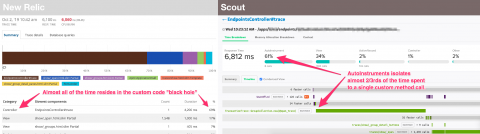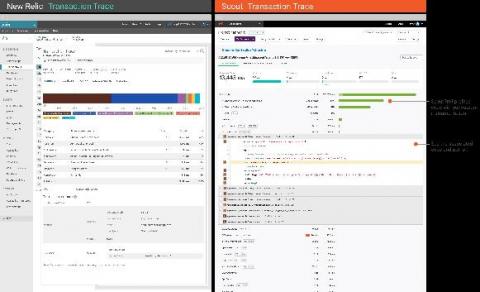
Meet Scout's new transaction timeline view
Today we're happy to announce that our transaction timeline view has exited BETA and is now generally available for Ruby.
If you are hosting your application with Heroku, and find yourself faced with an unexplained error in your live system. What would you do next? Perhaps you don’t have a dedicated DevOps team, so where would you start your investigation? With Scout APM of course! We are going to show you how you can use Scout to find out exactly where the problem lies within your application code.
Coming back from Monitorama, I had a chance to sit back and start playing with some tools to see how they worked. Prometheus is a pretty ubiquitous tool in the monitoring space, it's pretty easy to spin up, and is open-source. Having a very active community of engaged developers means finding help articles or guides is easy. We are also going to use Grafana to build nicer looking graphs based on API queries from Prometheus.
A few members of the Scout team had the chance to head to Monitorama in Portland, Oregon this week. For those who do not know what Monitorama is, it is a 3-day, open-source monitoring conference with a single track. There is plenty of time during the breaks to chat with attendees, ask the speakers questions or just catch up on some email.
If you’re a Rails developer, then you’ve probably used Rails Logger on at least one occasion or another. Or maybe you have used it without even realizing, like when you run ‘rails server’ and it prints information to the terminal window, for example. Rails Logger provides us with a powerful way of debugging our applications and gives us an insight into understanding errors when they occur.
How are you deploying your applications in 2019? Are you using containers yet? According to recent research over 80% of you are. If you are within this group, were you initially sold on the idea of containers but found that in reality, the complexity involved with this approach makes it a difficult trade-off to justify? The community is aware of this and has come up with a remedy to ease the pain, and it’s called container orchestration.
In a recent post, we talked about Docker containers, and what you should know about them. Hopefully we cleared up any confusion you might have had about the Docker ecosystem. Perhaps with all that talk, it got you thinking about trying it out on one of your own applications? Well in this post we’d like to show you how easy it is to take your existing Ruby on Rails applications and run them inside a container.
These days Docker is everywhere! Since this popular, open-source container tool first launched in 2013 it has gone on to revolutionize how we think about deploying our applications. But if you missed the boat with containerization and are left feeling confused about what exactly Docker is and how it can benefit you, then we’ve put together this post to help clear up any confusion you might have.
Mint is a shiny new Elixir package which allows you to make HTTP requests using the HTTP 1 and HTTP 2 protocols. It can transparently handle ALPN (Application Layer Protocol Negotiation), which essentially means that it can figure out if a server uses HTTP2 or HTTP1 on its own. It also comes with an optional dependency on a castore package which verifies the SSL certificates of the servers (that you connect to).
Spark is known as a fast general-purpose cluster-computing framework for processing big data. In this post, we’re going to cover how Spark works under the hood and the things you need to know to be able to effectively perform distributing machine learning using PySpark. The post assumes basic familiarity with Python and the concepts of machine learning like regression, gradient descent, etc.