Operations | Monitoring | ITSM | DevOps | Cloud

The latest News and Information on Continuous Integration and Development, and related technologies.

Got a Few Minutes? Install Artifactory Enterprise on Azure

Some things, like high-end coffee or enterprise technology, are worth working and waiting for. But if you can get quality without the effort or delay, wouldn’t you? Installing or updating a self-managed (BYOL), High Availability edition of JFrog Artifactory hosted in an Azure VM can be a complex, and time-consuming process.

Monitor Jenkins jobs with Datadog

Jenkins is an open source, Java-based continuous integration server that helps organizations build, test, and deploy projects automatically. Jenkins is widely used, having been adopted by organizations like GitHub, Etsy, LinkedIn, and Datadog. You can set up Jenkins to test and deploy your software projects every time you commit changes, to trigger new builds upon successful completion of other builds, and to run jobs on a regular schedule.

Block Security Vulnerabilities from Entering Your Code

As continuous software deployments grow and become the accepted standard, security measures gain even more importance. From development and all the way through to production, security requirements should be adopted by all teams in an organization. JFrog IDE integrations provide security and compliance intelligence to the developer right from within their IDE.

The art of shipping and monitoring software with speed and confidence

Software teams are under increasing pressure to ship code faster than ever before, but without the right workflow and tools in place, this can introduce unnecessary risk and headache. We wanted to share how to configure deployments, identify issues, and track performance gains using tools and process to get the best results and enable you to ship software with speed and confidence. The tools we will be using in today’s example include Jenkins, Octopus, and Raygun.

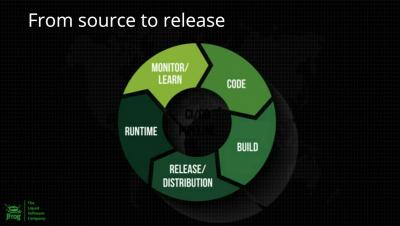
DevOps Patterns and Antipatterns for Continuous Software Updates at Cloud Native Virtual Summit

So, you want to update the software for your user, be it the nodes in your K8s cluster, a browser on user’s desktop, an app in user’s smartphone or even a user’s car. What can possibly go wrong? In this talk, we’ll analyze real-world software update fails and how multiple DevOps patterns, that fit a variety of scenarios, could have saved the developers. Manually making sure that everything works before sending an update and expecting the user to do acceptance tests before they update is most definitely not on the list of such patterns.