

Operations | Monitoring | ITSM | DevOps | Cloud

Sponsored Post

5 AWS Logging Tips and Best Practices

If you're an Amazon Web Services (AWS) user, you're probably familiar with some of Amazon's native services available for logging and monitoring, such as CloudWatch and CloudTrail. With that said, log management can get complicated quickly, especially if you're dealing with a high volume of logs from AWS Lambda functions or a multi-cloud/hybrid cloud environment. In this blog, we'll introduce the basics of AWS logging along with five tips and best practices for optimizing your log management in AWS.

Filebeat filestream configs that pass test config but still fail

A Filebeat config can print Config OK and still exit on start, ship your multiline settings as event data, or send a whole log file to your stack twice. We found most of these while testing the Filebeat configs on our integration pages, then rebuilt each mistake, plus the migration traps around them, on Filebeat 8.19.23 and 9.5.5 to see exactly what happens.

Dataset Curation: Turn Production Failures Into Test Datasets | Splunk Agent Observability

Your agent breaks in production. You fix it and move on. But the input that actually broke it is gone and two months later the same failure quietly comes back, because there was never anything to test against. That's not a debugging problem. It's a missing dataset. This demo turns low-scoring production traces into a regression suite you can run against every prompt and model change, without writing a single test case by hand.

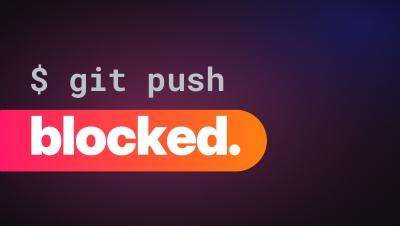
Pre-Push Eval Gate: Block AI Agent Regressions Before They Ship | Splunk Agent Observability

Every engineering team has unit tests. They tell you the code still works. They tell you nothing about what the model started saying. This demo wires a single eval gate script into a git pre-push hook, so Splunk Agent Observability scores every agent's output before the push is allowed through. Luna, an on-premise small language model, runs as a synchronous judge against fixed thresholds. Fail one, and the push is blocked.

Agent Control Demo: Steer, Block, and Audit AI Agents | Splunk Agent Observability

Most teams keep an agent from regressing by hardcoding checks into its logic, an if-statement here, a regex there. Every new rule then becomes a code change, a review, and a deploy, and the person who spots the problem in production is rarely the person who can ship the fix. Agent Control moves those rules out of the code and into one hub. Steer, block, and validate agent behavior in real time, with rules any team member can update without touching the codebase.

Find the Retry Loop Burning Your AI Agent Budget with Tracing | Splunk Agent Observability

One of the most expensive failure modes in AI agents is a silent retry loop. An agent hits a rate limit, blindly retries until it succeeds, the user gets a response, and no ticket ever gets filed. Under the hood, tokens are burning, latency is compounding, and a transient error today becomes a sustained outage tomorrow.

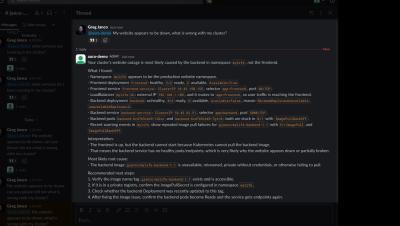
AI SRE Agent Slack Integration: Ask AURA About Your Kubernetes Cluster | HQ

Running an agent in your cluster should not mean opening it to the internet. AURA reaches Slack over an outbound socket, so the cluster stays locked down. Jeff Vogt connects an AURA deployment running in Kubernetes to Slack using AURA's direct Slack integration. The setup is a Slack app with an app token and a bot token, plus a few lines added to the deployment's configuration. The Kubernetes MCP server is already deployed and connected to AURA before the video starts.

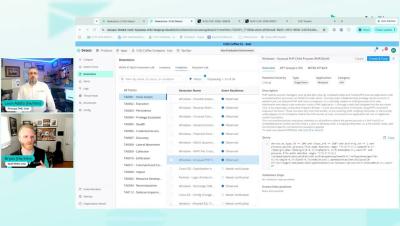
It's a Critical CVE, Now What?

Bryan Peace Leon Adato break down what exactly security-minded IT folks - whether they work in SRE, dev, networking, or more esoteric disciplines - should do when a new, critical, apocalyptic vulnerability is announced. They walk you step by step through research, analysis, and how to protect your company if a patch isn't out yet. Along the way they muse about the nature of the industry, the sudden spike in CVEs, and where to find the best hard cidr to take the edge off.

Malicious Claude Code extension in the Cursor marketplace: Coralogix Security Advisory

The Claude Code extension in the Cursor marketplace was compromised for a short period of time today. Watch this security advisory from Chris Cooney and Hetram Yadav, threat detection and response manager at Coralogix, to understand: How the malicious attack operates How to know if you're affected How Coralogix is supporting customers.

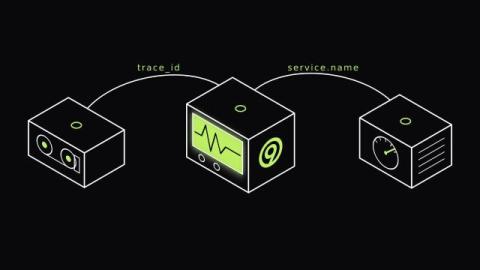
Correlating Logs, Traces and Metrics to Find Root Cause

Correlate logs, traces and metrics with trace_id, span_id, exemplars and shared resource attributes, then pivot from an alert to the root cause. Last9 is an observability platform built for high-cardinality telemetry. It unifies logs, metrics, and traces with native OpenTelemetry and Prometheus support, real-time alerting, and long-term retention.