Operations | Monitoring | ITSM | DevOps | Cloud

How to prevent performance bottlenecks in Google Compute Engine: CPU spikes, RAM waste, and network overload

Cloud computing is all about efficiency. You need to get the most out of your resources without overspending or causing performance issues. For example, if you’re running virtual machines in Google Compute Engine, you need to size your instances correctly, optimize your workloads, and monitor your network traffic to prevent unexpected failures. However, when resources aren’t properly managed, things can quickly spiral out of control.

How to use data source variables in Grafana dashboards

Data source variables let you change where Grafana looks for data without having to create duplicate dashboards. So for example, if you have multiple different Prometheus databases, you can have one dashboard and use a data source variable to choose which Prometheus that dashboard uses. We'll look at how to set these up in this video. Grafana Cloud is the easiest way to get started with Grafana dashboards, metrics, logs, and traces. Our forever-free tier includes access to 10k metrics, 50GB logs, 50GB traces and more. We also have plans for every use case.

Meet Ted Young, OpenTelemetry co-founder and the newest Grafanista

In just a few short years, OpenTelemetry has become the second largest CNCF project behind Kubernetes and is well on its way to becoming an industry standard for collecting and exporting telemetry data. And with KubeCon + CloudNativeCon Europe 2025 just around the corner, there’s no one better to talk to about the state of OpenTelemetry than Ted Young. Ted is the co-founder of OpenTelemetry and serves on the OpenTelemetry Governance Committee.

License to observe: Why observability solutions need agents

Note: The original version of this blog post published on ;login: on February 24, 2025. When architecting the flow of observability data such as logs, metrics, traces or profiles, you’ve likely noticed that most solutions ask you to deploy an agent or collector. Understandably, you might be hesitant to deploy yet another application just so you can get your data into your storage system of choice.

Grafana 11.6 release: new data visualization features, LBAC for metrics data sources, alerting updates, and more

Our engineering team is hard at work on Grafana 12, the next major release of the open source data visualization platform that we’re launching at GrafanaCON this May, but in the meantime, Grafana 11.6 is officially here — and there’s a lot to be excited about. The latest minor release delivers a number of new dashboarding features, including one-click data links and actions, along with other notable updates related to security, alerting, and more.

The state of observability in 2025: a deep dive on our third annual Observability Survey

Across companies of all shapes and sizes, observability practices are maturing and getting attention at the highest levels. At the same time, cost and complexity continue to hinder efforts as teams look to emerging tools to help simplify their processes in hopes of better outcomes. With so much in flux, we went into our third annual Observability Survey hoping to get a window into the ways the community is approaching observability and where it wants it to go next.

The Biggest Trends Shaping Observability in 2025: Highlights from Grafana Labs' Observability Survey

The Grafana Labs 3rd annual Observability Survey has landed and we're excited to launch a limited video series that breaks down the findings from over 1200 observability practitioners and leaders around the world. In this video, CTO Tom Wilkie breaks down the 4 biggest trends shaping observability in 2025 across open source, executive buy-in, AI, and cost vs. value. Stay tuned for more video explainers!

How to use text box variables in Grafana dashboards

Text box variables let users type whatever they want -- great for text filtering and searching! In this video we'll look at how to use text box variables in Grafana dashboards. Grafana Cloud is the easiest way to get started with Grafana dashboards, metrics, logs, and traces. Our forever-free tier includes access to 10k metrics, 50GB logs, 50GB traces and more. We also have plans for every use case.

How to redact secrets from logs with Grafana Alloy and Loki

In any observability stack, logs are essential for uncovering insights, troubleshooting issues, and ensuring system health. However, managing the security of logged data presents its own challenges, especially when it comes to preventing sensitive information, like API keys and credentials, from slipping into logs. Secrets can originate from a variety of sources, and it’s often challenging to predict which applications or services might inadvertently expose sensitive information.

An open source app for easily building performance tests: Grafana k6 Studio is generally available

Here at Grafana Labs, we have an on-going commitment to providing solutions that increase productivity without sacrificing ease-of-use. Last year, in line with that effort, we introduced experimental and public preview releases of Grafana k6 Studio, an open source desktop application that helps you create k6 test scripts quickly and easily via a visual interface. Today, we’re excited to share the general availability of k6 Studio v1.0.

Grafana Cloud updates: Fleet Management is now GA, a unified app for IRM, and more

We consistently roll out helpful updates and fun features in Grafana Cloud, our fully managed observability platform powered by the open source Grafana LGTM Stack (Loki for logs, Grafana for visualization, Tempo for traces, and Mimir for metrics). In case you missed them, here’s our monthly round-up of the latest and greatest Grafana Cloud updates. You can also read about all the features we add to Grafana Cloud in our What’s New in Grafana Cloud documentation.

The latest in Kubernetes Monitoring: new features to track persistent storage, simplify alerting, and more

Monitoring is an essential part of any Kubernetes deployment, helping organizations optimize cluster health, streamline troubleshooting, and control their costs. In Grafana Cloud, we offer all these capabilities (and more) in our out-of-the-box Kubernetes Monitoring solution. Since introducing Kubernetes Monitoring in 2022, we’ve been steadily adding new features, improving the UI, and making it even easier to gain insights into the state of your Kubernetes fleet.

How we responded to a 2+ hour partial outage in Grafana Cloud

On Tuesday, Feb. 18, 2025, we experienced an outage that lasted approximately 150 minutes and impacted roughly 25% of our Grafana Cloud services. To our customers: we are very sorry and more than a little embarrassed that we stepped outside our own processes and advice to cause this. You rely on us to help monitor and troubleshoot your environments, and this type of incident obviously makes it harder for you to do that.

Telemetry pipeline management at any scale: Fleet Management in Grafana Cloud is generally available

We announced Fleet Management in Grafana Cloud last year to solve the pain points that come with managing dozens, hundreds, or even thousands of telemetry collectors across departments and environments. And today we’re excited to announce that Fleet Management is generally available for all Grafana Cloud users who need help managing telemetry collector deployments at scale.

Grafana OnCall OSS in maintenance mode: your questions answered

At Grafana Labs, we believe in treating everyone with respect, and a core aspect of respect is clear and transparent communication. When we decided to move Grafana OnCall (OSS) into maintenance mode, we knew that along with the public announcement, there would be a lot of questions.

Incident response and on-call management in one app: Introducing Grafana Cloud IRM

At Grafana Labs, we’re always searching for ways to develop products that give our users the best tooling to help in their day-to-day understanding of their systems. We built OnCall and Incident in Grafana Cloud, our fully managed observability platform, to make it easier to respond to and fix incidents — all on top of the Grafana dashboards you know and love.

Getting Started with Grafana Cloud IRM | Grafana Labs

In this video, Joey Orlando, Engineering Manager at Grafana, walks you through Grafana Cloud Incident Response Management (IRM)—a new powerful solution that unifies Grafana OnCall and Grafana Incidents into one seamless experience. You'll learn how to: Set up on-call schedules and escalation chains Configure integrations for your monitoring systems Respond to alerts efficiently with automated workflows Migrate from PagerDuty or Splunk On-Call to Grafana IRM.

Grafana Drilldown: first-class OpenTelemetry support now available for metrics

When we launched Grafana Drilldown, our queryless experience for quicker, easier insights into your telemetry, we focused first on Prometheus because it was—and is—such a great solution for storing time series data. But as the industry continued to evolve, a different open source project began to emerge as another standard for modern observability: OpenTelemetry.

Visualize Google Sheets data: how to turn your spreadsheets into Grafana dashboards

In 2020, we launched the Google Sheets data source for Grafana, providing organizations with real-time data visualization capabilities for all their go-to spreadsheets. Since then, thousands of users have installed the data source to quickly and easily derive insights from their spreadsheet data. In this blog post, we’ll explore key features of the Google Sheets data source, as well as some helpful resources to install and start using the data source today.

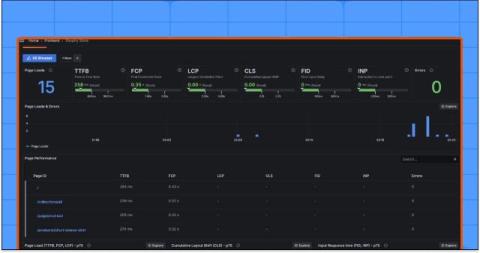
How to monitor your Shopify store with Grafana Cloud Frontend Observability

Shopify is a fantastic tool for organizations who want to sell products, but don’t want to build or maintain an e-commerce platform themselves. Even some of the largest brands that have built their own e-commerce platforms in the past have seen the value of using Shopify to accelerate their business. As your Shopify site scales and grows, however, you may need more insight into the performance of your store.