Windows 7 to Windows 10 - Migration Made Easy!
This webinar will give you the complete details about Windows 7 End-of-life and the various options that you have to proceed after the EOL date.


Cyberattacks are a growing threat, and organizations are investing time and money in security strategies to make certain that their infrastructures are secure. Active Directory (AD) is a constant target for compromise, as it’s at the core of any organization’s security — it handles authentication and authorization for all users in an organization.
We are delighted to share that market research and advisory firm, IDC, has recognized Zoho/ManageEngine in the following three IDC MarketScape reports: Zoho/ManageEngine has also been named a Leader in the IDC MarketScape. In these reports, the IDC MarketScape identified 18 providers and evaluated them in the capabilities, strategy, and market presence.
Five worthy reads is a regular column on five noteworthy items we’ve discovered while researching trending and timeless topics. This week, we discuss the escalating significance of AI and machine learning in IT security space.
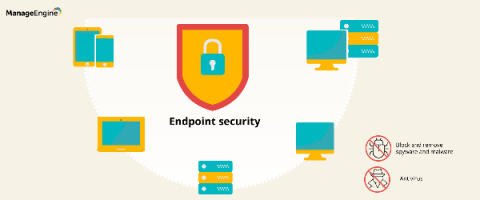
To operate efficiently, businesses today use numerous devices such as laptops, desktop computers, and mobile devices. Securing all these devices—collectively called endpoints—significantly improves the overall security of your enterprise’s IT network. This blog can help you get started with endpoint security. To begin with, let’s define endpoint security.
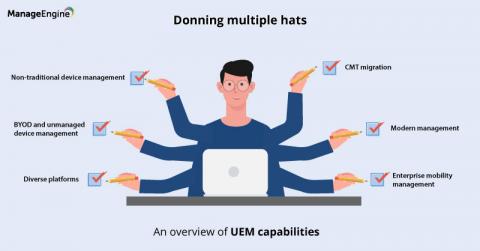
Unified endpoint management (UEM) is an IT best practice and strategy for securing and controlling desktop computers, laptops, smartphones, and tablets in a connected, secure manner from a single console. It’s increasingly important for enterprises today because of the prevalence of corporate-owned, personally-enabled (COPE) devices, and bring your own devices (BYOD) policies.
Barely a week after Patch Tuesday, internet security company Qihoo 360 has discovered yet another vulnerability in Internet Explorer (IE), this time due to a remote code execution vulnerability in the jscript.dll scripting engine. The vulnerability, identified as CVE-2020-0674, is considered Critical for IE 11, and Moderate for IE 9 and IE 10.