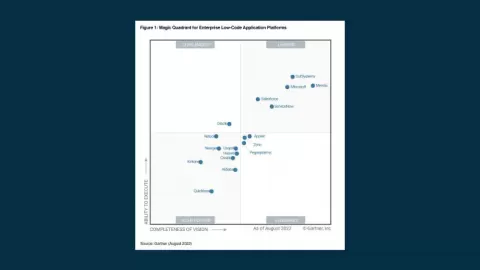
I’m thrilled to announce that, for the third consecutive year, ServiceNow has been named a Leader in the Gartner Magic Quadrant Enterprise Low-Code Application Platforms.1 We believe this recognition demonstrates our commitment to help customers build low-code enterprise workflow apps fast and deliver them safely and at scale on a single platform. Digital transformation is in full swing, and the market demands a more agile and productive way to build software.
The telecommunications industry led the charge on technology adoption decades ago. Now the industry is facing a severe technology debt. As customers demand faster and better products, companies must somehow update or adapt legacy infrastructure to deliver cutting-edge services. To keep up, executives are making bold choices: investing billions in infrastructure to keep up with demands for digital services and building workflows to eliminate silos between departments.
From humble beginnings to becoming an enterprise with more than 20,000 employees globally, ServiceNow has been through a lot of changes since its founding in 2004. Although it started as an IT service management company, it's grown to connect people, functions, and systems across organizations.
Executives have a difficult task ahead of them: innovating against a backdrop of global uncertainty. To minimize the possibility of disruption, they’re seeking business strategies that enable them to cut costs while pursuing ambitious projects at scale. This might seem like more of a paradox than a balancing act. However, some executives are meeting their goals with global business services (GBS).
Customer relationship management (CRM) is sometimes like a bucket. New customers represent water going into the bucket, and departing customers reflect water flowing out. The water level—or the number of customers—rises and falls depending on the amount of water flowing into the bucket and the number and size of the holes. At ServiceNow, we recognized we had a leaky CRM bucket, thanks to rapid customer growth.
“Security defense is exciting, because you’re always trying to stay ahead of the bad guys,” says Tracy T., senior staff detection engineer at ServiceNow. Who are these bad guys? They could be malware or hackers who try to threaten the security of employee data or the company network—or anything in between. Detection engineering plays a major role in keeping a company safe, especially amid changing tool capabilities and detection methods.
Highly successful companies and individuals share one similarity: They have an extremely clear vision of what they want to achieve and why. They know that although all work delivers outcomes, not all outcomes yield the same value. That’s why goals and a goal framework are important. Goal setting has always been essential to business success. Businesses today face different conditions and need systems to support their unique challenges in managing goals.
As corporate budgets shrink worldwide, product and engineering leaders are making tough prioritization calls to focus on the initiatives that truly deliver business outcomes. They’re also looking at ways to optimize costs, especially those resulting from heavy manual processes. The Forrester Wave™: Value Stream Management Solutions, Q4 2022 could not have come at a more important time.