Operations | Monitoring | ITSM | DevOps | Cloud

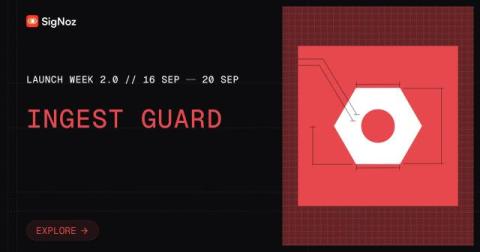
Introducing Ingest Gaurd: A Game-Changer for Observability Cost Control

Ingest Guard is a feature that will help platform and finops teams have granular control on data ingestion and observability costs. This new addition to our platform is designed to enhance security, provide better cost control, and offer a streamlined approach to managing observability data.

OpenFeature - A Guide to Open-Source Feature Flagging

Feature flags are crucial in modern software development, allowing teams to safely deploy and test new features. However, the absence of standardization has resulted in fragmentation and vendor lock-in. OpenFeature addresses this by offering an open specification for feature flagging, set to transform how developers manage and implement feature flags across various projects.

Using SigNoz in the Staging Environment to improve reliability

Monitor your applications and troubleshoot problems in your deployed applications, an open-source alternative to DataDog, New Relic, etc. Backed by Y Combinator. SigNoz helps developers monitor applications and troubleshoot problems in their deployed applications. SigNoz uses distributed tracing to gain visibility into your software stack.

Centralized Observability on Kubernetes with SigNoz

Monitor your applications and troubleshoot problems in your deployed applications, an open-source alternative to DataDog, New Relic, etc. Backed by Y Combinator. SigNoz helps developers monitor applications and troubleshoot problems in their deployed applications. SigNoz uses distributed tracing to gain visibility into your software stack. If you need any clarification or find something missing, feel free to raise a GitHub issue with the label documentation or reach out to us at the community Slack channel.

FluentD vs FluentBit - Choosing the Right Log Collector

As applications grow in complexity, the ability to gather, process, and analyze logs becomes crucial for maintaining system health and troubleshooting issues. Two popular open-source log collectors have emerged as frontrunners in this space: FluentD and FluentBit. But how do you choose between them? This article dives deep into the FluentD vs FluentBit debate, exploring their features, performance, and use cases to help you make an informed decision.

Log Shipper - What Is It and Top 7 Tools

Centralizing logs (arranging all records in one place) is often challenging as we need to decide whether to use a log shipper or directly log from the application. If you are not familiar with a log shipper, logging directly from the library might be a suitable option for development (it is easy to configure). However, in production, you'll likely want to use one of the available log shippers, mainly due to buffers, since blocking the application or dropping data (immediately) may not be an option.

Implementing OpenTelemetry in React Applications

OpenTelemetry can be used to trace React applications for performance issues and bugs. You can trace user requests from your frontend web application to your downstream services. OpenTelemetry is an open-source project under the Cloud Native Computing Foundation (CNCF) that aims to standardize the generation and collection of telemetry data. Using OpenTelemetry Web libraries, you can instrument your React apps to generate tracing data.

Jaeger vs Zipkin - Choosing the Right Tracing Tool

Distributed tracing is becoming a critical component of any application's performance monitoring stack. However, setting it up in-house is an arduous task, and that's why many companies prefer outside tools. Jaeger and Zipkin are two popular open-source projects used for end-to-end distributed tracing. Let us explore their key differences in this article.