Operations | Monitoring | ITSM | DevOps | Cloud

The Place Where Modern Operations & Technology Come Together

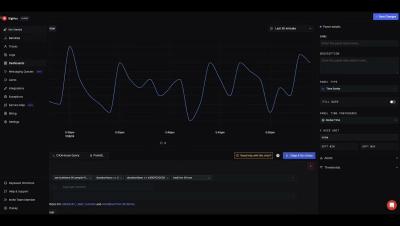

Getting Started with OpenTelemetry Visualization - A Practical Guide
OpenTelemetry is a Cloud Native Computing Foundation(CNCF) project aimed at standardizing the way we instrument applications for generating telemetry data(logs, metrics, and traces). However, OpenTelemetry does not provide storage and visualization for the collected telemetry data. For OpenTelemetry visualization, you need to use a backend that can ingest the collected data and provide a web UI to visualize it.

An Open Source OpenTelemetry APM | SigNoz
OpenTelemetry is a Cloud Native Computing Foundation(CNCF) project aimed at standardizing the way we instrument applications for generating telemetry data(logs, metrics, and traces). However, OpenTelemetry does not provide storage and visualization for the collected telemetry data. APM stands for Application Performance Monitoring or Application Performance Management. APM tools help engineering teams effectively monitor their applications by monitoring key metrics for application performance.

OpenTelemetry UI - See What's Possible With OpenTelemetry data
OpenTelemetry is a Cloud Native Computing Foundation(CNCF) project aimed at standardizing the way we instrument applications for generating telemetry data(logs, metrics, and traces). However, OpenTelemetry does not provide storage and visualization for the collected telemetry data. For visualizing OpenTelemetry data, you need an OpenTelemetry UI. The data collected by OpenTelemetry can be sent to a backend of your choice, which can then be visualized.

11 Top MongoDB Monitoring Tools - Including Free & Open-Source [2024]
MongoDB has become a cornerstone in modern database architectures. Its flexibility and scalability make it a go-to choice for many organizations. But with great power comes great responsibility—and the need for robust monitoring. There are many monitoring tools out there, and choosing the right one can be confusing. This article lists the top MongoDB monitoring tools, from open-source ones to fully managed SaaS solutions.
Single Pane of Glass Monitoring - Quick Guide & Open Source Solution
Single Pane of Glass (SPOG) monitoring is a term used to denote monitoring applications with a single tool that provides a comprehensive set of dashboards for the entire software system of an organization. Managing multiple monitoring tools for different aspects of the IT system becomes too cumbersome. And that’s how the concept of a single pane of glass monitoring evolved. Most modern applications are now built using distributed software systems.
Implementing OpenTelemetry with Nginx - Instrument and visualize traces
OpenTelemetry is an open-source standard for instrumenting cloud-native applications for generating different types of telemetry data. A robust observability framework set up using OpenTelemetry can help tremendously while troubleshooting software in production. Nginx is one of the most widely adopted web servers. Most often, nginx is used as a reverse proxy. It serves the frontend or backend applications behind the reverse proxy.
Health Check Monitoring With OpenTelemetry | Complete Code Tutorial
Health check monitoring is a critical practice for maintaining reliable and high-performing systems. It allows you to proactively identify and address issues before they impact your users. This guide explores the fundamentals of health check monitoring, its importance in modern systems, and practical strategies for implementation. You will also learn how HTTP endpoints can be monitored with OpenTelemetry.

Getting started with OpenTelemetry in SigNoz was quick & easy
Cedana, a YCombinator-backed startup, offers an automated system for saving, migrating, and resuming compute workloads to ensure operational reliability during hardware failures. By enabling seamless recovery and continuity, Cedana optimizes real-time computational tasks across various environments. To ensure operational stability and continuous performance, Cedana uses SigNoz to monitor its infrastructure comprehensively.
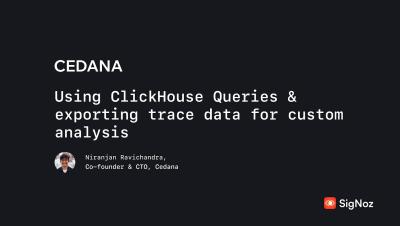
Using ClickHouse Queries & exporting trace data for custom analysis
Cedana, a YCombinator-backed startup, offers an automated system for saving, migrating, and resuming compute workloads to ensure operational reliability during hardware failures. By enabling seamless recovery and continuity, Cedana optimizes real-time computational tasks across various environments. To ensure operational stability and continuous performance, Cedana uses SigNoz to monitor its infrastructure comprehensively.