Monitor infrastructure from mobile application
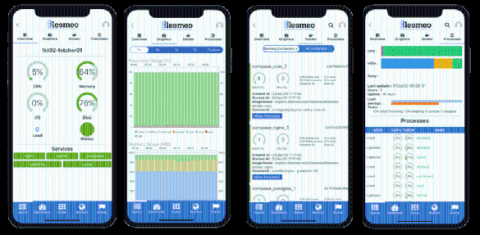
Our mobile team has just released an updated version of our mobile application. We have completely reworked the navigation and make it available on iOS!
This article is a follow up of our previous article where we explain how we deployed a Kubernetes cluster with k3s on a Raspberry Pi cluster.
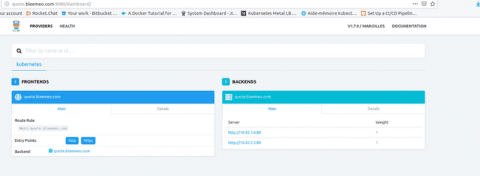
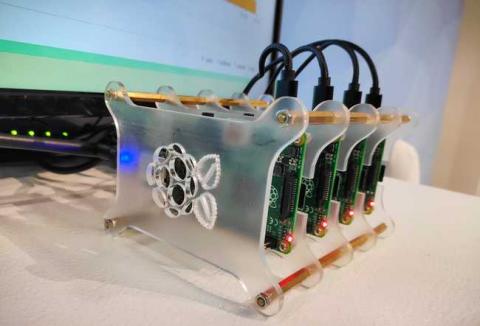
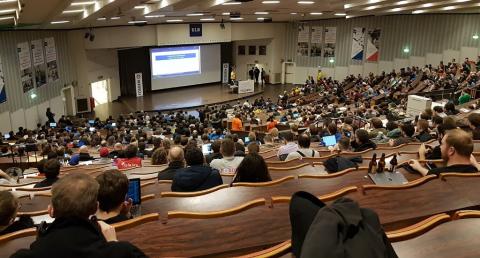
In order to carry out a demonstration of our smart tool: the Bleemeo agent at the 8th Devoxx France conference planned for the 17th of April, Bleemeo team decided to use the Kubernetes infrastructure and specially the lightweight version of Kubernetes: k3s. We choose to run k3s on a cluster of 3 Raspberry Pi nodes composed of 1 master node and 2 slaves nodes.
Bleemeo has integrated the Amazon Web Services (AWS) Technology Partner program in February in order to get a closer relationship with the leader of Cloud Infrastructure market. We released at the same time our integration with AWS: CloudWatch metrics can be displayed in Bleemeo dashboards and can feed your alerts.
This year, and for the second time in a row, Bleemeo has supported a team of INP Toulouse (the engineering school of two of our founders) during the EDHEC Sailing Race. This year the race was in Arzon in French Britany. During the race, we provided them a tracker composed of a Raspberry Pi and a GPS antenna. Then all along the race, it was reporting data in Bleemeo and we were displaying the boat data on a map.
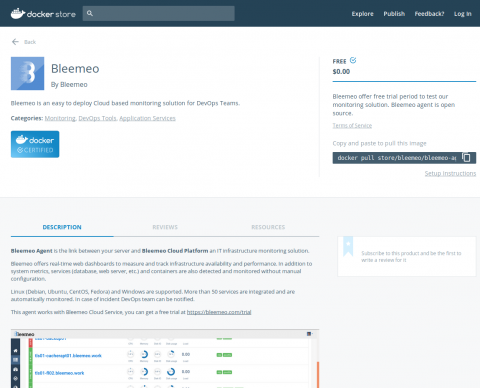
We are happy to announce today that Bleemeo's smart agent has been accepted into the Docker Certification Program, a framework for partners to integrate and certify their technology to the Docker Enterprise Edition (EE) commercial platform. Starting today, Bleemeo's smart agent is now listed on the Docker Store as a "Docker Certified Container".
Last week-end, we were attending FOSDEM, in Brussels for one of the largest and maybe the largest open source conference over the world with about 8000 attendees from all over the world. Here is our recap.
During PyconFR 2016 in Rennes, a yearly conference of French Python developers, our team give a talk about lessons learned building a public API using Django REST framework. You can find the complete code of what we presented in our slides on Bleemeo account .
In this article, we will explain how we are using Rocket.chat as our internal chat and how we deploy this tool. You can use IRC, Jabber (XMPP) or any other "modern" chat system: Slack, Rocket.Chat, etc. After using XMPP for a couple of months, we decided to move to Rocket.Chat.
At Bleemeo, as many geeks, we use a couple of tools on a day to day basis. Most of those tools are small Open Source web applications and, to be trendy, we deploy those tools with Docker. In the past, we used to create a virtual machine per service, deploy the tool and configure web server on each machine. Moreover if you are using https, you need to deploy certificates and private keys on each server.