Operations | Monitoring | ITSM | DevOps | Cloud

Confidently Shifting from Logs-centric to a Unified Trace-first Approach: Ritchie Bros. Journey to Modern Observability

Transitioning from a monolithic system to a cloud-native microservices environment, Ritchie Bros. sought to modernize their observability infrastructure to support the transition and fuel future growth. Ritchie Bros. has been a pioneering force in the auctioneering market for nearly 70 years, charting remarkable growth through a strategic mix of organic expansion and acquisitions.

Staffing Up Your CoPE

Getting the right people working in the CoPE is crucial to success because these change agents must limber up the organization and promote the flexibility necessary to perform resilience. We’ll look for teammates who share enough in common to work well together, but who don’t necessarily perfectly overlap so that they can play off each other’s strengths.

Why Every Engineering Team Should Embrace AWS Graviton4

Two years ago, we shared our experiences with adopting AWS Graviton3 and our enthusiasm for the future of AWS Graviton and Arm. Once again, we're privileged to share our experiences as a launch customer of the Amazon EC2 R8g instances powered by AWS Graviton4, the newest generation of AWS Graviton processors. This blog elaborates our Graviton4 preview results including detailed performance data. We've since scaled up our Graviton4 tests with no visible impact to our customers.

Modern Observability in Action at the University of Oxford

The Bennett Institute for Applied Data Science at the University of Oxford is pioneering the better use of data, evidence, and digital tools in healthcare, policy, and beyond. The institute employs an open-source approach with its OpenSAFELY analytics platform, enabling high-impact research that yields actionable insights, drives innovation, and enhances lives globally.

The Hater's Guide to Dealing with Generative AI

Generative AI is having a bit of a moment—well, maybe more than just a bit. It’s an exciting time to be alive for a lot of people. But what if you see stories detailing a six month old AI firm with no revenue seeking a $2 billion valuation and feel something other than excitement in the pit of your stomach? Phillip Carter has an answer for you in his recent talk at Monitorama 2024. As he puts it, “you can keep being a hater, but you can also be super useful, too!”

Unlocking Smiles: HappyCo's Observability Success

With a diverse range of applications, HappyCo sought to advance their system investigations with a modern observability solution while embarking on an application refactor project. Since its start in 2011, HappyCo has experienced rapid growth through both organic expansion and strategic acquisitions. As a result, the company has a diverse range of applications for customers to smile about.

Navigating Software Engineering Complexity With Observability

In the not-too-distant past, building software was relatively straightforward. The simplicity of LAMP stacks, Rails, and other well-defined web frameworks provided a stable foundation. Issues were isolated, systems failed in predictable ways, and engineers had time to innovate on new features for the business. And it was good.

OpenTelemetry Best Practices #3: Data Prep and Cleansing

Having telemetry is all well and good—amazing, in fact. It’s easy to do: add some OpenTelemetry auto-instrumentation libraries to your stack and they’ll fill your disks with data pretty quickly. However, having good telemetry data—data that’s curated into being useful—is something that is both cost-effective and represents good value.

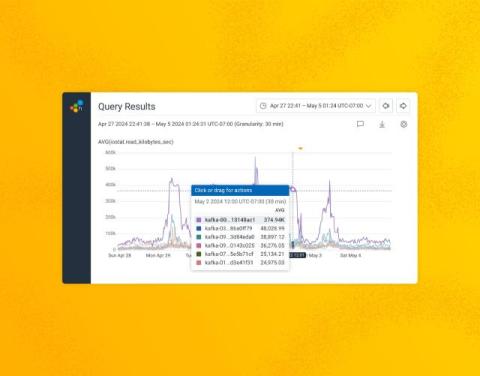
Investigating Mysterious Kafka Broker I/O When Using Confluent Tiered Storage

Earlier this year, we upgraded from Confluent Platform 7.0.10 to 7.6.0. While the upgrade went smoothly, there was one thing that was different from previous upgrades: due to changes in the metadata format for Confluent’s Tiered Storage feature, all of our tiered storage metadata files had to be converted to a newer format.

Independent, Involved, Informed, and Informative: The Characteristics of a CoPE

As our Field CTO Liz Fong-Jones says, production excellence is important for cloud-native software organizations because it ensures a safe, reliable, and sustainable system for an organization’s customers and employees. A CoPE helps organizations cultivate the practices and tools necessary to achieve that consistently. In part one of our CoPE series, we analogized the CoPE with safety departments.