Operations | Monitoring | ITSM | DevOps | Cloud

Making the Business Case for DevOps

Engineering and “the business” don’t always speak the same language. That’s why in this blog post and webinar, we want to show you how to bridge the gap using the language “the business” understands: cold hard cash. When talking to the business value, here are four areas that DevOps provide value for your organization with associated calculators so you can get an exact value to share with your organization.

Deploying Your Applications Using Codefresh, Google Cloud Platform, and Google Kubernetes Engine

Kubernetes offers scalability and reliability for your container-based applications. Combine this with GKE, and you now eliminate the need to install or operate clusters on your own. A huge plus to using GKE is that you now will be running Kubernetes in a GCP environment, therefore you can utilize all the handy integrations Google has to offer. Codefresh simplifies the process even more, by automating the process of getting your code built, tested, and deployed.

Our roadmap for the new Docker image API and pipeline build step enhancements

In our previous announcement for the removal of the Codefresh Docker registry, we presented a timeline of the migration phases along with the actions expected from our customers. One of the milestones in the migration process is the introduction of our new Image API along with several enhancements on the pipeline build step. We believe that these features deserve a dedicated explanation of why they are useful on their own (regardless of the registry removal).

Three Ways to Create Docker Images for Java

Long before Dockerfiles, Java developers worked with single deployment units (WARs, JARs, EARs, etc.). As you likely know by now, it is best practice to work in micro-services, deploying a small number of deployment units per JVM. Instead of one giant, monolithic application, you build your application such that each service can run on its own. This is where Docker comes in!

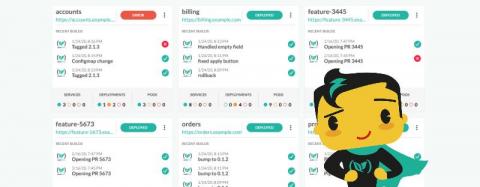
Announcing a new dashboard for Deployment Environments

One of the central ideas behind the Codefresh GUI is giving as much information as possible to both developers and operators regarding the status of a deployment. Just because a pipeline has finished successfully does not always mean that the respective environment is healthy.

Looking back at 2019 and why it was a great year for Codefresh

Like in 2018, now that 2019 is gone, it is time to look back and see all the major Codefresh features that were added over the past year. The highlight of the year was, of course, the world’s first live debugger for CI/CD pipelines, a feature that makes us really proud since it changes completely the way you create and analyze CI/CD pipelines.

Programmatic Creation of Codefresh Pipelines - Part 2

At Codefresh, we know that any CI/CD solution must be attractive to both developers and operators (SREs). One of the major advantages of Codefresh is the graphical user interface that includes dashboards for Kubernetes and Helm deployments. These graphical dashboards are very useful to developers who are just getting started with deployments and pipelines.

Integrating Open Source Management Into Your CI/CD Pipeline with WhiteSource

Open source components have become a basic building block in today’s software development process. It’s no surprise that 60%-80% of the codebase in 92% of modern applications is open source — they provide us with tried-and-true code that allows us to save time and focus on creating the secret sauce that will make our products the next great tech innovation.

Codefresh vs. GitlabCI

If you have selected Gitlab as your git provider, you may automatically think about selecting GitlabCI as your CI/CD solution as well. Using the same vendor for source control and CI/CD might seem natural, but is not always the best combination. In fact, choosing a “good-enough” option just because it is part of the same solution is unwise in the long run if it doesn’t cover your needs.