Operations | Monitoring | ITSM | DevOps | Cloud

Grafana Cloud Demo in Under 5 minutes | Full Stack Observability and more

Overview & demo of how Cloud provides an end to end Observability Platform that empowers users who have adopted open standards like or to improve their systems reliability using & a shift left approach with performance testing while optimizing their observability costs.

Finding performance bottlenecks with Pyroscope and Alloy: An example using TON blockchain

Performance optimization often feels like searching for a needle in a haystack. You know your code is slow, but where exactly is the bottleneck? This is where continuous profiling comes in. In this blog post, we’ll explore how continuous profiling with Alloy and Pyroscope can transform the way you approach performance optimization.

From raw data to flame graphs: A deep dive into how the OpenTelemetry eBPF profiler symbolizes Go

Imagine you're troubleshooting a production issue: your application is slow, the CPU is spiking, and users are complaining. You turn to your profiler for answers—after all, this is exactly what it's built for. The profiler runs, collecting thousands of stack samples. eBPF profilers, including the OpenTelemetry eBPF profiler, operate at the kernel level, so they capture raw program counters: memory addresses pointing into your binary.

How OpenRouter and Grafana Cloud bring observability to LLM-powered applications

Chris Watts is Head of Enterprise Engineering at OpenRouter, building infrastructure for AI applications. Previously at Amazon and a startup founder. As large language models become core infrastructure for more and more applications, teams are discovering a familiar challenge in a new context: you can't improve what you can't see.

Grafana Campfire - Release Pipelines - (Grafana Community Call - March 2026)

In this Campfire Community call, we'll be exploring Grafana's release pipelines - covering both our on-prem (public and private) artifact delivery and our Rolling Release Channels for building Grafana Cloud We'll walk through the fundamentals of how our pipelines work, including how ICs can patch branches and manage their own core Grafana releases, and where we're headed in the future. Plus much more!

Instrument zerocode observability for LLMs and agents on Kubernetes

Building AI services with large language models and agentic frameworks often means running complex microservices on Kubernetes. Observability is vital, but instrumenting every pod in a distributed system can quickly become a maintenance nightmare. OpenLIT Operator solves this problem by automatically injecting OpenTelemetry instrumentation into your AI workloads—no code changes or image rebuilds required.

Monitor Model Context Protocol (MCP) servers with OpenLIT and Grafana Cloud

Large language models don’t work in a vacuum. They often rely on Model Context Protocol (MCP) servers to fetch additional context from external tools or data sources. MCP provides a standard way for AI agents to talk to tool servers, but this extra layer introduces complexity. Without visibility, an MCP server becomes a black box: you send a request and hope a tool answers. When something breaks, it’s hard to tell if the agent, the server or the downstream API failed.

Observe your AI agents: Endtoend tracing with OpenLIT and Grafana Cloud

In another post in this series, we discussed how to instrument large language model (LLM) calls. This can be a good starting point, but generative AI workloads increasingly rely on agents, which are systems that plan, call tools, reason, and act autonomously. And their non‑deterministic behavior makes incidents harder to diagnose, in part, because the same prompt can trigger different tool sequences and costs.

How to monitor LLMs in production with Grafana Cloud,OpenLIT, and OpenTelemetry

Moving a large language model (LLM) application from a demo to a production‑scale service raises very different questions than the ones you ask when playing with an API key in a notebook. In production, you have to answer: How much is each model costing us? Are we keeping latency within our service‑level objectives? Are we accidentally returning hallucinations or toxic content? Is the system vulnerable to prompt‑injection attacks?

What Engineers Want from AI in Observability... According to the 2026 Observability Survey Report

The results show strong interest in AI for forecasting, root cause analysis, onboarding, and generating dashboards, alerts, and queries. But when it comes to autonomous action, practitioners are more cautious — and 95% say AI needs to show its work to earn trust.

AI in observability in 2026: Huge potential, lingering concerns

The role of AI in observability is evolving rapidly, but the data from our fourth annual Observability Survey makes one thing abundantly clear: the potential is real, and so are the reservations. Practitioners overwhelmingly see value in using AI to help surface anomalies, forecast and spot trends, assist with root cause analysis, and get new users up to speed quicker.

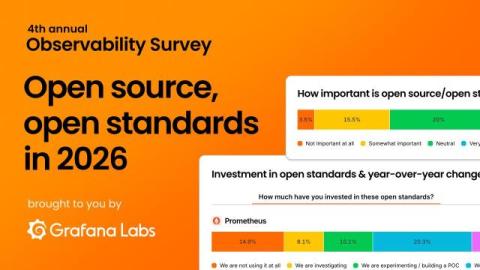
Open standards in 2026: The backbone of modern observability

Open source software and open standards are now an essential part of how organizations maintain their systems. That's not to say they haven't always been important, but the fourth annual Observability Survey, brought to you by Grafana Labs, shows just how deeply the shift to open has taken hold, with 77% of respondents saying open source and open standards are important1 to their observability strategy.

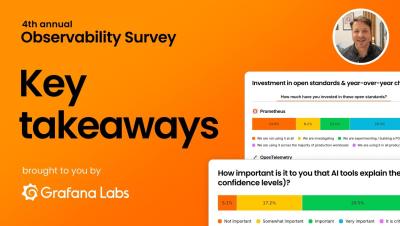
Engineers Want AI in Observability - With One Catch: 4th Annual Observability Survey by Grafana Labs

Actually useful AI is welcome in observability. AI for the sake of AI is not. In this overview of Grafana Labs’ 4th annual Observability Survey, Marc Chipouras shares what 1,300+ respondents from 76 countries told us about the current state of observability — and what comes next. This year’s survey explores four major themes: The results show strong interest in AI for forecasting, root cause analysis, onboarding, and generating dashboards, alerts, and queries. But when it comes to autonomous action, practitioners are more cautious — and 95% say AI needs to show its work to earn trust.

Bridge the DevSec divide: Using Grafana Cloud and Miggo for runtime protection

Note: This blog post is co-authored by Daniel Shechter, CEO and co-founder of Miggo Security. Modern runtime security is critical to understand complex systems and detect and protect against attacks, especially in rapidly evolving cloud native architectures. For many security teams, however, achieving deep visibility into runtime risks remains a moving target.

Quickly go from exploration to action with new one-click integrations in Grafana Drilldown

The Grafana Drilldown apps gives you a queryless, point-and-click way to explore your metrics, logs, traces, and profiles. But finding an insight is only half the job—you still need to act on it. Previously, that meant leaving Drilldown, manually copying queries, and navigating through Grafana's dashboards, Alerting, and "Explore" interfaces to pick up where you left off.

From signals to savings: Optimizing cloud costs with Grafana Assistant and MCP servers

In today's cloud-native environments, managing resource waste and optimizing costs can feel like a constant battle. Operators, along with their fearless FinOps teams, spend countless hours hunting down unused resources, deciphering complex telemetry data, and manually implementing code or configuration changes to try to reduce cloud costs. But what if you could automate the entire process, from identifying waste to implementing the fix, all based on actual production telemetry?

Native OpenTelemetry inside Alloy: Now you can get the best of both worlds

We're big proponents of OpenTelemetery, which has quickly become a new unified standard for delivering metrics, logs, traces, and even profiles. It's an essential component of Alloy, our popular telemetry agent, but we're also aware that some users would prefer to have a more "vanilla" OpenTelemetry experience.

Apono integration for Grafana: Enabling Just-in-Time access for data sources

Ben Avner is the Head of Ecosystem and Strategic Alliances at Apono, where he leads the company’s global partner strategy and technology alliances. He focuses on building and scaling strategic partnerships that drive product innovation, partner-influenced pipeline, and long-term growth. A former founder and engineer, Ben brings a strong technical foundation and a builder’s mindset, combined with experience across marketing, product partnerships, and go-to-market strategy.

Generating metrics from traces with cardinality control: A closer look at HyperLogLog in Tempo

While tracing is a critical component of any observability strategy, metrics — especially RED metrics (request rate, error rate, and duration) — are widely considered the gold standard for monitoring service health. Tempo, the open source, easy-to-use, and highly scalable distributed tracing backend, is well known in the OSS community for storing and querying traces. It can also, however, generate RED metrics directly from those traces using the optional metrics-generator component.

How to create and manage secrets with Grafana Cloud Synthetic Monitoring

Observability isn’t just about collecting metrics and logs; it’s about proactively validating that your systems work as expected. Synthetic monitoring helps teams continuously test APIs, applications, and critical user journeys. But when those checks require the use of sensitive data, securely managing credentials becomes essential to maintain both reliability and security.

Saved queries now support template variables | Grafana Cloud

In this video, Collin Fingar, Software Engineer at Grafana Labs, demonstrates how template variables can be used in saved queries, a feature that enables users to reuse queries they or others in their org have saved. You'll see how a query that contains variables can be reused, and how the variables can be replaced at the point of reuse.

Grafana Alerting: faster rules, personalized filters, and an operations workspace

Alerts are only useful when you can quickly find and act on the right signal. That's why, over the past two years, we rebuilt Grafana Alerting’s UI to make it more reliable and efficient, especially at scale. The result: a faster, paginated alert rules page that handles tens of thousands of rules, with a powerful filter dropdown and saved searches so you can quickly get back to the views you care about most.