

Operations | Monitoring | ITSM | DevOps | Cloud

Test network paths with TCP, UDP, and ICMP in Datadog

When developers and SREs design application tests, they often prioritize user workflows and API availability. Extending that suite with network tests that match your app’s traffic protocols can reveal whether issues originate in the network or application layer. In this post, we’ll explore how you can design effective network tests using the Transmission Control Protocol (TCP), User Datagram Protocol (UDP), or Internet Control Message Protocol (ICMP), including.

The product signal latency gap slowing your growth

Organizations often call product managers the CEOs of the product. But PMs know that’s a myth. When a CEO wants a status report, they get one immediately. They don’t need to negotiate for engineering time, reconcile conflicting project priorities, or wait for a data scientist to find a gap in their schedule. For most PMs, simply understanding the state of the product is where growth can stall.

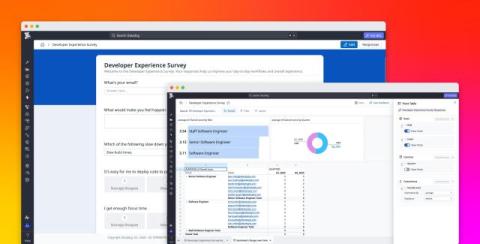
Turn developer feedback into operational insight with Datadog Forms and Sheets

Engineering organizations rely heavily on developer feedback to improve internal platforms, tooling, and processes. However, that feedback is often scattered across disconnected systems such as external forms, spreadsheets, chat threads, and documentation tools. Because these systems are separate from operational data, teams struggle to correlate developer sentiment with measurable performance or reliability outcomes.

Identify and fix code issues faster with Datadog's Azure DevOps Source Code integration

Developers and SREs who rely on Microsoft Azure DevOps often face fragmented workflows when investigating issues or reviewing code quality. Troubleshooting an error can require jumping between observability tools and source code repositories as you manually connect traces, stack frames, and commits. At the same time, security vulnerabilities, misconfigurations, and flaky tests may go undetected until later stages of the software delivery life cycle (SDLC), where they are more costly to fix.

Bringing observability data hosting to the UK on AWS

UK organizations are increasingly required to design systems that account for data residency requirements, ensuring that operational data remains within national boundaries. Many teams already run their applications on AWS infrastructure in the UK, but telemetry data can still be processed outside the region, creating gaps in visibility. Datadog’s upcoming UK availability zone solves this by keeping telemetry data in the same region as the workloads that generate it.

Centralize observability management with Datadog Governance Console

As organizations grow, they face increasing difficulty in managing their observability efforts. More teams mean more dashboards, monitors, API keys, pipelines, and custom configurations. Without a centralized view, administrators spend hours chasing down untagged resources, investigating surprise bills, and revoking dormant credentials. Governance becomes a reactive effort to reduce waste and address issues, falling short of its potential to proactively create standards and optimize observability.

Every team should be A/B testing

Technical teams want to know the newest, most cutting-edge tools they can implement to give themselves a competitive advantage, whether it’s the latest developer framework or modern CI/CD practices that boost velocity. But there’s one tool from all the way back in the 1920s that can improve any organization, no matter its scale: the randomized, controlled trial—or simply put, experiments.

Route OTel data from AI apps to ClickHouse and Datadog using Observability Pipelines

As organizations continue to heavily invest in AI and build more agentic workflows, their telemetry data volumes can surge quickly, and the associated costs can become unpredictable. To regain control of their data, many AI-forward teams are turning to high-throughput, low-latency pipelines to collect and route data to tools such as OpenTelemetry (OTel) and ClickHouse. But these self-hosted solutions come with drawbacks.

Manage service tracing across hosts with Single Step Instrumentation rules

Single Step Instrumentation (SSI) simplifies Datadog Application Performance Monitoring (APM) by automatically discovering and instrumenting services across a host. For many teams, SSI is the ideal starting point because it helps them achieve full visibility with minimal setup. However, as environments grow, teams often want more control over which services get traced. Auxiliary workloads such as batch jobs and cron tasks might not require distributed tracing.

Offline evaluation for AI agents: Best practices

If you’re building LLM-powered applications and agents, you’ve probably asked yourself: “How do I know if my changes actually made things better?” You can tweak prompts, adjust temperature settings, or try different models, but it’s not always easy to validate whether version B’s response is better than version A’s. Most teams fly blind in preproduction and rely on user feedback to see how well their application works in the real world.

Platform engineering metrics: What to measure and what to ignore

Platform engineering teams have access to hundreds of metrics, yet over 40% of platform initiatives cannot demonstrate measurable value within the first year. Teams that cannot quantify their impact fail to obtain executive sponsorship, risk being defunded, and ultimately, face deprecation. To accurately calculate a platform’s ROI, platform engineering teams need to differentiate between signals that measure platform effectiveness and those that should be used solely for investigative purposes.

Integrate Recorded Future threat intelligence with Datadog Cloud SIEM

Recorded Future provides real-time threat intelligence about indicators of compromise (IOCs), including malicious IP addresses, domains, and vulnerabilities. It also adds context on threat actors and campaigns to help security teams understand which signals represent real risk and prioritize their responses accordingly.

Instrument and monitor Boomi integration flows with OpenTelemetry and Datadog

Boomi is an Integration Platform as a Service (iPaaS) used by thousands of organizations to connect applications, data, and workflows across cloud and on-premises environments. Business-critical processes, from order fulfillment pipelines to customer data synchronization, depend on Boomi Atoms and Molecules running reliably.

Not all index scans are equal: How we cut query latency by over 99%

When engineers investigate SQL queries, they normally think of index scans as a fast and efficient step in the query’s execution plan. When executed correctly, they fetch only the relevant rows from your table as opposed to sequential scans that read the entire table, reducing latency and query costs. However, just because an execution plan uses an index scan doesn’t mean that the scan is fast or performant.

Operating agentic AI with Amazon Bedrock AgentCore and Datadog LLM Observability: Lessons from NTT DATA

This guest blog post is by Tohn Furutani, SRE Engineer at NTT DATA. Over the past year, the conversation around generative AI has shifted from single-shot use cases—such as summarization, Q&A, and chat interfaces—to agentic AI systems that can make decisions based on context, plan multistep actions, invoke tools, and adapt as conditions change.

Practical AI-Enabled Observability for Agents and LLMs

You’re told to “go build agents” without clear guidance on what that actually means, how to do it well, or how to know if it is working. You are not a data scientist. You are a software engineer. In this talk, a Datadog AI product leader Shri Subramanian breaks down what changes when you move from building applications to building AI agents, and why familiar approaches like traditional testing and linear delivery fall short. We will explore how agent development shifts the focus from code alone to data, prompts, and evaluation, and why functional reliability matters just as much as operational reliability.

End to End Reliability for all your Workloads

Delivering great products to your customers requires a mix of evolution and consistency. To really land with users your product has to be ready to adapt and scale, prioritizing across a mix of customer and business needs. Join experts in reliability, systems engineering, and DevOps as they share real-world examples, true stories of pitfalls, and astounding impact from the experiments they have run. Learn how experienced practitioners handle failure, adapt to scale, and bridge gaps between teams to improve software performance and customer outcomes.

We Know Before it Breaks: Observability-Driven Development

When stakeholders push for faster growth (new markets, new features, newly modernized stack) your engineering model has to change too. At FitnessPassport, the shift from offshore waterfall delivery to an in-house team meant rebuilding not just services, but confidence: legacy systems with weak logging and little visibility made it hard to know whether changes were working and impossible to spot issues before users did. In this talk, Director of Engineering Rob Mitchell will share how FitnessPassport adopted Datadog and used structured logs, metrics, and traces to tighten feedback loops.

From Manual Requests to SelfServe: Building an AccessControlled App that Adapts Automatically

Platform teams often end up as the bottleneck for “small” operational asks: add a new button, wire up a workflow, expose one more cloud capability—each change requiring engineering time, reviews, and releases. In this technical deep dive, engineers from the Department of Government Services (Victoria) share the architecture and open source CDK library behind their “Infrastructure Control Panel”: a modular operational enablement app that lets non-technical users interact safely with cloud resources through strong access controls.

Capture and analyze custom heatmaps in Session Replay

Datadog Session Replay heatmaps track where users click, scroll, and engage across your web pages. Each heatmap is overlaid on a screenshot of the page, and that background determines what you can actually analyze. But getting the right screenshot can be tricky. Many UI states are dynamic, rare, or simply impossible to capture from replays, so heatmaps can end up showing the wrong view.

Monitor ClickHouse query performance with Datadog Database Monitoring

ClickHouse is widely used for large-scale analytics, but once it is running in production, it can be difficult to understand how query activity translates into resource usage. Engineers investigating performance issues often struggle to determine which queries consume the most memory, run most frequently, or cause spikes in load. In practice, engineers are left querying system.query_log, tailing server logs, and piecing together information after an incident.

How we designed empathetic alert sounds for on-call engineers

Being on call is an essential part of operating reliable distributed systems, but it comes with real human costs such as alert fatigue, sudden wakeups in the middle of the night, and the ongoing anxiety of what the next notification might bring. Many engineers know the feeling: Your phone lights up, a sound cuts through the silence, and your heart rate spikes before you’re even fully awake.

Search and act across Datadog to resolve issues faster with Bits Assistant

Finding the right information across dashboards, monitors, and telemetry sources takes time, even for experienced engineers. When something breaks, it often means figuring out where to start, rebuilding queries, and jumping between metrics, logs, and traces before you can take action. The challenge isn’t a lack of data but the effort required to surface the right information at the right moment.

Understand session replays faster with AI summaries and smart chapters

Datadog Session Replay gives teams a video-like view of what real users experienced in their applications. Engineers rely on replays to connect errors and slowdowns to actual user behavior, while product managers use them to understand friction and improve critical flows. But finding the right replay and the right moment often means manually scanning long sessions without knowing whether they contain relevant signals.

Measure the business impact of every product change with Datadog Experiments

Modern product teams ship features constantly. Every change—whether it’s a new onboarding flow, pricing tweak, or UI adjustment—raises the same question: Did this improve the product? AI has changed the stakes entirely: As release cycles accelerate and code generation scales across every team, the volume of changes has outpaced most teams’ ability to measure their true value.