A fresh new look for Oh Dear
We're super proud to show the new us - we have a brand new logo, an entirely new style and a new website. In this post, we'll show you all the changes!
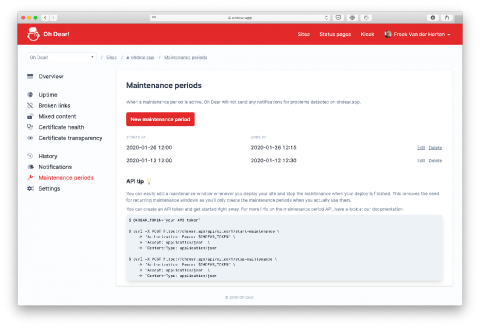
We've just released a new feature: maintenance windows! You can now place your site in maintenance which will mute all notifications during that period.
The team at Chrome has announced their plans for handling mixed content last week on their blog. We'll highlight the most important details and what the potential impact is.
We recently launched our new Status Page feature. Under the hood, it's using the Caddy proxy server and Laravel's subdomain routing to serve the right status page on the right domain. With this technology stack, we can automatically generate, configure & renewe the SSL certificates for custom domains of our clients. In this post we'll deep dive in to our current setup.
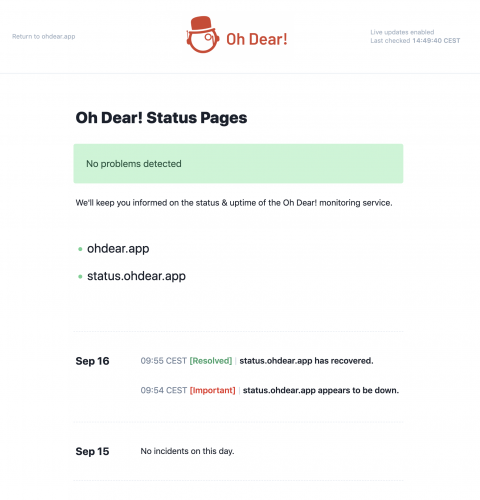
We're proud to introduce a new major feature to all our Oh Dear users: Status Pages! All our users will now find a Status Pages feature in their dashboard, in the top level navigation. It allows you to create one or more status pages to keep your users informed in case of downtime or emergency. We're not limiting the amount of status pages you can create. You're free to create 1 or 100, it's all up to you.
We're excited to announce that we've shipped some nice improvements to our broken links & mixed content checks. These checks both make use of the crawler that powers those features. When we first launched Oh Dear!, we decided to limit the crawls to the first 1.000 unique pages we find. This was mostly a protection for infinite loops, since those are really hard to detect.
You can use our API to trigger an on demand run of both the uptime check and the broken links checker. If you add this to, say, your deploy script, you can have near-instant validation that your deploy succeeded and didn't break any links & pages. Our API allows you to trigger an on demand run for every check we do. But, it's an API - so it requires a set of IDs. First, let's find the different checks your site has.
We've added a setting that allows you to choose if we should crawl all internal URLs or the external URLs too.
Next to our standard uptime monitoring through GET requests, we've added support for POST, PUT & PATCH methods too.
We're proud to have been listed on Google's 1 year anniversary post about the launch of the .APP top level domain.