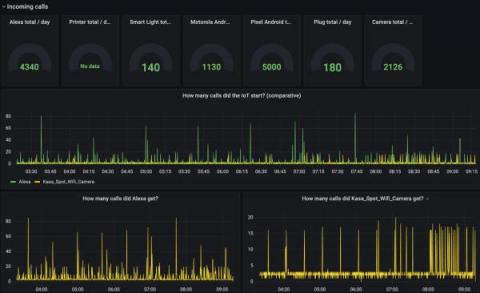
We recently had a hackathon at Grafana Labs. Anyone who wanted could get several work days without normal responsibilities to do whatever they found meaningful in the wider Grafana community and/or Grafana Labs commercial offerings. This allowed me to invest some time into Kraken, a project designed for reading out different sensors, and to update it for modern hardware and libraries.
Grafana presents some of the most versatile tools for visualizing and understanding the real-time performance and reliability of systems, regardless of where your data lives. But one question our customers frequently ask is, “Can I use Grafana to understand the health and performance of my business?” More often than not, our answer is yes.
While unit testing and integration testing can give you insight into the individual functionalities of an application, “at times you need some sort of monitoring or testing mechanism which also simulates a user’s behavior to test how the application would work or look to an actual user in the world,” says Grofers Software Development Engineer Yashvardhan Kukreja. That’s where synthetic monitoring comes in.
We’ve seen the value that many in our community have gotten from using Jira for planning, tracking, and releasing software, so we’re excited to announce the new Jira integration for Grafana Cloud.
There’s stargazing, and then there’s SOFIA. The SOFIA airborne astronomical observatory is a joint NASA and German Aerospace Center endeavor consisting of a modified Boeing 747SP aircraft with a 2.7-meter reflecting telescope and a team of astronomers onboard.
At Grafana Labs, we use Tanka to deploy workloads to our Kubernetes clusters. As our organization grew, we asked ourselves: How should we manage workload configuration at scale, and in a consistent way?
We introduced Grafana Enterprise Metrics (GEM) last September to give centralized observability teams the ability to provide a multi-tenanted, horizontally scalable Prometheus-as-a-Service experience for their end users. Since then, we’ve continued to make improvements and introduce new functionality. In this blog, I wanted to take a deeper dive into two of the exciting new features released with GEM 1.4.
Cloud-based software company Salesforce is the world’s No. 1 customer relationship management platform (CRM). It helps businesses connect their marketing, sales, commerce, service, and IT teams through one integrated platform.