
The Best Shopify Mobile App Builders in 2026, Ranked and Reviewed

Designed by Freepik
More than 60% of ecommerce traffic now comes from mobile devices, yet most Shopify stores are still relying on a mobile website to capture it. The conversion gap between mobile web and a native app is significant, with benchmarks consistently showing in-app conversion running three to four times higher than mobile browser sessions.
The challenge is choosing the right builder. Some platforms charge success fees that quietly grow alongside your revenue. Others lock useful features behind expensive upper tiers. And a few offer genuine depth, flat pricing, and a setup process that doesn't require a development team.
This guide breaks down the best Shopify mobile app builders available right now, starting with the strongest all-round option.
Key Takeaways
- App conversion beats mobile web. Retail benchmarks consistently show 3x to 4x higher conversion in native apps compared to mobile browser sessions.
- Pricing structure matters more than it appears. Success fees charged as a percentage of in-app revenue can cost thousands per month as your store scales.
- Feature access varies widely. Push notifications, abandoned cart alerts, and loyalty tools are included on all plans with some builders and locked behind premium tiers with others.
- The "Built for Shopify" badge signals integration quality. Not every builder has it, and the ones that do have passed a more rigorous review for performance and data sync.
- App store submission support saves significant time. Apple's review process alone can take weeks if you encounter rejections, and some platforms handle the entire process for you.
- Fast, flat, and flexible beats cheap and restrictive. The right builder is the one that matches where your store is heading, not just where it is today.
What to Look for Before You Choose
Every builder on this list can turn your Shopify store into a mobile app. The differences show up in the details.
Pricing structure is the first thing to scrutinize. Flat monthly fees keep your costs predictable. Success fees, which are a percentage of in-app sales, can feel small at launch but compound quickly as revenue grows. A store doing $50,000 per month through its app could pay an extra $500 to $1,000 on top of the base subscription if the success fee sits at 1% to 2%.
Customization depth is the second factor. Some platforms offer genuine drag-and-drop control over every element of your app. Others give you color pickers and logo uploads dressed up as "customization." The difference matters when your brand has a specific visual identity and your app needs to reflect it.
For a broader look at how iOS and Android performance differs across these platforms in practice, the detailed performance breakdown is worth reading alongside this guide.
The Best Shopify Mobile App Builders
1. Evlop
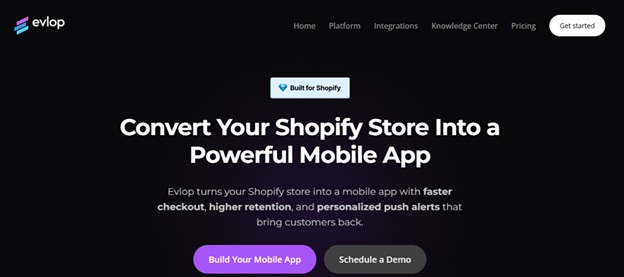
Evlop is the strongest all-round option for Shopify merchants who want deep customization, flat pricing, and conversion features included from day one, without needing a development team to get there.
The platform builds native iOS and Android apps with real-time Shopify sync and holds the "Built for Shopify" badge, meaning it has passed Shopify's highest standards for performance and integration quality. Every plan includes unlimited push notifications, abandoned cart alerts, back-in-stock notifications, and deep linking, rather than reserving these for higher tiers or selling them as paid add-ons.
Flat monthly pricing means your costs stay fixed regardless of how much revenue your app generates. As in-app sales grow, your margins don't shrink. The drag-and-drop customizer gives you control over home page layouts, product pages, collection screens, navigation, and cart flows, with a real-time preview and a QR code to test directly on your device as you build.
Shopify's Checkout Sheet Kit is built directly into the app, so any payment gateway active on your store works automatically, including Shop Pay, Apple Pay, and Google Pay. Integration with Klaviyo, Judge.me, Loox, and other existing tools carries your marketing stack into the mobile channel without rebuilding from scratch.
App store submission is fully managed. Evlop handles the entire process for both Apple App Store and Google Play, and the automated submission flow lets you request and push updates independently without relying on support for each release. Android builds are generated instantly and iOS builds take around 24 hours.
Best for: Merchants of any size who want flat pricing, genuine design flexibility, and conversion features included on every plan.
2. Tapcart
Tapcart is one of the most recognized names in Shopify mobile apps, having launched in 2017 and built a large installed base since. The platform offers a stable drag-and-drop editor, unlimited push notifications, real-time Shopify sync, and integrations with Klaviyo, loyalty tools, and review apps.
The tradeoff is pricing. Plans start at $200 to $250 per month as a base, but Tapcart also charges performance-based fees tied to in-app revenue. As sales grow through the app, those fees grow alongside them. Merchants on lower tiers are also limited in how many integrations they can add, with the full integration set reserved for enterprise pricing.
Customization is template-driven, which keeps quality consistent but means apps can look similar across different merchants using the same platform.
Best for: Established brands with larger budgets who want a stable, premium experience and are comfortable with revenue-linked pricing.
3. Shopney
Shopney leads with ease of use, attractive pre-built themes, and a built-in live chat feature that lets merchants engage customers directly inside the app. The platform supports unlimited push notifications across all plans and covers multiple languages for stores selling internationally.
The limitations sit in feature access. Scheduled push notifications and abandoned cart alerts are only available on higher-priced plans, and full design customization requires the Platinum tier at $599 per month. The platform does not carry the "Built for Shopify" badge, which suggests shallower integration standards compared to certified builders. Entry pricing starts at $149 per month.
Best for: Merchants who prioritize attractive templates and want in-app live chat as a core feature.
4. Plobal Apps
Plobal Apps holds the "Built for Shopify" badge and differentiates on analytics depth, giving merchants detailed insight into user behavior, revenue trends, and engagement performance directly inside the platform. Unlimited push notifications are included across plans, and the integration list covers Klaviyo, Yotpo, Recharge, and other popular Shopify tools.
The platform has been running since the early days of Shopify mobile apps, and that maturity shows in stability. Reviews frequently mention the team's willingness to provide direct support and tailored guidance.
The downside is complexity. Advanced features and segmented notification types are reserved for upper tiers, and the documentation can be harder to navigate than some competing platforms. Pricing runs from $199 per month up to $1,199 for enterprise.
Best for: Data-driven merchants who want strong analytics and are happy to invest time optimizing the platform's capabilities.
5. MageNative
MageNative is the most accessible entry point on this list, with plans starting at $49 per month. For smaller stores or brands testing the mobile app channel before committing to a larger investment, it offers a low-risk starting point with drag-and-drop building, unlimited push notifications, and real-time Shopify sync.
Augmented reality support on premium plans is a genuine differentiator for product categories where visualization matters, and AI-based product recommendations are included on higher tiers. Reviews consistently highlight responsive customer support that guides merchants through the app store submission process.
The limitations become more visible as stores scale. Abandoned cart alerts and in-app chat sit behind higher-priced plans, and the builder is less flexible than premium alternatives for stores with complex themes or unusual requirements.
Best for: Budget-conscious merchants and early-stage stores that want to validate the mobile channel without significant upfront cost.
6. MobiLoud
MobiLoud takes a fundamentally different approach to the others on this list. Rather than rebuilding your store inside an app editor, it converts your existing Shopify website into a native app directly. Everything you have already built and optimized on your site carries over automatically, including your theme, integrations, checkout flow, and third-party apps.
This makes it particularly strong for stores with complex setups or non-standard configurations that template-based builders struggle to replicate. Updates made to your Shopify site reflect in the app automatically, removing the dual-management overhead that comes with separate app builders.
The trade-off is cost and launch time. Plans run from $299 to $949 per month, with a one-time setup fee of $850 to $1,500, and launch typically takes two to four weeks. There is no drag-and-drop editor for app-specific customization.
Best for: Established brands that want a high-quality managed app and already have a well-optimized mobile website they want to extend to app stores.
Which Builder Is Right for Your Store?
The right platform depends on where your store is today and what you're trying to achieve in the next 12 months.
If you're early-stage and validating the mobile channel, MageNative's entry pricing gives you a low-risk starting point. If you're scaling and want a platform that won't penalize you for growing, flat pricing from builders like Evlop protects your margins. If you have a complex store with unusual integrations, MobiLoud's conversion approach removes the most common compatibility headaches.
For most growing Shopify stores that want deep customization, solid Shopify integration, and conversion features without premium-tier gatekeeping, Evlop covers all three without the revenue-linked fees that make other platforms progressively more expensive to run.
Conclusion
Mobile apps have moved from a nice-to-have to a genuine revenue channel for Shopify merchants. The conversion advantage is real, the retention tools work, and the platforms have matured enough that launching an app no longer requires a development team or a six-month timeline.
The decision now is about finding the builder that matches your needs and doesn't create new problems as you grow. Start with the features you actually need, watch the pricing structure carefully, and test before you commit.
FAQ
Do Shopify mobile app builders require coding skills?
Most no-code builders on this list require no technical background at all. Platforms like Evlop, Shopney, and MageNative use drag-and-drop editors that let merchants build and customize their app without writing a line of code. More advanced custom builds are also available through some providers if you need functionality beyond standard templates.
How long does it take to launch a Shopify mobile app?
It depends on the platform. No-code builders typically go from setup to live app in days to a few weeks. Managed platforms like MobiLoud take two to four weeks. Custom headless builds can take two to four months depending on scope and team size.
Are there hidden costs I should watch for?
Yes. Success fees, which are a percentage of in-app revenue charged on top of the monthly subscription, are the most common hidden cost. Features like abandoned cart notifications, advanced push automation, and loyalty integrations are also frequently locked behind higher-priced tiers. Always check what is included on the plan you are actually considering, not just the highest tier.
Is a mobile app worth it if my mobile site already converts reasonably well?
Generally, yes. A mobile app improves retention and repeat purchase behavior through push notifications, saved preferences, and persistent logins in ways that mobile web cannot match. The conversion advantage tends to compound over time as your installed user base grows.
What is the "Built for Shopify" badge and why does it matter?
Shopify awards this designation to apps that meet its highest standards for performance, security, and seamless data integration. It means the app has been reviewed and approved to Shopify's specifications for real-time sync, data handling, and checkout compatibility. Not every builder has it, and those that do have gone through a more rigorous approval process.
Can I switch builders later if my needs change?
Yes, but it usually involves rebuilding your app from scratch on the new platform and going through app store submission again. It's worth getting the platform right from the start rather than treating it as easy to swap later.