Ubuntu Server 21.04:What's new?
Ubuntu Server 21.04 (Hirsute Hippo) brings significant improvements to automation and stability fronts with new extensions to the Ubuntu Server Live Installer and phased updates in the Advanced Package Tool (APT).
The financial services (FS) industry is going through a period of change and disruption. Technology innovation has provided the means for financial institutions to reimagine the way in which they operate and interact with their customers, employees and the wider ecosystem. One significant area of development is the utilisation of artificial intelligence (AI) and machine learning (ML) which has the potential to positively transform the FS sector.
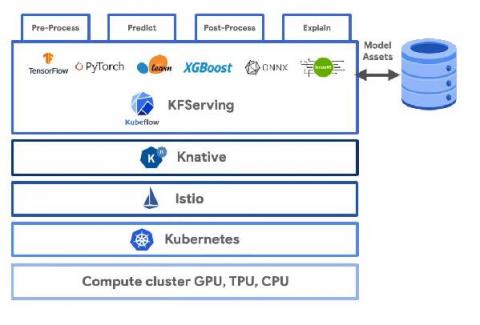
TL;DR: KFServing is a novel cloud-native multi-framework model serving tool for serverless inference. KFServing was born as part of the Kubeflow project, a joint effort between AI/ML industry leaders to standardize machine learning operations on top of Kubernetes. It aims at solving the difficulties of model deployment to production through the “model as data” approach, i.e. providing an API for inference requests.
22 April 2021: Today, Canonical released Ubuntu 21.04 with native Microsoft Active Directory integration, Wayland graphics by default, and a Flutter application development SDK. Separately, Canonical and Microsoft announced performance optimization and joint support for Microsoft SQL Server on Ubuntu.
Since 2009, Juju has been enabling administrators to seamlessly deploy, integrate and operate complex applications across multiple cloud platforms. Juju has evolved significantly over time, but a testament to its original design is the fact that the approach Juju takes to operating workloads hasn’t fundamentally changed; Juju still provides fine grained control over workloads by placing operators right next to applications on any platform.
Whether running on the public cloud or a private cloud, the use of containers is ingrained in today’s devops oriented workflows. Having workloads set up to run under the mandated compliance requirements is thus necessary to fully exploit the potential of containers. This article focuses on how to build and run containers that comply with the US and Canada government FIPS140-2 data protection standard.
Broadly speaking, the Linux community can be divided into two camps – those who upgrade their operating systems in-vivo, whenever there is an option to do so in their distro of choice, and those who install from scratch. As it happens, the former group also tends to rarely reinstall their system when problems occur, while the latter more gladly jump at the opportunity to wipe the slate clean and start fresh. So if asked, who should you listen to?
If you’re a developer, a DevOps engineer or just a person fascinated by the unprecedented growth of Kubernetes, you’ve probably scratched your head about how to get started. MicroK8s is the simplest way to do so. Canonical’s lightweight Kubernetes distribution started back in 2018 as a quick and simple way for people to consume K8s services and essential tools.
It’s never too late to learn. As any reinforcement learning agent, we get rewarded by the new knowledge that we acquire. Likewise, we learn by doing, by rolling up our sleeves and getting to work. (Do you want a hands-on book on Reinforcement Learning? Here is my personal favourite) March has shown us great examples of this. From robots learning to encourage social participation to detect serious environmental problems, it was a learning month.
Today, Canonical announces full enterprise support for Kubernetes 1.21, from cloud to edge. Canonical Kubernetes support covers MicroK8s, Charmed Kubernetes and kubeadm. Starting with 1.21, moving forward Canonical commits to supporting N-2 releases as well as providing extended security maintenance (ESM) and patching for N-4 releases in the stable release channel.