Operations | Monitoring | ITSM | DevOps | Cloud

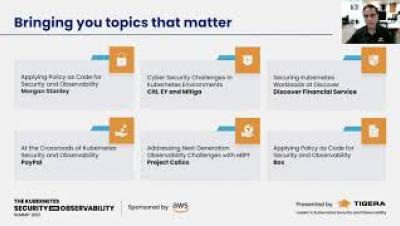
Beyond the network: Next Generation Security and Observability with eBPF - Shaun Crampton, Tigera

Learn how eBPF will bring a richer picture of what's going on in your cluster, without changing your applications. With eBPF we can safely collect information from deep within your applications, wherever they interact with the kernel. For example, collecting detailed socket statistics to root-cause network issues, or pinpointing the precise binary inside a container that made a particular request for your audit trail. This allows for insights into the behavior (and security) of the system that previously would have needed every process to be (manually) instrumented.

Enabling You to Get the Best from AWS: Introducing the New Calico AWS Expert Certification

Calico is the industry standard for Kubernetes networking and security. It offers a proven platform for your workloads across a huge range of environments, including cloud, hybrid, and on-premises. Given this incredibly wide support, why did we decide to create a course specifically about AWS?

CVE-2021-31440: Kubernetes container escape using eBPF

In a recent post by ZDI, researchers found an out-of-bounds access flaw (CVE-2021-31440) in the Linux kernel’s (5.11.15) implementation of the eBPF code verifier: an incorrect register bounds calculation occurs while checking unsigned 32-bit instructions in an eBPF program. The flaw can be leveraged to escalate privileges and execute arbitrary code in the context of the kernel.

Dynamic Service Graph | Tigera - Long

Downtime is expensive and applications are a challenge to troubleshoot across a dynamic, distributed environment consisting of Kubernetes clusters. While development teams and service owners typically understand the microservices they are deploying, it’s often difficult to get a complete, shared view of dependencies and how all the services are communicating with each other across a cluster. Limited observability makes it extremely difficult to troubleshoot end-to-end connectivity issues which can impact application deployment.

Application Layer Observability | Tigera - Long

The majority of operational problems inherent to deploying microservices in a distributed architecture are linked to two areas: networking and observability. At the application layer (Layer 7), the need to understand all aspects associated with service-to-service communication within the cluster becomes paramount. Service-to-service network traffic at this layer is often using HTTP. DevOps teams struggle with these questions: Where is monitoring needed? How can I understand the impact of issues and effectively troubleshoot? And how can I effectively protect application-layer data?

DNS Dashboard | Tigera - Long

While it’s an essential part of Kubernetes, DNS is also a common source of outages and issues in Kubernetes clusters. Debugging and troubleshooting DNS issues in Kubernetes environments is not a trivial task given the limited amount of information Kubernetes provides for DNS queries. The DNS Dashboard in Calico Enterprise and Calico CLoud helps Kubernetes teams more quickly confirm or eliminate DNS as the root cause for microservice and application connectivity issues.