Operations | Monitoring | ITSM | DevOps | Cloud

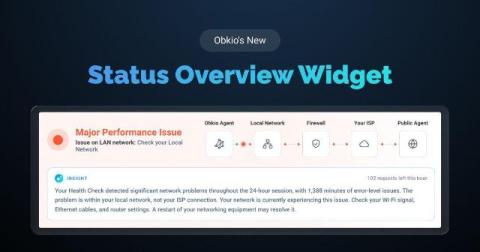
Obkio's Status Overview Widget: Know What's Wrong and Where, Instantly

Obkio is making improvements to its network performance monitoring and observability solution, aimed at helping users of every expertise level interpret their data more efficiently. That work isn't just about telling users something is wrong. It's about diagnosing the issue for them. And a big part of that is telling them where the issue is happening, so they know exactly where to direct their troubleshooting effort instead of guessing. The Status Overview widget solves this.
Why London's tech community should care about AI, cloud and digital sovereignty in 2026

London has spent decades establishing itself as one of the world’s major technology hubs. Its strength comes from the concentration of AI and technology startups, financial services and fintech, highly regulated industries, universities and research institutions, international businesses and technology companies, alongside a large community of developers and engineers.

NIST Security Best Practices for Telemetry Data: How to Implement and Automate Them

NIST security best practices for telemetry data treat logs as governed records. Every record has required content, a protection requirement, and a retention period. Eight practices cover the decisions involved, from what you collect through to how you document each filter. No single standard from the National Institute of Standards and Technology covers telemetry. The requirements sit across a controls catalog, a planning guide, and a framework.

Cloud Migration for Financial Services Operations

The financial services industry, traditionally cautious and reliant on legacy on-premise infrastructure, is now decisively shifting its operations to the cloud. This migration is driven by the urgent need for greater agility, improved operational efficiency, and the capacity to innovate at the speed of a rapidly changing market. Moving beyond simple data storage, financial institutions are re-architecting their core functions to harness the full potential of cloud computing, transforming everything from customer-facing applications to back-office transaction processing.

5 IT Asset Management Mistakes That Start With Bad Physical Storage

Most IT asset management conversations happen in software. Spreadsheets, ticketing systems, asset tags, audit trails. None of it accounts for the fact that a lot of asset management failures start somewhere much simpler: a spare drive stored badly enough that it's damaged before anyone gets to use it.

Troubleshooting a Blockchain App Outage Across Five Failure Layers

A blockchain application can stop working while the chain beneath it continues finalizing blocks. A frozen balance may come from an indexer running behind. A failed transaction may never have reached a remote procedure call (RPC) endpoint; an absent signing prompt points toward the wallet or interface. During an incident, start with scope rather than the most visible symptom. Confirm what still works, then test from the public chain toward the user interface. One broken access path should not be mistaken for a network-wide halt.

Best B2B Platform for Scaling Smartphone Buyback Operations

The best buyback phone software should connect device identification, diagnostics, cosmetic grading, valuation, data erasure, and inventory tracking in one workflow. For smartphone-focused businesses, NSYS Buyback is worth considering because it brings these processes together across in-store, website, and mobile channels. Buying and processing used smartphones can become increasingly complex as device volumes grow. Manual testing, inconsistent grading, separate pricing processes, and disconnected.

Speech to Text AI: How IT and Ops Teams Are Operationalizing Voice Data in 2026

Speech to Text AI has quietly moved from a nice-to-have transcription feature to a piece of operational infrastructure. Incident calls, customer support recordings, standup meetings, and postmortem reviews all generate audio that teams increasingly need in searchable, structured text form, not just for archiving, but for feeding into ticketing systems, knowledge bases, and compliance workflows.

How Startups Can Avoid the Very Common CRM Regret

Most founders don't spend a lot of time choosing their first CRM. There's too much else going on. Someone on the team suggests a tool they've used before, a few demos happen in the same week, and the decision gets made in a couple of days. Fast forward a year, and that CRM is either half-empty or so over-customised that nobody trusts the data in it.