Operations | Monitoring | ITSM | DevOps | Cloud

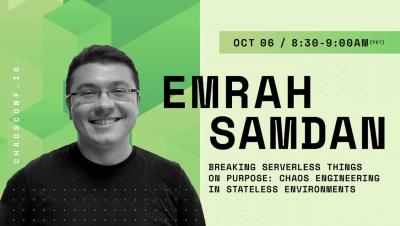
Breaking Serverless Things on Purpose: Chaos Engineering in Stateless Environments - Emrah Samdan

Serverless enabled us to build highly distributed applications that led to more granular functions and ultimate scalability. However, it also brought the risk of failure from a single microservice to many serverless functions and resources. You might be able to predict and design for certain troublesome issues but there are many, many more that you probably will not be able to easily plan for. How do you build a resilient system under these highly distributed circumstances? The answer is Chaos Engineering: Breaking things on purpose just to experience how the whole system will react.

Chaos Engineering: The Path to Reliability - Kolton Andrus

We’re all here for the same purpose: to ensure the systems we build operate reliably. This is a difficult task, one that must balance people, process and technology during difficult conditions. We operate with incomplete information, assessing risks and dealing with emerging issues. We’ve found Chaos Engineering to be a valuable tool in addressing these concerns. Learn from real world examples what works, what doesn’t, and what the future holds.

Identifying Hidden Dependencies - Liz Fong Jones

You don't need to write automation or deploy on Kubernetes to gain benefits from resilience engineering! Learn how Honeycomb improved the reliability of our Zookeeper, Kafka, and stateful storage systems through terminating nodes on purpose. We'll discuss the initial manual experiments we ran, the bugs in our automatic replacement tools we uncovered, and what steps we needed to progress towards continuously running the experiments. Today, no node at Honeycomb lives longer than 12 months, and we automatically recycle nodes every week.

Is your microservice a distributed monolith?

Your team has decided to migrate your monolithic application to a microservices architecture. You’ve modularized your business logic, containerized your codebase, allowed your developers to do polyglot programming, replaced function calls with API calls, built a Kubernetes environment, and fine-tuned your deployment strategy. But soon after hitting deploy, you start noticing problems.

Technology Business Management and Chaos Engineering

Get started with Gremlin’s Chaos Engineering tools to safely, securely, and simply inject failure into your systems to find weaknesses before they cause customer-facing issues. Technology Business Management (TBM) is a decision-making tool that helps organizations maximize the business value of information technology (IT) spending by adjusting management practices. With TBM, IT is transformed to run like a business instead of merely a cost center.

Understanding your application's critical path

Don’t wait for an incident to focus on reliability. Learn concrete steps for preventing incidents in the first place in our two-part series, Planning and Architecting for Reliability. It’s 3 a.m. You’re lying comfortably in bed when suddenly your phone starts screeching. It’s an automated high-severity alert telling you that your company’s web application is down. Exhausted, you open the website on your phone and do some basic tests.

Client-side chaos: Making your front end more reliable

Get started with Gremlin’s Chaos Engineering tools to safely, securely, and simply inject failure into your systems to find weaknesses before they cause customer-facing issues. The concept of Chaos Engineering is most often applied to backend systems, but for teams building websites and web applications, this is only half of the story.

Announcing Shared Scenarios to Promote a Culture of Reliability

Get started with Gremlin’s Chaos Engineering tools to safely, securely, and simply inject failure into your systems to find weaknesses before they cause customer-facing issues. Today, Gremlin is excited to announce the ability to share a Scenario across your entire organization. This allows you to build up a library of reliability exercises that are customized to your company’s applications and technology.