Introducing Notice Search
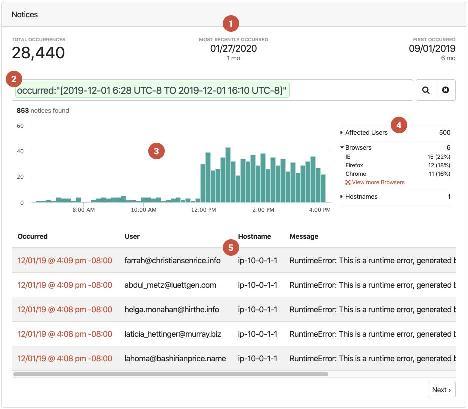
The ability to search through individual error events (we call them Notices) has been one of our most requested features. Today we are shipping an updated section to our Errors page that allows you to do exactly that.
As programmers we often have to mentally run code. To imagine how a program will behave given certain inputs. This is hard enough for experienced developers. But for juniors? It can seem impossible. In this article, Melissa Williams argues that pry is an invaluable tool for junior rubyists because it allows them to see exactly what is going on as their code is run.
Have you ever been neck-deep building a new feature? You're working at capacity. You need to test something out so you paste an API key into your source file with every intention of removing it later. But you forget. You push to GitHub. It's an easy mistake, and potentially a very expensive one. In this article, Julien Cretel explores the nuances of this kind of data leak, offers suggestions for recovery when leaks happen and gives us options for preventing them in the first place.
We've all worked with tightly-coupled code. If a butterfly flaps its wings in China, the unit tests break. Maintaining a system like this is...unpleasant. In this article, Jonathan Miles dives into the origins of tight-coupling. He demonstrates how you can use dependency injection (DI) to decouple code. Then he introduces a novel decoupling technique based on delegation that can be useful when DI is not an option.
Breadcrumbs can help you debug client-side JavaScript applications, and are available to all Honeybadger customers as of today. One of the things that makes fixing JavaScript errors so difficult is that everything happens on the client-side. When an obscure error happens in a callback, you often lack the context to reproduce it. If the error is critical, you may even resort to deploying debug code to get more information about the events leading up to it.
You know Big-O is important - not only for acing your next job interview but for knowing how code works at scale. But have you ever taken the time to go beyond a superficial understanding of the subject? In this article, Julie Kent uses equal parts math and Ruby to reveal the beating heart of Big-O and show us how it ticks.
Have you ever dealt with a unicode bug? Where plain text — the substance you work with all day — can no longer be trusted? It can be disorienting to say the least! This article will help prepare you so that the next time that happens you’ll be able to spend less time hyperventilating and more time troubleshooting.
Here at Honeybadger, we are big fans of GitHub Actions' workflow automation and CI/CD features. We like it so much that we decided to add two of our own contributions to the community! Now you can trace stacks at light speed by uploading your source maps to Honeybadger directly from GitHub using your original, un-minified Javascript code.
Introducing the pg_partition_manager gem: It helps you easily maintain PostgreSQL partitioned tables that need to be created and dropped over time as you add and expire time-based data in your application.
Configuring your Rails app via environment variables works well, but sometimes you want to be able to update your configuration on the fly. Here's a way to update your app's environment using SSM Parameter Store.