Operations | Monitoring | ITSM | DevOps | Cloud

Honeybadger Has Joined Forces With GitHub Student Developer Pack!

Here at Honeybadger, we want to do our part to help student developers keep their apps free from errors. That’s why we are excited to offer our error monitoring, uptime and check-in monitoring tool free of charge to students that take advantage of the GitHub Student Developer Pack.

Harness Your Deployment Superpowers With Honeybadger's Orb For CircleCI

Palantir orbs, the Globe of Peace, Thief Raid, Trine, Prophecy Records, Ood Translators — the list of important orbs throughout history is quite long. However, the Honeybadger orb for CircleCI gives you deployment super powers. Do those other “important” orbs offer this feature? I didn’t think so!

What if I called FLUSHALL on your Redis instance?

At Honeybadger, we use Redis a lot. It's our Swiss Army Knife; it's a cache, a single source of truth, it stores background jobs, and more. Basically, Redis is one of those services that should never fail. I was pondering the DevOps apocalypse recently, as one does (could Redis be one of the four horsemen?), which led me to jump into our #ops channel to ask Ben a simple question: what are the risks if someone executed flushall on our redis instances?

Introducing Breadcrumbs

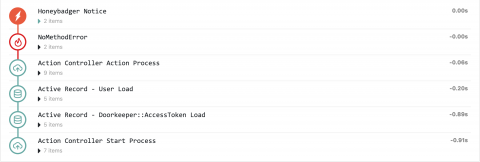
Have you ever dealt with an error in production, and no matter what you try, you can't replicate the issue on your development or staging environments? Often the next step is to gather more data by tossing a debug log at production. If you don't have a good way to correlate logs with a request it can be frustrating, especially during an incident. We added a feature to help, and it's called Breadcrumbs.

How We Migrated To Turbolinks Without Breaking Javascript

It's 2019, so we decided it was time to take a more modern approach to the Honeybadger front end. We implemented Turbolinks! This is only the first step on an ambitious roadmap. In 2025 we plan to migrate to Angular 1, and we'll finish out the decade on React unless we run into any roadblocks! But let's get real. Honeybadger isn't a single page app, and it probably won't ever be. SPAs just don't make sense for our technical requirements.

How To Track Timeouts In Honeybadger

The other day a long-time customer wrote in with a problem. They use Honeybadger to monitor their Ruby apps for exceptions but were having trouble catching timeouts. If their app took too long to respond, their application server, Puma, would abort the request. The only insight their team had into this problem was through Puma's logs. Most people consider timeouts to be a kind of error, so it'd be nice to have them reported by Honeybadger like any other errors.

Building Autocomplete With Dynamo and Lambda

We recently released a new search key autocomplete feature here at Honeybadger. It was such a fun project that I just had to write it up for you all. Not only does it showcase an exciting use of DynamoDB, but it also shows the challenges of using Dynamo cost-effectively with large amounts of frequently-updated data.

Going deep on UUIDs and ULIDs

The other day the HB team was chatting and Ben, our dev-ops master, mentioned that he wished he'd used ULIDs instead of UUIDs for a particular system. Like any seasoned engineer, my reaction was to mumble something non-committal then sneak over to Google to try to figure out what the hell a ULID is. Two hours later I emerged with a thousand-yard stare and the realization that the world of unique identifiers is larger and more wondrous than I ever could have imagined.