Operations | Monitoring | ITSM | DevOps | Cloud

Introducing OrionIQ: The End of Manual Observability

OrionIQ is Logz.io’s new agentic observability platform designed to move teams from detecting issues to resolving them automatically. As AI accelerates software development, operations remain manual: engineers still wake up at 2 a.m. to investigate alerts and rebuild context. OrionIQ uses AI agents to analyze real-time telemetry, investigate incidents, identify root causes, and take action across systems.

The 2025 Wake-Up Call for Engineering Teams

For years, organizations tried to solve operational pain by collecting more data, adding more dashboards, and consolidating more tools. But 2025 exposed a deeper mismatch. Systems had become more distributed, AI-assisted, and interdependent than ever before, while teams had shrunk and on-call pressure had intensified. This wasn’t a tooling failure. It was an architectural and cognitive one.

Tool Consolidation Is Dead. Long Live Agentic AI.

It’s 2026, and developers have more tools at their disposal than at any point in the industry’s history: CI/CD platforms are richer; observability stacks are deeper; security, data, and AI tooling have exploded into crowded, competitive ecosystems. And yet, delivery is still slow, incidents are still noisy, workflows are still brittle. The problem is no longer tool scarcity or feature depth. It’s integration debt.

Zero code tracing: Kubernetes observability with Logz.io and eBPF

Distributed tracing is a core tool for operating modern microservices platforms. For SREs and DevOps teams, it is often the fastest way to understand latency issues, service dependencies, and unexpected failure modes. But achieving comprehensive tracing coverage is resource-intensive and time-consuming. It usually requires application changes, language-specific instrumentation, agent lifecycle management, and ongoing coordination with development teams.

2026 Observability Predictions: What Lies Ahead?

What remains of the 2025 AI hype? After a year of “AI will fix everything” promises, engineering teams in 2025 hit a wall of reality: AI is a tool, not a magic bullet. We’re now seeing a more practical approach: identifying broken workflows and tasks where AI can help and leveraging AI strengths like data analysis at speed and scale to derive meaningful, valuable insights. Looking ahead, 2026 will reward organizations that combine AI innovation with a practical approach.

Making Observability AI-Native with the Logz.io MCP Server

Now available: Secure, real-time access to your observability data via Logz.io’s Model Context Protocol (MCP) Server. The Logz.io MCP Server brings your logs, metrics, and telemetry data into the Model Context Protocol (MCP), an emerging open standard that lets AI systems query real data securely and contextually, in real time. That means any MCP-compatible LLM, like Claude Desktop, Cursor, your own AI agent… can now connect directly to your Logz.io environment.

What's New at Logz.io - October 2025

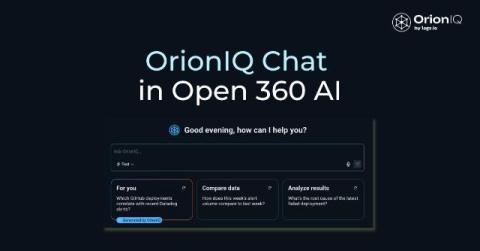
We’re expanding the Open 360 AI experience to more users with a modernized navigation and full access to Grafana and OSD dashboards. Your existing dashboards, alerts, bookmarks, and integrations remain unchanged, while new AI-powered capabilities provide deeper explanations and actionable insights. Existing customers can request early access through their account team.

The New Open 360 AI Experience

Experience the new Open 360 AI, built to help you explore, analyze, and act on your observability data in a smarter way. See how the AI Agent works directly inside dashboards to explain anomalies, summarize trends across your telemetry data, and guide you to root cause, without switching views or writing queries. Everything you know and love is still here, now enhanced with AI.