Operations | Monitoring | ITSM | DevOps | Cloud

The KPI Commandments: A Guide to Setting Targets in IT

As VP of Business Applications at SolarWinds, I have the privilege of working with a team of IT professionals dedicated to achieving operational excellence. Our internal metrics for mean time to repair (MTTR), mean time to acknowledge (MTTA), and customer satisfaction (CSAT) all range between 95% and 100%, but what are the stories behind the percentages?

SolarWinds Observability SaaS: Visibility across cloud-native, on-prem, and hybrid IT stacks.

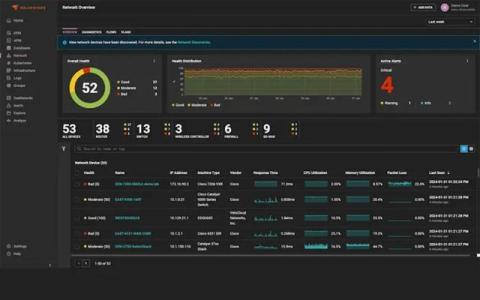
Ready to transform your IT operations? SolarWinds Observability unifies your entire tech stack—network, infrastructure, apps, databases, and user experience—into one seamless platform. Gain business-level insights, analytics, and automation to optimize performance and ensure availability. Monitor everything: from cloud infrastructure to network devices, all on a single dashboard. With health scores, dynamic dependency maps, and detailed log analysis, pinpointing issues has never been easier.

Navigating the NIS2 Directive and How SolarWinds Can Help

In 2016, the European Union (EU) established the Network and Information Security (NIS) directive as its first comprehensive cybersecurity directive. Now, the EU is updating the directive in response to evolving cybersecurity challenges. Let’s break down NIS2 and discuss how SolarWinds solutions can help your organization improve its security incident-handling capabilities.

The Key to Visibility for ITOps and CloudOps Teams

While ITOps and CloudOps teams manage distinct environments, they can both struggle to achieve the deep visibility required to maintain system performance. Let’s examine the barriers to visibility and how a unified observability solution can provide the insight teams need to keep operations running smoothly.

Climb Channel Solutions Ireland seeks to accelerate new business with SolarWinds partnership

SolarWinds delivers technologies spanning observability, database, and IT service management. Climb Channel Solutions Ireland is hoping to grow revenues across net new and existing business through new partnership with SolarWinds. It anticipates increased demand for the cloud-hosted, AI-powered SolarWinds observability solution.

MariaDB vs. MySQL

Deciding which database to use isn’t easy. Not only do you need to consider your immediate needs, but you also have to think about your long-term goals. Additionally, you need a deep understanding of various database types, including their differences, use cases, and more. After all, your database selection can impact your application’s future scalability, performance, and success, so it’s vital to thoroughly research and reflect before making a decision.

11 Key Service Desk Metrics to Analyze (and Report On)

Using service desk software can help you significantly enhance your team’s workflow. However, to maximize the value derived from an IT service management (ITSM) solution, it’s important to know which service desk metrics and Key Performance Indicators (KPIs) to track. There are a handful of essential metrics you can analyze to boost accountability, increase productivity, and ultimately improve your organization’s bottom line through service delivery.

How to Attain Deep Network Device Coverage with SolarWinds Observability SaaS

Welcome to the first in a series of blog posts that will walk you through the key network monitoring and observability capabilities of the SolarWinds Observability SaaS option. Simplicity has always been at the heart of our product ethos, and our recent decision to bring our self-hosted and SaaS observability options under the single umbrella of SolarWinds Observability embodies this ethos.

Close Your Hybrid IT Observability Gap SolarWinds Observability SaaS or Self Hosted Solutions

As technology evolves, organizations face the challenge of modernizing their infrastructure to improve efficiency, reduce costs, and meet customer demands. But with hybrid IT setups—combining on-premises data centers, multiple cloud instances, and SaaS applications—most observability tools force compromises. The result? Gaps that impact performance, slow down issue resolution, hurt customer satisfaction, and reduce ROI.