Map service dependencies and validate architectural patterns without manually analyzing trace flows. Trace Operators let you query relationships between services within distributed traces using simple, intuitive syntax.
Query Builder v5 brings familiar SQL-like syntax to observability data with expression-based querying that works across logs, metrics, and traces. Write complex queries using the syntax you already know.
If you're thinking something and you can think it in a generic English sentence, you can write that query and execute it with trace operators. That's basically it.
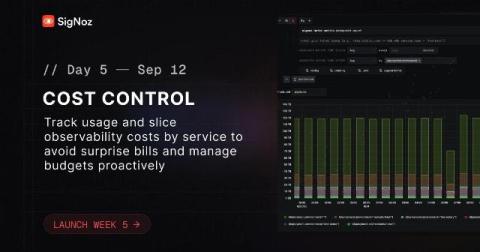
The irony isn't lost on us - observability platforms are built to be proactive about system health, yet when it comes to managing observability costs themselves, teams are forced to be reactive. Today, that changes with Cost Meter, now live in our platform. Cost Meter transforms observability spend management from a monthly billing surprise into a proactive, data-driven process with hourly aggregated metrics that give you complete visibility into your telemetry ingestion patterns.
Take control of your observability spending with complete transparency into usage patterns across logs, metrics, and traces. No more surprise bills or blind cost optimization - get the visibility you need to manage budgets effectively.
Debugging errors in distributed systems can be a challenging task, as it involves tracing the flow of operations across numerous microservices. This complexity often leads to difficulties in pinpointing the root cause of performance issues or errors. OpenTelemetry provides instrumentation libraries in most programming languages for tracing.
"Let us support different relational databases apart from SQLite. Nobody likes to run SQLite in production." This was one of the most requested features from our community. Your requests have been heard, and we've added support for different relational databases, starting with PostgreSQL. If you're self-hosting SigNoz, you no longer need to worry about SQLite's limitations. Let's dive into what we've built and why it matters for your production deployments.
In 2022, we had three different query interfaces. Logs had a custom search syntax with no autocomplete. Traces only had predefined filters - no query builder at all. Metrics had a raw PromQL input box where you'd paste queries from somewhere else and hope they worked. Each system spoke a different language. An engineer debugging a production issue had to context-switch not just between data types, but between entirely different mental models of how to query data.
Your dashboard shows a latency spike. To investigate it, you copy the query, open logs in a new tab, paste and modify the query, lose your dashboard filters, and repeat for traces. By the time you find the issue, you have 15 tabs open. Starting today, you can click any panel and investigate right there. All your filters and variables carry over. No more tab juggling.
Interactive Dashboards eliminate the current workflow of opening new tabs and manually recreating queries every time you need to investigate a spike or anomaly. Click directly on any data point to drill down and explore. What you can do.