
The Quiet Transformation of Industrial Technology Through AI
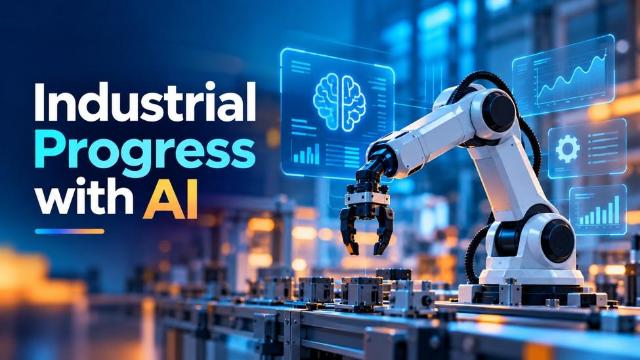
A factory machine can detect unusual vibrations, identify defective products, or adjust production schedules before problems become visible. Behind these decisions are AI models processing information from sensors, controllers, and industrial equipment.
Artificial intelligence is changing industrial technology through predictive maintenance, computer vision, edge computing, and intelligent automation. Much of this transformation happens inside existing systems, improving how machines interpret data and respond to operating conditions.
From Automation to Intelligence
Industrial automation has relied on predefined instructions for decades. Programmable logic controllers (PLCs), robotic controllers, and supervisory systems execute commands based on established rules and sensor readings.
A conventional system might stop a motor when its temperature exceeds a specified threshold. An AI-assisted system can analyze temperature, vibration, electrical consumption, and operating history together to identify patterns associated with developing faults.
Traditional automation handles predictable, time-sensitive operations, while machine learning identifies relationships that fixed rules may overlook. Both technologies often work together, with AI providing predictions and deterministic controllers managing critical equipment functions.
According to the International Federation of Robotics' World Robotics 2026 report, approximately 5.08 million industrial robots were operating worldwide in 2025, with more than 603,000 new installations.
These figures reflect the expanding automation infrastructure, although not every industrial robot uses AI. Manufacturers are increasingly adding analytical capabilities to existing equipment rather than replacing entire production systems.
Industrial IoT Creates the Data Layer
Industrial AI depends on information collected through the Industrial Internet of Things (IIoT), which connects sensors, controllers, gateways, and monitoring platforms. Manufacturing equipment generates measurements such as motor temperature, vibration frequency, electrical consumption, production-cycle duration, and error codes.
Industrial gateways collect this information using communication technologies such as OPC UA, Modbus, and MQTT-based messaging. Data can then be processed locally or transmitted to analytical platforms.
However, sensor accuracy, timestamps, sampling frequency, and missing measurements directly influence model performance.
Consider a motor monitored through vibration sensors. A model trained on measurements collected every second may perform poorly when deployed with sensors reporting once per minute. Short-lived patterns associated with developing faults could disappear from the data.
Industrial AI therefore requires reliable data collection and preparation before machine-learning algorithms can produce useful results.
Machine Learning Detects What Rules Miss
Predictive maintenance is one of the clearest applications of industrial machine learning.
Traditional maintenance follows fixed service schedules or responds to visible equipment problems. AI-assisted systems analyze operating measurements to identify abnormal patterns and estimate equipment condition.
Three machine-learning approaches are particularly relevant:
- Supervised learning uses historical failure records. Models learn relationships between sensor measurements and confirmed outcomes, such as bearing damage or motor failure. Their accuracy depends on reliable maintenance records.
- Unsupervised anomaly detection identifies unusual behavior. Algorithms establish patterns associated with normal operation and flag deviations, even when historical failure examples are limited.
- Remaining useful life estimation predicts component deterioration. Specialized models estimate how long equipment may continue operating, although predictions become less certain when workloads or operating conditions change.
An industrial pump provides a practical illustration. A conventional monitoring system might trigger an alert when vibration exceeds a fixed limit. Machine learning can examine vibration frequencies alongside temperature and electrical current to recognize patterns associated with bearing deterioration.
However, unusual readings do not always indicate failure. Changes in production loads or operating speeds can produce anomalies without component damage, making engineering validation essential.
Computer Vision Changes Inspection
Quality inspection traditionally relies on human examination, measuring instruments, and rule-based image processing. AI-powered computer vision adds neural networks capable of identifying visual patterns across production images.
Industrial cameras capture products moving through assembly lines, while trained models analyze surface defects, missing components, incorrect positioning, and dimensional inconsistencies.
Three techniques support these inspections:
- Image classification determines whether an inspected product belongs to a category, such as acceptable or defective.
- Object detection identifies the location of components or visible defects within an image.
- Image segmentation examines individual image regions to outline cracks, scratches, and surface irregularities.
Convolutional neural networks and newer vision architectures can recognize variations that fixed inspection rules struggle to describe. However, model performance depends on lighting, camera calibration, image resolution, and training data quality.
A model trained on clearly visible scratches may miss subtle defects under different lighting. Excessive sensitivity can also cause acceptable products to be rejected. Manufacturers must therefore evaluate missed defects and false-rejection rates rather than relying on overall accuracy alone.
Edge AI Moves Intelligence Closer
Cloud computing provides significant processing capacity, but transmitting every industrial measurement to remote servers can introduce latency and unnecessary network traffic.
Edge AI allows trained models to perform inference on industrial computers, embedded processors, or specialized hardware near production equipment.
This approach offers several advantages:
- Reduced communication delays: Local inference limits dependence on remote data transmission, although total response time still depends on processing and control-system design.
- Greater operational continuity: Certain monitoring functions can continue operating during temporary network interruptions.
- Lower data-transfer requirements: Equipment can transmit summarized measurements, alerts, or selected images instead of continuous raw data streams.
A high-speed inspection line processing hundreds of products per minute may benefit from running its vision model locally rather than sending every image to cloud infrastructure.
However, edge devices introduce limitations involving processing capacity, hardware maintenance, and model deployment across multiple machines.
Digital Twins Connect Data With Simulation
A digital twin is a virtual representation of physical equipment or an industrial process, using relevant information to reflect its condition or behavior. Industrial digital twins may combine sensor measurements, engineering models, operating histories, and simulation software.
Engineers can use these systems to evaluate potential operating changes before applying them to physical equipment.
A production-line model, for instance, can help assess whether increasing machine speed might create bottlenecks elsewhere in the manufacturing process. Machine learning can complement digital twins by estimating behavior that traditional engineering equations cannot easily represent.
However, not every 3D factory visualization qualifies as a digital twin. A functional twin requires an appropriate connection between the physical system, its operational data, and the underlying model.
Simulation results also depend on accurate measurements and assumptions. Incomplete data can produce recommendations that fail to reflect actual equipment behavior.
When Intelligent Systems Affect Safety
AI-assisted systems increasingly influence fleet monitoring, industrial transportation, route planning, and equipment maintenance. These applications support operational decisions, but their recommendations depend on reliable information, appropriate safeguards, and human supervision.
Digital evidence can become relevant when transportation incidents require investigation. Depending on the circumstances, for instance someone consulting a Louisville car accident attorney may encounter questions involving maintenance records, driver actions, operating conditions, and available vehicle data. AI-generated recommendations or system logs may provide additional context, although they cannot independently establish the cause of an incident.
The same principle applies to industrial automation. As intelligent systems influence physical activities, organizations need traceable decisions, dependable operating records, and procedures for investigating unexpected behavior.
AI Is Reshaping Industrial Robotics
Traditional industrial robots perform programmed movements within defined workspaces. They provide high repeatability but often require reprogramming when tasks or product configurations change.
AI expands their capabilities through machine vision, sensor fusion, and learned motion-planning techniques. Sensor fusion combines information from cameras, force sensors, encoders, and proximity detectors to improve environmental awareness.
A robotic picking system can use computer vision to locate randomly positioned components. Grasp-planning algorithms then estimate suitable contact points and movements based on object geometry and sensor information.
These capabilities support warehouse automation, electronics assembly, and production involving variable product designs. However, learned behavior must remain separate from essential safety functions. AI may recommend movements, while independent controls enforce speed restrictions, collision protection, and emergency stops.
Successful integration also requires sensor calibration, mechanical compatibility, and continued performance testing.
AI Models Need More Than Training
Industrial AI models can lose accuracy when equipment conditions, production materials, or operating procedures change after deployment. Machine Learning Operations (MLOps) addresses this challenge through model monitoring, version management, testing, and controlled updates.
Three issues are particularly important.
- Data drift occurs when incoming measurements differ from the information used during training. A vibration model trained at one production speed may encounter unfamiliar patterns at another.
- Concept drift occurs when relationships between inputs and outcomes change. A pattern previously associated with a defect may become less reliable after equipment modifications.
- Model versioning allows engineers to identify which model was operating at a particular time and compare its performance with previous versions.
Industrial MLOps also requires validation before deployment. Retraining on newer data does not automatically improve performance, particularly when datasets contain inaccurate labels or insufficient examples of critical operating conditions.
The Integration Problem
Industrial AI projects often encounter difficulties unrelated to machine-learning algorithms. Manufacturing facilities may contain equipment installed across several decades, using different communication protocols, controllers, and data-storage systems.
Integrating these environments requires secure, consistent information exchange between industrial networks and analytical platforms.
|
Technical challenge |
Why it matters |
Practical response |
|
Legacy equipment |
Older machines may lack modern interfaces |
Industrial gateways and protocol adapters |
|
Poor data quality |
Missing measurements weaken predictions |
Sensor validation and data monitoring |
|
Limited training examples |
Rare failures complicate supervised learning |
Anomaly detection and expert review |
|
Cybersecurity exposure |
New connections increase potential attack surfaces |
Network segmentation and access controls |
|
Operational constraints |
Deployment may interrupt production |
Staged testing and planned maintenance |
Cybersecurity is especially important because industrial networks connect digital systems with physical equipment. NIST's Guide to Operational Technology Security emphasizes that security measures must account for operational performance, reliability, and safety.
Organizations must evaluate how AI applications access equipment data, whether remote connections introduce vulnerabilities, and how essential operations continue if analytical services become unavailable.
Industrial AI Becomes More Autonomous
Industrial AI is moving beyond identifying problems toward recommending and coordinating operational responses. Planning systems can evaluate equipment availability, production priorities, maintenance schedules, and material constraints to suggest operational adjustments.
More advanced applications combine predictive models, optimization algorithms, and software agents to perform selected tasks within predefined limits.
However, generating recommendations and independently controlling equipment are different capabilities.
|
AI capability |
Industrial application |
Human involvement |
|
Prediction |
Identifying developing equipment faults |
Engineers review alerts |
|
Recommendation |
Suggesting maintenance or scheduling changes |
Operators approve actions |
|
Controlled automation |
Adjusting permitted operating parameters |
Supervisors monitor limits |
|
Greater autonomy |
Coordinating selected equipment operations |
Human-defined boundaries and oversight |
The World Economic Forum's Global Lighthouse Network reported that analytical AI and machine learning represented approximately 62% of solutions documented for its 2025 Lighthouse sites, while generative AI accounted for 23%.
These figures concern selected advanced manufacturing facilities rather than overall industrial adoption. They indicate the substantial role of analytical AI in documented industrial applications.
Generative AI may also support technical knowledge retrieval, maintenance documentation, and operator assistance. However, its outputs require verification before being used for decisions involving physical equipment. Greater autonomy will depend on clear operating boundaries, dependable model performance, and appropriate human supervision.
Final Verdict
Industrial AI is changing how machines are monitored, maintained, inspected, and controlled. Industrial IoT supplies operational data, machine learning identifies patterns, edge computing supports local processing, and digital twins help engineers evaluate system behavior.
These technologies can improve fault detection, inspection accuracy, and production planning without requiring complete equipment replacement. However, their effectiveness depends on reliable data, secure integration, model monitoring, and operational safeguards. The value of industrial AI ultimately comes from producing measurable improvements in equipment reliability, efficiency, and engineering decisions.