
Pollo AI vs Vidu AI: Which Is Better for AI Video Generation in 2027?

Pollo AI and Vidu AI take different approaches to AI video generation. Pollo AI brings multiple video models and creative tools together, while Vidu AI focuses on reference-based generation and character consistency. Both can produce strong results, but their usefulness depends on the project. Here's how they compare in terms of features, performance, pricing, and everyday use.
1. What Are Pollo AI and Vidu AI?
Pollo AI
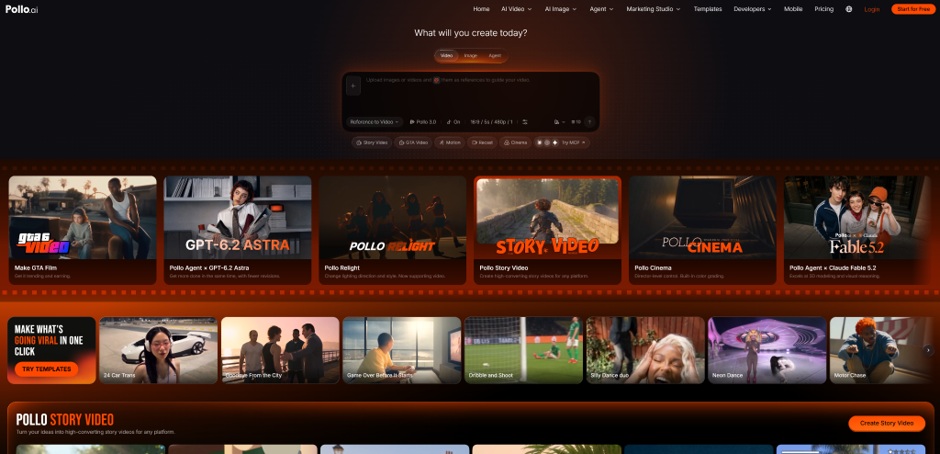
Pollo AI is a multi-model AI creative platform that gives users access to video generators from different providers. Its model selection includes Kling 4.0, Vidu Q4, Seedance 2.5, MiniMax H3, and Wan 3.0, covering different styles of motion, animation, and cinematic video.
Its AI Video Generator handles text-to-video and image-to-video creation. Other tools cover specific production tasks: Pollo Director helps organize scenes and characters, Pollo Cinema offers cinematic controls, and Pollo Recast lets users recreate existing videos with different characters.
The platform also includes applications for product videos and UGC ads, along with utilities for video enhancement and lip-sync. Pollo Agent and MCP integrations support more automated creative workflows.
The main appeal is having different generation models and production tools in one place. The trade-off is that each model has its own strengths, settings, and credit costs, so finding the right one takes some testing.
Vidu AI
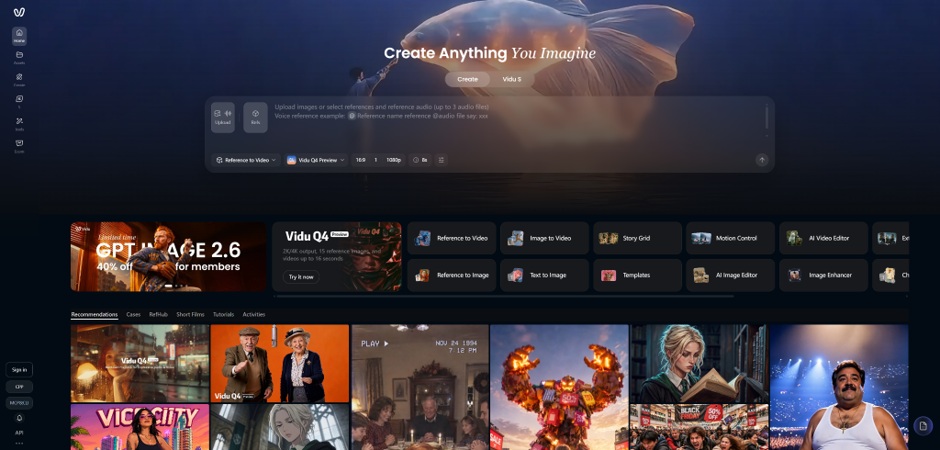
Developed by ShengShu Technology, Vidu AI focuses on its own family of video generation models. It supports text-to-video, image-to-video, and reference-to-video generation, with particular attention to keeping characters, objects, and environments consistent.
Its lineup includes Q2 Turbo and Pro, Q3 Turbo, Mix, Ad, and Drama, as well as Q4. Vidu Q4 supports up to 15 image references, three voice references, videos of up to 16 seconds, and output resolutions up to 4K.
Vidu is particularly relevant to creators making animated stories, recurring characters, and branded video series. Its focused model development provides a more dedicated generation experience, although users who need extensive editing or other generation engines may need additional software.
2. Pollo AI vs Vidu AI: Feature Comparison
|
Feature |
Pollo AI |
Vidu AI |
|
Text-to-video |
Yes |
Yes |
|
Image-to-video |
Yes |
Yes |
|
Reference-to-video |
Selected models |
Core capability |
|
Model selection |
Multiple providers |
Vidu model family |
|
Reference images |
Model-dependent |
Up to 15 on Q4 |
|
Audio generation |
Selected models |
Newer models |
|
Editing tools |
Enhancement, lip-sync, Recast, etc. |
Primarily generation-focused |
|
Automation |
Agent, API, MCP |
API, batch generation |
Pollo AI: Multiple Models and Production Tools
Pollo AI's biggest advantage is model choice. Creators can try Kling for realistic movement, Vidu for reference-based animation, or Seedance 2.5 for projects requiring extensive visual references.
Its specialized applications are useful for specific production tasks. An online seller can use Product Video to create promotional footage, while a social media manager can make UGC Video Ads or URL to Video Ads. Existing clips can also be improved with video enhancement tools.
Pollo Agent provides another option for creators working from scripts, briefs, URLs, and reference materials. API and MCP access are useful for teams connecting video generation to external applications.
The downside is that users need to understand which model and tool suits each job. More options do not automatically mean better results.
Vidu AI: Reference Control and Specialized Generation
Vidu focuses more directly on video generation. Its reference-to-video feature lets creators provide multiple images to guide characters, props, and backgrounds. For example, an animator can upload a character sheet and environment references before generating a scene.
Its Q3 lineup includes models for general creation, advertisements, and dialogue-driven videos. Q4 expands reference support to 15 images and three voice references, making it useful for projects that require consistent visual and audio elements.
Batch generation is also helpful when creators need several versions of the same scene.
However, Vidu is not a full editing suite. Users who need timeline adjustments, compositing, or extensive post-production will generally need another application.
One important detail: Vidu models are also available through Pollo AI. Creators can therefore access Vidu generation through Pollo AI while retaining the option to try other models.
3. Video Quality and Generation Performance
Pollo AI: Flexibility Across Different Models
Video quality on Pollo AI depends on the selected engine. This gives creators more room to experiment when a particular model struggles with a scene.
Kling can be considered for realistic movement, Vidu for reference-heavy animation, and MiniMax H3 or Seedance 2.5 for more elaborate multi-shot projects. Seedance 2.5 also supports up to 50 references and clips of up to 30 seconds.
This is useful for projects involving different types of footage. A product advertisement might need realistic object movement, while another shot calls for stylized character animation.
The catch is that models interpret prompts and references differently. Switching engines can improve a result, but it may also require rewriting prompts and spending credits on more attempts.
Vidu AI: Character Expressions and Reference Consistency
Vidu is particularly useful when the same character or object needs to remain recognizable across scenes.
Its Q3 reference-based generation has received positive feedback from creators working on animated series. In a Reddit discussion, a creator experimenting with Q3 praised its subtle facial movements, including eye and ear expressions. Other users have also noted that complex mechanical movements and realistic facial details can remain inconsistent.
Results vary between model generations, so newer does not necessarily mean better for every type of footage.
Q4 adds support for more image and voice references, along with synchronized audiovisual generation. This is useful for short narrative scenes where character appearance, voice, and scene changes need to work together. However, generated movement and audio still deserve a manual review before publication.
4. Workflow and Editing Experience
Pollo AI: From Generation to Post-Production
Pollo AI covers more than individual clip generation. A marketer can start with product images, create promotional footage, and refine it with available enhancement tools.
For narrative projects, Pollo Director helps organize scenes and characters, while Pollo Cinema provides cinematic controls. Pollo Recast offers another way to adapt existing video concepts with different subjects.
Pollo Agent, API, and MCP integrations are useful for teams automating repeated production tasks. Still, generated footage needs checking, especially when scene transitions, subtitles, and character details matter.
Vidu AI: A Direct Generation Workflow
Vidu keeps the process straightforward: select a model, provide a prompt or reference images, and generate a clip. Its specialized Q3 models help narrow the choice for advertisements, general video creation, and dialogue-driven scenes.
Batch generation is useful for testing different character movements or visual styles. Users can compare several outputs without creating every variation separately.
The limitation comes after generation. Vidu focuses on producing footage rather than providing a complete editing timeline. Creators assembling longer videos will generally need Premiere Pro, CapCut, or another editor for transitions, subtitles, and final cuts.
5. Pricing and User-Reported Drawbacks
Pollo AI: Multiple Models, Variable Credit Costs
Pollo AI offers three main paid plans: Lite at $15/month for 400 credits, Pro at $29/month for 800 credits, and Ultra at $129/month for 5,000 credits, based on annual billing. Credit consumption varies by model, duration, resolution, and output quantity. Unused subscription credits do not roll over.
Reddit users have reported confusion around promotional generation limits, subscription management, and finding older creations in the interface. These are individual complaints, but they are worth considering before subscribing.
Vidu AI: Lower Entry Price, but Watch Generation Costs
Vidu AI's monthly plans include Standard at $10 for 800 credits, Pro at $43 for 3,500 credits, and Ultimate at $230 for 20,000 credits. Annual billing reduces the effective monthly prices to approximately $8.25, $35.42, and $191.67, respectively.
Vidu also offers off-peak generation for eligible models. However, longer clips and higher resolutions consume more credits. Reddit users have reported long free-tier queues, strict content moderation, and occasional customer support issues. Repeated attempts to fix imperfect generations can also use up credits quickly.
Pricing note: Prices are in USD and reflect the published plans at the time of research. Promotions, regional taxes, and plan availability may change.
6. Which Platform Should Creators Choose?
Choose Pollo AI for Multi-Model Creation and Marketing Content
Pollo AI is a practical choice for creators who regularly switch between video formats. Marketers producing product demonstrations, UGC ads, and social clips can use dedicated applications instead of building every project through a general-purpose generator.
It also suits filmmakers and creative teams that want to compare different models. Access to Kling, Vidu, Seedance, and MiniMax makes it easier to test different approaches when a scene needs realistic motion, reference consistency, or multi-shot storytelling.
Developers may also prefer Pollo AI when API and MCP integrations are part of their workflow. The main consideration is credit consumption, particularly when using premium models repeatedly.
Choose Vidu AI for Character-Driven Stories and Reference-Based Videos
Vidu AI makes more sense for creators whose projects depend on recurring characters and recognizable visual elements. Anime creators, independent storytellers, and brands developing mascots can use multiple reference images to guide character appearance across different scenes.
Its newer models are also worth considering for projects that need facial expressions, dialogue, and synchronized audio. Batch generation helps when several versions of a scene are needed.
The trade-off is its narrower production scope. Users who need advanced editing, multiple unrelated generation models, or extensive post-production will probably need additional tools.
Final Verdict
Pollo AI and Vidu AI serve different creative priorities. Vidu focuses on reference-based generation, character consistency, and audiovisual storytelling. Pollo AI offers more model choices and a wider range of tools for creating and refining different types of video.
For character-driven animation and short narratives, Vidu is worth testing first. For marketing videos, mixed creative projects, and multi-model experimentation, Pollo AI offers more flexibility. The better choice is the one that produces more usable footage for the intended project without excessive retries or extra editing.