
A Look at the Hydraulic Systems in Robotics and Automation
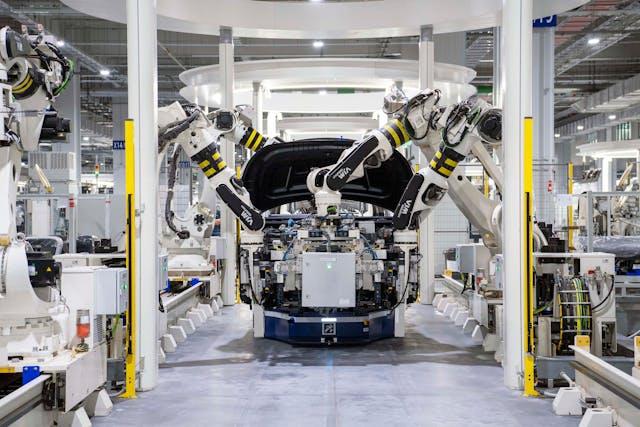
Hydraulics have long been an essential facet of industrial machinery, providing powerful and precise motion control. In robotics and automation, these systems are critical for enabling robots to perform heavy-duty tasks efficiently and accurately. Unlike electric or pneumatic systems, hydraulics are excellent in applications that demand high force, durability and smooth actuation.
From industrial robotic arms to construction and agricultural automation, hydraulic-powered robots are reshaping industries by offering unmatched power density and reliability. Explore the advantages, challenges and diverse applications enhancing automation.
How Hydraulics Systems Work in Robotics
Hydraulic systems in robotics operate on Pascal’s Law, which states that pressure applied to a confined fluid is transmitted equally in all directions. This principle allows such robots to generate immense force with minimal effort.
A hydraulic system consists of a pump, fluid reservoir, valve actuators like cylinders or motors, and hydraulic fluid. The pump pressurizes the fluid, sending it through hoses to actuators, which convert the pressure into mechanical movement. By controlling the flow of fluid using valves, a robot can execute precise movements, such as gripping objects or extending an arm.
Unlike electric or pneumatic systems, hydraulics are excellent for anything requiring high force and durability. This makes them ideal for heavy-duty robotics, such as those used in construction, underwater industries and industrial automation. Despite their power, hydraulic robots require careful design to manage leaks, heat buildup and system efficiency.
Advantages of Hydraulic Systems in Robotics
Hydraulic systems offer a myriad of advantages that make them perfect for robotics, particularly in heavy-duty situations:
- High power-to-weight ratio: Hydraulics can generate immense force without requiring bulky components. This makes them perfect for robots that need to lift heavy loads or operate in demanding environments.
- Precision and smooth motion: By regulating fluid flow, hydraulic robots achieve controlled, smooth movements. This is essential for tasks requiring accuracy, such as robotic arms in manufacturing or surgery.
- Consistent force output: Hydraulic systems provide steady force, regardless of speed changes. This is useful for robots that must maintain constant pressure, like those used in metal forming or industrial pressing.
- Quick response time: With the right valve control, hydraulic robots can react swiftly, making them suitable for emergency response, military applications and high-speed automation.
Challenges and Limitations
While hydraulic systems offer unmatched power and durability, they also come with challenges that can limit their use in certain robotic applications:
- Complexity and maintenance: Hydraulic systems require pumps, valves, reservoirs and intricate tubing, making them more complex than electric or pneumatic systems. Regular maintenance is necessary to prevent leaks and ensure smooth operation.
- Potential for fluid leaks: Hydraulic robots rely on pressurized fluid, which can leak over time. Leaks not only reduce efficiency but can also create safety and environmental concerns, especially in sensitive industries like health care and food processing.
- Heat generation: The movement of hydraulic fluid generates heat, which can cause it to thicken and reduce the machine’s cooling even further. This may require additional cooling mechanisms, adding to the system’s complexity.
- Energy inefficiency: Compared to electric systems, hydraulic robots can be less energy-efficient due to fluid resistance and energy loss through heat dissipation. This makes them less ideal for applications where power conservation is a priority.
- Size and weight considerations: Hydraulic components such as pumps and fluid reservoirs can be bulky and heavy. This can be a drawback in mobile robotics or applications requiring lightweight, compact designs.
- Noise levels: Hydraulic pumps and actuators can be noisy, which may be an issue in environments where quiet operation is essential, such as hospitals or research labs.
Applications of Hydraulic Robotics in Automation
Hydraulic robots are essential in automation, where high power and durability are required. The first was used for spot welding and die casting at a General Motors plant in the 1960s. In construction and demolition, they operate heavy machinery for lifting and breaking down materials. Agriculture benefits from hydraulic robots in automated harvesting and irrigation.
They are also used in mining and drilling, where they handle rock breaking and material transport in hazardous conditions. Additionally, rescue operations rely on hydraulic robots to clear debris, and military applications use them for bomb disposal and heavy transport. Their strength and reliability make them invaluable in demanding industries.
The Unsung Muscle of Modern Robotics
Hydraulic systems play an essential part in robotics, offering unmatched power, durability and precision in demanding applications. While they come with challenges like maintenance and inefficiency, their advantages often outweigh these drawbacks in sectors requiring high-force operations. From manufacturing to rescue missions, hydraulic robots continue to push the boundaries of automation, proving that sometimes, raw power is the key to innovation.