
How Can I Accept Crypto Payments Online: Mechanics, Integration, and Settlement

Image Source: depositphotos.com
Accepting crypto payments online starts with choosing a cryptocurrencies payment solution, but implementation is not a single decision. It is a pipeline: a customer selects a coin, the transaction is broadcast, confirmations accumulate, funds settle, and the merchant either holds the asset or converts it. Each stage assigns control of the money to a different party, and the choice of gateway model decides which of those stages land on the merchant's team.
This guide walks the full pipeline rather than stopping at the checkout. It covers the mechanics of a crypto payment, the difference between custodial and non-custodial models, the integration paths available to an existing stack, and the settlement and payout operations that follow the first successful transaction.
Fee levels, settlement timing, confirmation thresholds, licensing, and volume limits are not fixed in this article. Where those figures matter, they are marked for human review rather than estimated.
What Happens Between Checkout and Settlement
The mechanics of a crypto payment are usually compressed into one sentence, which is why the operational consequences surprise merchants later. The pipeline has distinct stages, and each one hands control of the funds to a different party.
The payment flow from invoice to confirmation
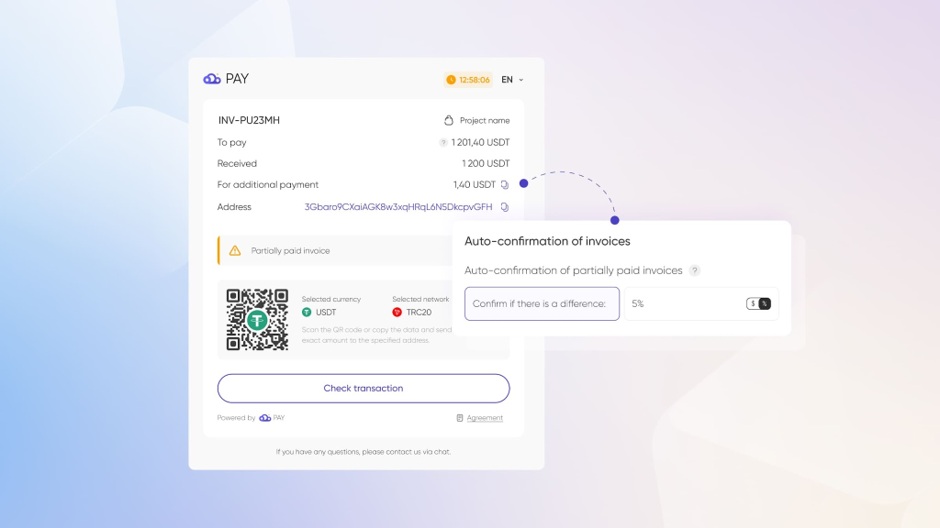
When a customer selects crypto at checkout, the gateway generates a payment address and an invoice with an amount denominated in the chosen currency. The customer sends the transaction from their wallet. That transaction enters the mempool of the relevant blockchain network, where it waits for miners or validators to include it in a block.
Once included, the transaction receives its first confirmation. Additional blocks added on top of that block increase the confirmation count. The merchant's gateway monitors the blockchain and marks the payment as complete when the configured confirmation threshold is reached. Until that threshold, the funds are visible but not yet considered settled.
The address that receives the payment can belong to the merchant directly, or it can belong to the gateway provider. That distinction defines whether the model is non-custodial or custodial.
Custodial and non-custodial models
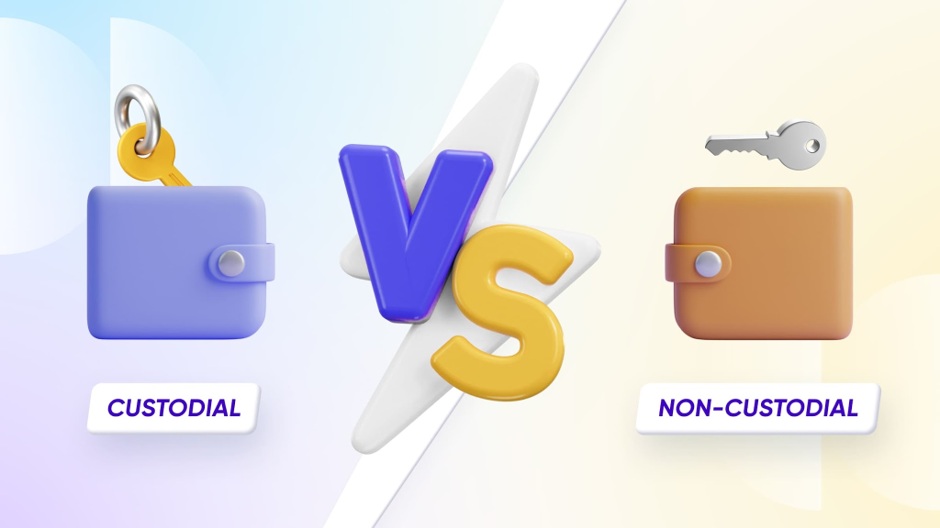
In a non-custodial model, the gateway generates a unique address for each invoice, but the private key controlling that address belongs to the merchant. The gateway monitors the blockchain and reports the payment status, but it never holds the funds. The merchant is responsible for securing the keys, managing wallet infrastructure, and handling withdrawals.
In a custodial model, the gateway generates the address and holds the private key. The funds land in the provider's wallet infrastructure. The merchant sees a balance in their personal account and can withdraw on demand or according to a schedule. The provider handles key security, blockchain monitoring, and liquidity management. The trade-off is operational simplicity against counterparty risk.
Most enterprise operations choose custodial models because the alternative requires maintaining hot and cold wallet infrastructure, monitoring multiple blockchains, and staffing security protocols. The custodial provider absorbs that operational cost in exchange for holding the funds temporarily.
Why confirmation counts change the risk profile
A transaction with zero confirmations is visible on the network but not yet irreversible. A double-spend attack or a chain reorganization can invalidate it. The probability of reversal drops exponentially with each additional block, which is why gateways require multiple confirmations before marking a payment as final.
The required count varies by blockchain. Bitcoin transactions typically require three to six confirmations for high-value settlements. Ethereum transactions settle faster due to shorter block times, but the principle is the same. Stablecoin transfers on networks with faster finality can settle in seconds rather than minutes.
The confirmation threshold is a risk parameter. Setting it too low exposes the merchant to reversal risk. Setting it too high delays settlement and degrades the customer experience. The gateway's default thresholds reflect the provider's risk tolerance, not necessarily the merchant's.
Choosing a Gateway Model
Once the pipeline is clear, the next question is whether a gateway is needed at all. A published wallet address works for a single-coin, low-volume operation; it does not scale to multi-currency checkout with reconciliation.
When a published wallet address is enough
A merchant accepting only Bitcoin and processing fewer than ten payments per day can publish a static address and monitor it manually. The customer sends the payment, the merchant checks the blockchain explorer, and the transaction is matched to an order by amount and timestamp. No API, no interface, no monthly fee.
This approach breaks down as soon as the merchant adds a second currency or processes enough volume that manual reconciliation becomes a bottleneck. It also breaks down when the merchant needs to issue refunds, track partial payments, or generate invoices with expiration windows. At that point, the gateway becomes infrastructure rather than overhead.
What to evaluate beyond the feature list
Gateway comparisons often focus on the number of supported currencies and the presence of an API. Those are prerequisites, not differentiators. The evaluation should focus on how the gateway handles the stages that follow the first successful payment: settlement timing, payout logic, conversion options, and the operational burden of withdrawals.
A gateway that supports 50 currencies but requires manual withdrawal approval for each one shifts the operational cost back onto the merchant. A gateway that auto converts incoming payments into stablecoins removes volatility risk at the moment of receipt. A gateway that allows scheduled or threshold-based withdrawals eliminates the need for a human to monitor balances daily.
The feature list tells you what the gateway can do. The settlement and payout configuration tells you how much of your team's time it will consume.
Currency coverage and payout logic
Currency coverage matters when the merchant's customer base is geographically distributed or when specific coins dominate a niche. A marketplace serving Latin America needs to support the coins its users already hold. An enterprise serving institutional clients needs to support the stablecoins those clients prefer for settlement.
Payout logic matters when the merchant needs to send funds to partners, suppliers, or users. A gateway that handles bulk payouts via API allows the merchant to submit a list of recipients and amounts in a single call. A gateway that requires individual withdrawal requests for each payout turns a five-minute task into an hour-long process.
Integration Paths
Integration is where the model becomes concrete. The available paths differ in how much of the checkout the merchant controls and how much the provider hosts.
API, widget, Host2Host, and CMS plugins
An API integration gives the merchant full control over the checkout interface. The merchant's backend calls the gateway's API to generate an invoice, the customer completes the payment, and the gateway sends a webhook notification when the payment is confirmed. This path requires backend development but allows the merchant to customize every element of the payment flow.
An HTML widget is a hosted checkout that the merchant embeds in their page. The widget handles currency selection, address generation, QR code display, and payment monitoring. The merchant configures the widget through the gateway's interface and receives a snippet of JavaScript to paste into their site.
Host2Host is a server-to-server integration used by platforms that already have a payment orchestration layer. The merchant's backend communicates directly with the gateway's backend, bypassing any hosted interface. This path is common in enterprise environments where the payment flow must remain entirely within the merchant's infrastructure.
CMS plugins are pre-built integrations for platforms like WooCommerce, Shopify, or Magento. The merchant installs the plugin, enters their API credentials, and the checkout is functional. This path works when the merchant's stack is standard and the plugin covers their use case.
The onboarding sequence
Onboarding typically follows a four-step sequence. The merchant signs up with an email address and a communication channel, usually Telegram or a support ticket system. The merchant creates a project by filling out a form with company information, expected volume, and the currencies they want to accept. The merchant integrates using one of the paths described above. The merchant tests the integration by making a trial payment, which the gateway processes in a sandbox environment before going live.
The sequence is designed to be completed in under an hour for standard use cases. Enterprise accounts with custom requirements may require additional steps, including contract negotiation, dedicated infrastructure provisioning, and compliance review.
What has to be built in-house
The merchant always builds the logic that maps a payment to an order. The gateway provides a transaction ID and a webhook notification, but it does not know which order in the merchant's database corresponds to that transaction. The merchant's backend must store the transaction ID when the invoice is generated and match it to the order when the webhook arrives.
The merchant also builds the reconciliation logic if they need to track partial payments, overpayments, or refunds. The gateway reports what happened on the blockchain. The merchant decides what that means for the order status.
Settlement and Payout Operations
The first payment landing is not the end of the pipeline. Settlement and payouts are where most guides stop and where the operational cost of a crypto stack actually accumulates.
Auto conversion into stablecoins
A merchant that holds Bitcoin or Ethereum between receipt and withdrawal is exposed to price volatility. A payment received at a certain Bitcoin price may be worth less by the time the merchant withdraws it. Auto conversion removes that risk by converting the incoming payment into a stablecoin at the moment of confirmation.
The conversion happens on the gateway's side, using the provider's liquidity. The merchant sees the stablecoin balance in their personal account and withdraws it when needed. The exchange rate is locked at the time of conversion, not at the time of withdrawal.
Scheduled and threshold-based withdrawals
Manual withdrawals require a human to log into the interface, check the balance, and initiate a transfer. That process works for a merchant processing ten payments per month. It does not work for a merchant processing ten payments per hour.
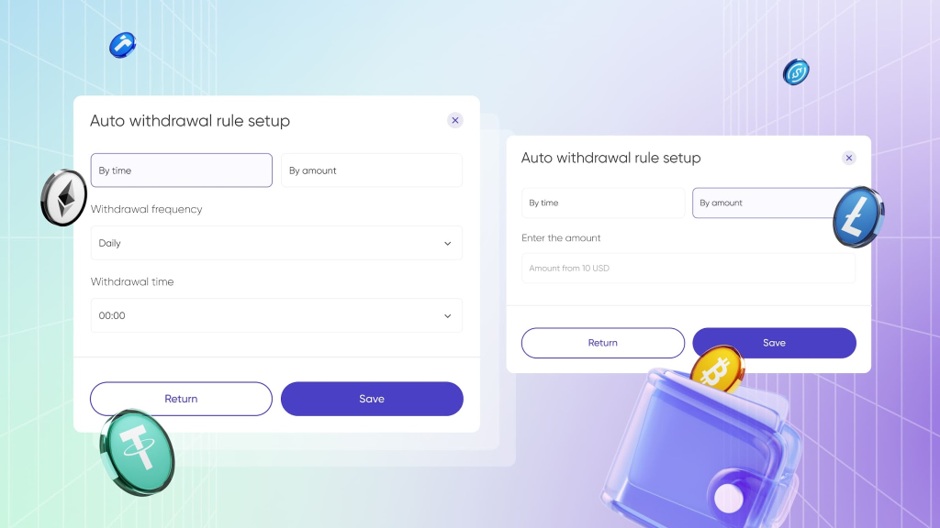
Scheduled withdrawals move funds to the merchant's external wallet on a fixed cadence: daily, weekly, or monthly. Threshold-based withdrawals trigger automatically when the account balance reaches a configured amount. Both options eliminate the need for manual monitoring and reduce the operational cost of running a crypto payment stack.
Bulk payouts via API
A marketplace that pays out to hundreds of sellers or a platform that distributes rewards to users cannot process each payout individually. Bulk payouts via API allow the merchant to submit a list of recipients and amounts in a single call. The gateway processes the list, sends the transactions, and returns a status report.
This feature is standard in enterprise gateways and rare in consumer-focused wallets. It is the difference between a payment tool and a payment infrastructure.
White-label flow
A white-label solution allows the merchant to present the payment flow under their own brand rather than the gateway's. The checkout page, the invoice, the confirmation email, and the receipt all carry the merchant's logo and domain. The customer never sees the gateway's name.
This feature matters when the merchant's brand is the primary trust signal or when the merchant operates in a regulated environment where third-party branding creates compliance friction.
Connecting Trybit
The capabilities described above map onto a specific set of tools. Trybit is a cryptocurrency processing platform that works with popular coins, offers a convenient interface, and supports a range of useful features — from automatic AML checks to automatic payment conversion.
Onboarding steps
- Sign up. You will need an email address and a Telegram account for communication.
- Create a project. Fill out a form with information about your company, expected volume, and the currencies you want to accept.
- Integrate. Choose from API, HTML widget, Host2Host, or ready-made CMS plugins depending on your stack.
- Test it. The system will prompt you to make a trial payment in a sandbox environment before going live.
What the platform provides
Trybit supports 40+ cryptocurrencies and has maintained 99.9% uptime over five years of operation. The platform includes auto conversion of incoming payments into stablecoins, scheduled and threshold-based withdrawals, bulk payouts via API, and white-label checkout flow. Fee configuration is flexible and adapts to the merchant's business model. Dedicated support is available for setup, scaling, and daily operations.
The platform is built for enterprise business and designed for stable round-the-clock operation without downtime. It is used by fintech companies, marketplaces, and services that require mass payout capabilities.
Accepting Crypto Is a Checkout Decision; Operating It Is an Infrastructure Decision
The checkout is the visible half of accepting crypto payments online. The settlement and payout layer is where the merchant's operating cost is decided. A gateway that stops at the checkout leaves the merchant to build withdrawal logic, manage volatility risk, and process payouts manually. A gateway that extends into settlement and operations absorbs those tasks and turns crypto payments into infrastructure rather than a project. The choice between the two is not about features. It is about how much of the pipeline the merchant wants to own.
FAQ (Frequently Asked Questions)
Do I need a gateway to accept crypto payments, or can I use a wallet address?
A published wallet address works for single-coin, low-volume operations where manual reconciliation is feasible. A gateway becomes necessary when you accept multiple currencies, process enough volume that manual matching becomes a bottleneck, or need automated invoicing, refunds, and payout logic.
What is the difference between custodial and non-custodial gateways?
In a non-custodial model, the merchant holds the private keys and the gateway only monitors the blockchain. In a custodial model, the gateway holds the keys and the funds, and the merchant withdraws from a balance. Custodial models reduce operational burden but introduce counterparty risk. Non-custodial models eliminate that risk but require the merchant to manage wallet infrastructure.
How does auto conversion protect against volatility?
Auto conversion exchanges the incoming cryptocurrency into a stablecoin at the moment the payment is confirmed. The exchange rate is locked at that point, so the merchant's revenue is predictable in fiat-equivalent terms even if the original asset's price moves before withdrawal.
What are bulk payouts, and when do I need them?
Bulk payouts allow you to submit a list of recipients and amounts in a single API call. The gateway processes the list and sends the transactions. This feature is necessary when you pay out to dozens or hundreds of parties regularly, such as marketplace sellers, affiliate partners, or reward recipients.
Can I customize the checkout to match my brand?
White-label solutions allow you to present the payment flow under your own branding. The checkout page, invoice, and confirmation messages carry your logo and domain. The customer does not see the gateway's name. This feature is standard in enterprise gateways and optional in consumer-focused tools.