
Buyer's Guide to Contract Lifecycle Management Software Platforms in 2026

Image Source: depositphotos.com
About a third of breaches at growth-stage companies trace back to a third party, and most of those third parties came through a contract somebody signed and forgot. That gap, between the agreement and the risk behind it, is where contract lifecycle management software earns or loses its keep in 2026. The platforms that win this year keep working after the filing. Their AI monitors the vendor behind each contract for financial trouble, cyber exposure, and compliance drift, long after the ink dries.
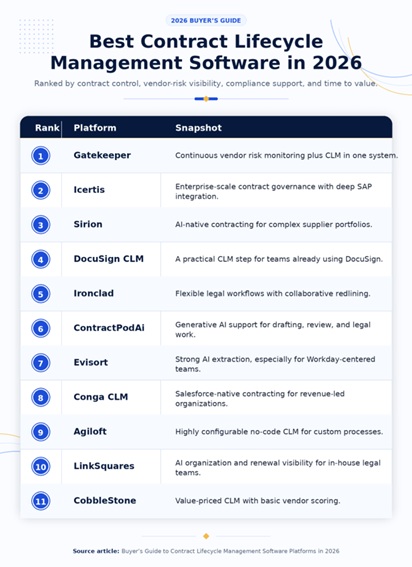
This guide ranks eleven contract lifecycle management software platforms with that lens. First a quick grounding in what these tools do and who they fit, then the ranked list with capabilities and limits for each, and a decision framework to narrow your shortlist.
What is contract lifecycle management software?
Contract lifecycle management software, or CLM, manages an agreement from the first request through drafting, negotiation, signature, storage, and renewal. The category grew out of simple repositories, and the modern versions add AI that reads, classifies, and monitors contracts so a small team can govern a large book of agreements.
Why contract lifecycle management software matters in 2026
The cost of a blind spot keeps rising. A missed renewal drains budget, a non-compliant vendor invites fines, and an audit with no trail burns weeks of staff time. Regulations like DORA in EU financial services raise the stakes further by holding companies responsible for their third parties. A CLM that ties the contract to the vendor's risk turns those blind spots into alerts you act on before they cost money.
Tailoring contract lifecycle management software to your team
High-growth teams care most about speed and low setup friction, so they favor tools that go live in weeks and don't need a dedicated admin. Mid-market organizations, the sweet spot for most buyers, want contract, vendor, and compliance management in one system without paying for enterprise complexity. Enterprises with global portfolios prioritize governance, scale, and deep ERP ties, and they accept longer rollouts to get them. Keep your own profile in mind as you read the list.
The 11 best contract lifecycle management software platforms, ranked
1. Gatekeeper
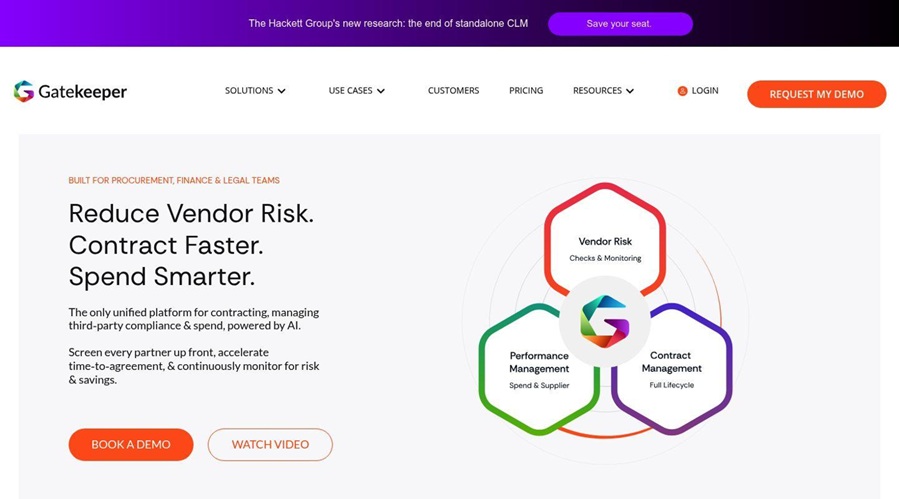
Gatekeeper ranks first because its AI keeps working after signature, monitoring the third party behind every contract. The Gatekeeper platform runs framework-specific LuminIQ reviewer agents, a DORA Reviewer for financial-services resilience, a SOC 2 Reviewer, an ISO 27001 Reviewer, and an ESG Assessment Reviewer, while Market IQ scans financial, cyber, and regulatory sources around the clock. Customers report up to 90% faster third-party onboarding and compliance checks and more than 400 hours saved per audit cycle.
Capabilities:
- Compliance reviewer agents mapped to DORA, SOC 2, ISO 27001, and ESG
- Market IQ 24/7 monitoring of vendor financial and cyber health
- Contract, vendor risk, and spend in a single record, with an audit-ready trail
Limitations:
- Pricing comes through a demo, not a public page
- A team that only wants a legal repository will leave much of the platform unused
Pricing: Quote-based, with unlimited users and storage; a Gatekeeper demo sizes the number to your vendor count.
2. Icertis
Icertis serves global enterprises that need governance at scale, with SAP endorsement and the analytics to track whether contract terms deliver on their intent.
Capabilities:
- Buy-side and sell-side contract management
- Negotiation playbooks and Intent Realization tracking
- Deep SAP and enterprise integration
Limitations:
- Reviewers describe a rollout that runs long and into six figures
- The interface feels dated, and the platform carries no native vendor risk or spend module
Pricing: Enterprise quote.
3. Sirion
Sirion brings AI-native contracting to enterprises with sprawling supplier portfolios, and it holds the highest user rating in the category.
Capabilities:
- Extraction, redlining, and issue-detection agents
- AskSirion natural-language queries
- Obligation tracking built for scale
Limitations:
- Reviewers cite a long road to first value
- The premium price suits enterprises, not teams wanting basic lifecycle management, and vendor risk lives outside the product
Pricing: Enterprise quote.
4. DocuSign CLM
DocuSign CLM extends the signature product almost every counterparty recognizes into lifecycle management, a sensible default for DocuSign-standardized teams.
Capabilities:
- Industry-leading eSignature
- Workflow routing and a clause library
- A broad connector ecosystem
Limitations:
- Reviewers find the interface dated and CLM rollouts slow
- Compliance monitoring of vendors sits outside its scope
Pricing: eSignature from about $10-25/user/month; CLM on a separate enterprise quote.
5. Ironclad
Ironclad gives legal operations a flexible workflow engine and collaborative redlining inside the editors lawyers already use.
Capabilities:
- Drag-and-drop Workflow Designer
- Two-way Microsoft and Google docs editing
- AI redlining with amendment tracking
Limitations:
- No concept of multiple entities, and admin access is all-or-nothing through one full-admin role
- Per-workflow pricing climbs, and the platform tracks no vendor risk or spend
Pricing: Quote-based, about $80,000/year for 100 licenses plus per-workflow fees.
6. ContractPodAi
ContractPodAi, now built around its generative AI "Leah," targets legal teams investing in AI for drafting and review.
Capabilities:
- Generative AI for legal contract work
- A robust repository with advanced analytics
- A vendor negotiation portal
Limitations:
- Loading lags, and reviewers find reporting and search limited
- It works with Adobe Sign but skips DocuSign, and there's no supplier management
Pricing: Enterprise quote, reported around $55,000-75,000/year, priced per user.
7. Evisort
Evisort, now part of Workday, leads on AI term extraction and fits enterprises standardized on Workday for finance and procurement.
Capabilities:
- Best-in-class AI extraction and Ask AI queries
- Bulk ingestion with auto-tagging
- A unified data model inside Workday
Limitations:
- Best value depends on living in the Workday ecosystem
- Reviewers note OCR accuracy gaps, and there's no dedicated vendor-risk module
Pricing: Enterprise quote within Workday; reported around $30,000-40,000/year for 11-20 users.
8. Conga CLM
Conga keeps contracting close to the deal for revenue teams that run on Salesforce.
Capabilities:
- Salesforce-native contracting
- Mature document generation
- Strong reporting
Limitations:
- Reviewers cite a limited workflow engine and no native Word redlining
- Gartner flagged a customer-experience caution, and vendor risk falls outside the tool
Pricing: From about $40/user/month; mid-market deals in the $40k-60k/year range.
9. Agiloft
Agiloft is the no-code specialist, bending to processes other tools can't accommodate.
Capabilities:
- A configurable no-code engine
- Out-of-the-box multi-language support
- Clause libraries and redlining
Limitations:
- Onboarding runs long for new admins, and the interface feels dated
- Getting an agreement to a vendor still means exporting it by hand, and risk monitoring sits outside the product
Pricing: Entry around $12,000/year, with possible setup fees.
10. LinkSquares
LinkSquares uses AI to organize in-house legal backlogs, tagging contracts on upload and surfacing renewals in a calendar view.
Capabilities:
- Auto-tagging on ingest
- A clause library with suggested language
- Reporting dashboards
Limitations:
- Search and eSignature lag rivals, and the Salesforce sync runs in one direction only
- The focus stays on legal, with no vendor risk or spend coverage
Pricing: Quote-based, entry around $20,000/year and often discounted.
11. CobbleStone
CobbleStone gives procurement teams a value-priced platform that, unusual here, includes basic vendor scoring alongside contracts.
Capabilities:
- VISDOM AI analytics and a structured repository
- Drafting inside Google Docs
- An approved-vendor list with scoring
Limitations:
- Reviewers describe a clunky interface with a learning curve
- Third-party risk reports bill per pull, and the tool has no spend module
Pricing: Tracks headcount, near $10,300/year for 6 users and about $15,000/year for 12.
How to choose the right contract lifecycle management software
Work through four questions in order. First, what regulations bind your vendors? If DORA, SOC 2, or ISO 27001 apply, prioritize a platform whose AI checks for them, since retrofitting that later is painful. Second, do you need to govern the vendor and the spend, or only the document? That answer rules tools in or out fast. Third, what's your realistic time to value, given the team and budget you have today? Fourth, what does the all-in cost look like once users, e-signature, and implementation are counted? Score each finalist against those four and the shortlist tends to settle itself.
The best contract lifecycle management software for 2026
The right pick tracks to your profile. Global enterprises will weigh Icertis, Sirion, and Evisort for scale and governance. Salesforce-driven and legal-first teams have fits in Conga, Ironclad, and LinkSquares. Gatekeeper earns the top rank because it closes the gap this guide opened with: its AI keeps reviewing after signature and monitors the vendor for risk and the budget for leakage. For any team accountable for third-party compliance, that ongoing intelligence separates the best contract lifecycle management software from a passive archive.
Frequently asked questions
How much does contract lifecycle management software cost?
Pricing spans a wide band. Entry platforms start near $12,000 a year, mid-tier tools land in the tens of thousands, and enterprise suites like Icertis reach six figures once implementation is counted. Vendors like Gatekeeper that keep pricing private size it to your vendor and contract counts, sometimes with unlimited users included.
How does contract lifecycle management software help with third-party and DORA compliance?
The stronger platforms map AI agents to specific frameworks and monitor vendors for drift. Gatekeeper runs a DORA Reviewer plus SOC 2 and ISO 27001 reviewers, and its Market IQ watches vendor financial and cyber health around the clock, which is how teams cut audit prep and catch issues early.
What's the difference between CLM and contract management software?
The terms overlap. Contract management often describes the core repository and signature workflow, while contract lifecycle management covers the full span from request to renewal with more automation. In practice, the strongest platforms deliver both and add vendor risk and spend on top, so the label matters less than the feature set.
Can contract lifecycle management software manage vendor risk?
Most can't on their own, which surprises buyers. Of the tools here, only a couple touch vendor risk at all. Gatekeeper is built for it, scoring vendors and monitoring them around the clock rather than treating risk as an afterthought.
What should enterprises look for in contract lifecycle management software?
Scale, governance, and integration depth come first, but the sharper question is whether the platform governs the third party behind each contract. Enterprises now want one system for contracts, risk, and spend, so weigh whether a finalist unifies that data or just stores documents.
Template: https://drata.com/blog/best-grc-tools-2025 Builder: v.0.1 Keyword: best contract lifecycle management software Client: Gatekeeper Campaign: 2026-06-usa Date: 2026-06-15 Notes: Draft 04 of 4. 11 items. Drata template structure (educational intro + why-it-matters + buyer-persona segmentation + ranked list with Capabilities/Limitations/Pricing + decision framework + FAQ). Hook: stat (third-party breaches/spend leakage). AI facet: LuminIQ compliance/risk reviewer agents (DORA, SOC 2, ISO 27001, ESG) + Market IQ continuous monitoring. Competitor order: GK, Icertis, Sirion, DocuSign, Ironclad, ContractPodAi, Evisort, Conga, Agiloft, LinkSquares, CobbleStone.