
Trailer Asset Tracking: What Fleet Teams Need Before Equipment Goes Missing

Image Source: depositphotos.com
There is a question every fleet or operations manager eventually hears:
“Do you know where that trailer is?”
Sometimes the answer takes thirty seconds. Someone remembers where it was dropped, dispatch checks with a driver, or a supervisor spots it in another part of the yard.
Sometimes nobody knows.
The trailer left one location yesterday. A skid steer was moved between jobsites. A generator was supposed to come back with a crew. A piece of equipment was loaned to another team and never made it onto the spreadsheet.
And occasionally, the asset was not moved by anyone who was supposed to move it.
That is the problem with managing trailers and mobile equipment: the trucks are usually easy to see. The assets attached to them—or left behind when the truck moves on—are where the blind spots start.
For construction companies, logistics operators, service fleets, rental businesses and companies managing expensive mobile equipment, asset tracking is increasingly less about putting dots on a map and more about answering a much more useful question:
Is this asset where it is supposed to be right now?
The Most Expensive Blind Spot May Be the Asset Without a Driver
Most fleet managers are already familiar with vehicle GPS tracking.
A truck has a driver. It follows routes. It starts and stops regularly. Dispatch knows where it is supposed to be.
Trailers and equipment do not play by those rules.
A trailer may sit disconnected for days. Construction equipment might remain at a remote jobsite overnight. A generator can move between crews without anyone in the office hearing about it. Fleet equipment may be staged in one yard on Monday and needed somewhere completely different by Wednesday.
Consider a contractor running 15 work trucks, eight trailers, several skid steers, a couple of excavators, generators and portable equipment across five active jobsites.
Tracking only the trucks solves part of the visibility problem.
It does not answer where everything else went.
That distinction matters because a business can have excellent vehicle visibility while still wasting hours every week trying to locate equipment it already owns.
It is also where equipment tracking, trailer tracking and broader GPS asset tracking start becoming useful operational tools instead of nice-to-have technology.
Good Trailer Asset Tracking Should Not Require Someone to Watch a Map All Day
A live map is useful.
A system that requires an operations manager to keep that map open all day is not.
The better approach to trailer asset tracking is to use location and movement data to identify the exceptions that actually require attention.
Maybe a trailer leaves a yard at 11:40 p.m.
Maybe a piece of construction equipment moves outside the jobsite where it was assigned.
Maybe a trailer that should be staged at a customer's facility suddenly starts traveling in the opposite direction.
Those events are more important than watching an icon sit in the same parking lot for eight hours.
For a company managing dozens—or hundreds—of assets, the operating principle should be simple:
Do not make people monitor everything. Make the abnormal activity obvious.
That is where GPS tracking becomes genuinely useful to a fleet team.
The technology is not there to create another dashboard somebody has to babysit. It should help dispatchers, fleet managers and operations leaders focus on the handful of events that deserve a decision.
Geofencing Makes Location Data Actionable
This is where geofencing earns its place in the conversation.
A geofence is a virtual boundary around a real location.
For a commercial operation, that might mean drawing boundaries around:
- an equipment yard;
- a construction site;
- a warehouse;
- a terminal;
- a customer facility;
- a distribution center;
- a storage lot; or
- another approved operating area.
Suppose a trailer is supposed to stay inside a company yard until 6:00 a.m.
Without geofencing, somebody may discover at the start of the morning shift that it is gone.
With geofencing and movement monitoring in place, the important event is no longer simply where the trailer eventually ends up.
It is when the trailer crossed the boundary.
That difference can matter.
The value of asset visibility is often not the final GPS coordinate. It is reducing the time between unexpected movement and somebody realizing that movement happened.
The same principle applies to construction equipment.
If a machine should remain on a jobsite all weekend, an unexpected location change deserves attention regardless of whether the explanation eventually turns out to be legitimate.
Trailer Theft Is Also a Timing Problem
Locks matter.
Gates matter.
Lighting matters.
Cameras matter.
Good yard procedures matter.
GPS tracking does not replace any of them.
But every physical security measure has one obvious limitation: eventually, the property line ends.
If a trailer gets past the gate, the business needs another way to maintain visibility.
That is why trailer theft is not only a physical-security problem. It is also an information problem.
When unauthorized movement is suspected, an operations team needs answers quickly:
- When did the trailer begin moving?
- Where was it last located?
- Is it still moving?
- Did it leave an approved location?
- What direction did it travel?
- Does the movement match any scheduled job or dispatch activity?
The same applies to equipment theft.
A skid steer, generator, compressor or other valuable asset can be difficult to protect once it is sitting miles from the main office.
Knowing about unexpected movement earlier does not eliminate theft risk.
It does eliminate some of the uncertainty.
And in security situations, uncertainty costs time.
Caption:
Real-time visibility becomes more useful when fleet teams can identify unexpected movement instead of manually watching every asset.
Construction Equipment Creates a Different Kind of Visibility Problem
Construction operations make the problem even more obvious.
Equipment moves constantly.
A machine finishes one project and gets transported to another. A generator goes with a crew. A trailer is staged overnight. Rental equipment gets mixed in with company-owned assets. Smaller machines get shared between teams.
And sooner or later somebody asks:
“Who has it?”
That is not always a security problem.
Sometimes it is simply poor asset visibility.
Without reliable equipment tracking, businesses often fall back on a combination of spreadsheets, calls, text messages and memory.
“I think Chris moved it.”
“Didn't that go to the north job?”
“Check with the other superintendent.”
Those conversations are normal in field operations, but they are also expensive when they happen repeatedly.
GPS equipment tracking can give teams a clearer starting point.
Instead of calling three people to work out where a machine was last seen, an operations manager can use location information to determine which site it is actually sitting at.
That can affect more than security.
Suppose another project needs a skid steer tomorrow.
The fastest response may be to call the rental company and get another unit delivered.
But what if the business already owns one that has been sitting unused at another site for four days?
Better equipment tracking can help answer that before another rental hits the P&L.
That is where asset security and utilization begin to overlap.
The same location data that helps locate equipment after unexpected movement can also help a company make better use of the equipment it already owns.
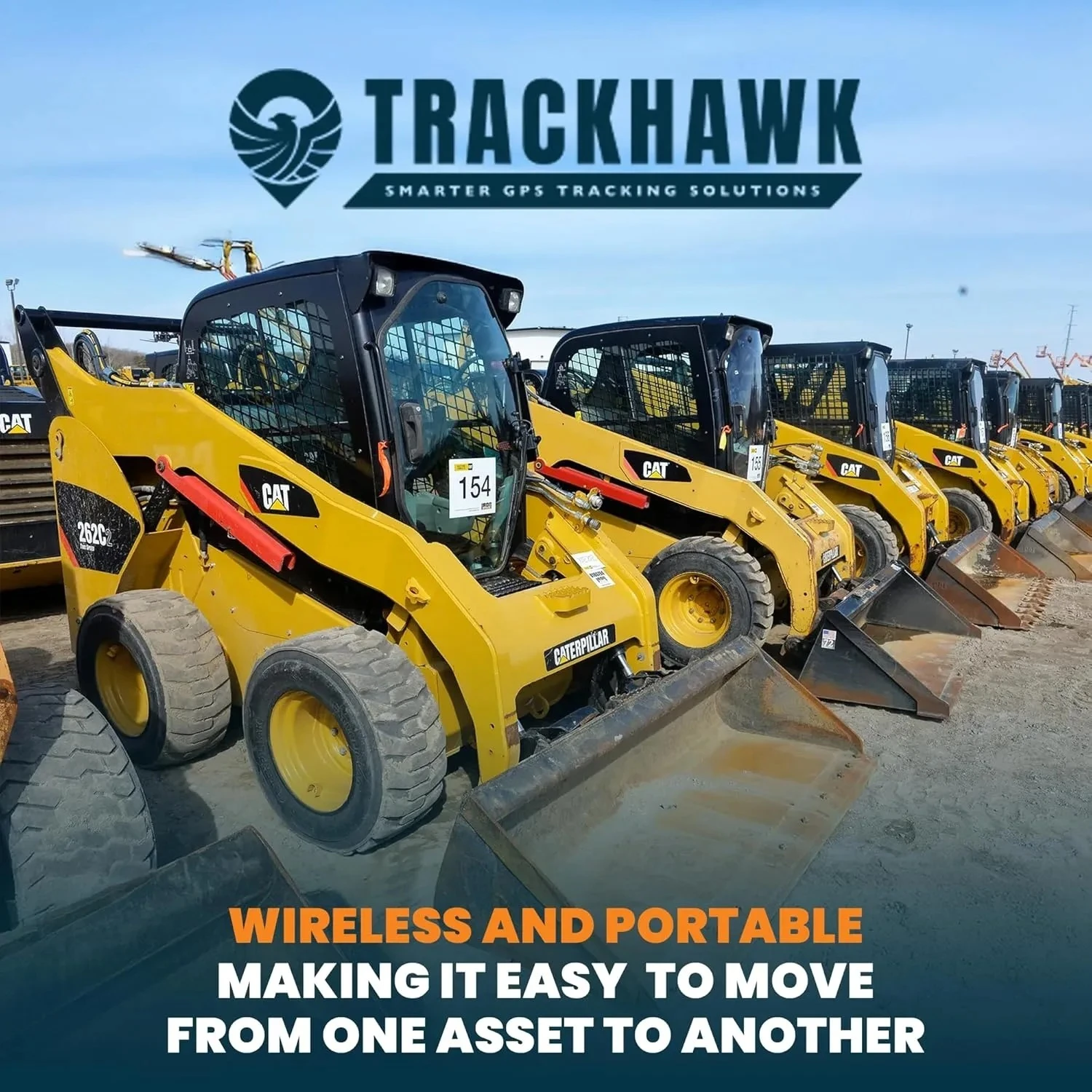
Caption:
Construction fleets often have equipment spread across several jobsites, making location visibility useful for both security and utilization.
A GPS Coordinate Is Not the Outcome
Operations teams do not need more data simply because more data is available.
They need information that leads to a decision.
That is an important distinction.
Here is what that looks like in practice:
|
Operational Problem |
Useful Tracking Information |
Possible Response |
|
Trailer leaves the yard unexpectedly |
Geofence departure or movement event |
Verify dispatch or investigate |
|
Equipment cannot be located |
Current or recent GPS location |
Direct the crew to the correct site |
|
Asset moves between jobsites |
Location history |
Confirm transfer and update assignment |
|
Trailer moves after hours |
Unexpected movement |
Verify authorization |
|
Equipment appears underused |
Location and activity patterns |
Check utilization before renting more equipment |
|
Cargo trailer leaves an approved location |
Geofence departure |
Validate movement with logistics or dispatch |
This is what separates useful asset tracking from simply collecting coordinates.
A fleet does not become more efficient because somebody can see 40 pins on a map.
It becomes more efficient when those pins answer questions the operation would otherwise spend time, money and manpower figuring out manually.
Unpowered Assets Need to Be Treated Differently
Trailers also introduce a technical issue that powered vehicles do not:
They can sit disconnected.
So can generators, containers and plenty of other mobile assets.
A truck may supply continuous electrical power while it is running. An unpowered trailer can sit in the same location for a week.
That changes what businesses should look for when evaluating an asset-tracking setup.
Reporting frequency matters.
Battery life matters.
The physical environment matters.
Movement patterns matter.
A tracker installed on equipment exposed to weather, vibration, dust or rough handling has different requirements from a device living inside the cab of a commercial vehicle.
Operations teams should think about questions such as:
How frequently do we actually need an update?
A high-risk trailer that moves every day may warrant different reporting behavior from equipment that remains stationary for weeks.
What happens when the asset is not externally powered?
Long-term unpowered asset monitoring requires a battery and reporting strategy suited to long periods of inactivity.
What event actually needs attention?
For some companies, knowing an asset moved outside a defined area is more valuable than receiving constant location updates while nothing is happening.
The hardware and tracking strategy should fit the operating reality of the asset.
Not the other way around.
Logistics Visibility Does Not End at the Tractor
The same blind spot appears in logistics.
Most fleet visibility starts with the tractor.
That makes sense. It has the driver, the route and the delivery schedule.
But the trailer carries the load.
Once the tractor drops the trailer, vehicle tracking alone may no longer tell the whole story.
That matters in operations involving:
- drop-and-hook freight;
- trailer pools;
- distribution yards;
- temporary storage;
- customer facilities;
- cargo staging; and
- multi-location logistics networks.
Independent trailer tracking helps preserve visibility when the tractor and trailer separate.
That can also support cargo security.
Imagine a loaded trailer that should remain at a distribution facility overnight.
Nobody needs to watch it on a screen every five minutes.
But if it leaves the facility at 2:15 a.m. without a corresponding dispatch instruction, that is information somebody probably wants.
That is the point.
GPS tracking does not eliminate cargo risk.
It helps remove a blind spot.
Five Questions to Answer Before Buying an Asset-Tracking System
Fleet teams should resist starting the buying process with:
“How much is the tracker?”
The better place to start is the operation itself.
1. What assets actually create risk?
List the equipment worth tracking first.
That might include trailers, construction equipment, generators, containers, fleet equipment, portable machinery or other mobile assets.
Not everything needs the same level of monitoring.
2. What problem are you trying to solve?
The answer could be:
- trailer theft;
- equipment theft;
- poor asset visibility;
- inefficient equipment utilization;
- yard management;
- logistics visibility;
- dispatch coordination;
- cargo security.
Be specific.
The problem determines which tracking capabilities matter.
3. Which locations should be monitored?
Identify your yards, jobsites, terminals, warehouses, customer locations and other operating zones.
Those locations become candidates for geofencing.
4. Who owns the alert?
This is one of the most important questions.
If a trailer moves at 2:00 a.m., who gets notified?
Who checks whether the movement is legitimate?
Who escalates the situation?
Technology can identify an exception.
It cannot fix a broken response process.
5. Will the system make life easier for the people using it?
A small or midsize fleet should not need a full-time analyst to figure out where its assets are.
Tracking information has to be usable by the people making day-to-day decisions: dispatchers, fleet managers, operations leaders and field supervisors.
If accessing basic location information becomes another complicated process, adoption will suffer.
The Goal Is Not More Tracking. It Is Fewer Blind Spots.
Most trailers will sit exactly where they are supposed to sit.
Most equipment movements will be legitimate.
Most geofence events will never become theft investigations.
That is a good thing.
The point of GPS asset tracking is not to create an operations room where somebody watches every trailer and machine around the clock.
It is to make the exceptions easier to see.
For a construction company, that might mean knowing a machine left the wrong jobsite.
For a logistics team, it may mean maintaining visibility after a trailer is dropped.
For a fleet manager, it could mean finding equipment without making six phone calls.
And when trailer theft or equipment theft does happen, it means starting with more information than:
“It was here yesterday.”
The businesses getting the most value from asset tracking are not necessarily the ones collecting the most location data.
They are the ones using that data to answer practical questions faster:
What moved?
When did it move?
Was it supposed to move?
And what do we need to do about it?
That is the real business case for better asset visibility.