
Building the Modern Ops Stack for Financial Services Teams in 2026
Financial services firms are in the middle of a fundamental operational shift. The pressure is coming from every direction. Regulations are getting stricter. Client expectations are higher. Talent is harder to find. And the legacy systems that kept things running for decades are now holding teams back.
The numbers are stark. Broadridge's 2026 Digital Transformation Study found that 84% of financial firms say unifying their front-, middle-, and back-office systems into one platform is a top priority. Yet 43% believe they will need to rebuild their entire technology stack to compete in an AI-driven world. That is not a minor upgrade. That is an ops overhaul.
This article looks at how financial services teams — from wealth management firms to insurance operations to lending groups — are building an ops stack that scales. Two areas sit at the core of that stack: client relationship management and compliance training. Get those right and everything else becomes easier.
Why the Old Stack Is Breaking Down
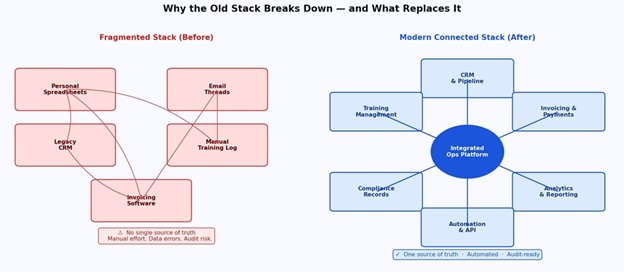
Most financial services firms built their operations on a patchwork of tools. A spreadsheet here, a legacy CRM there, a compliance training log someone maintains manually in a shared folder. It worked when teams were small and regulations were simpler. It does not work now.
The pace of digital transformation has accelerated sharply. Global digital transformation spending in financial services reached $596 billion in 2025 and is projected to climb to $685 billion in 2026. Yet only 32% of transformation initiatives are considered fully successful. The gap between ambition and execution is enormous.
The root cause is almost always the same: disconnected tools that do not talk to each other, teams spending too much time on manual administration, and no single view of what is actually happening across the operation.
Building a modern ops stack means fixing that. Not by buying every new platform on the market, but by making deliberate choices about the tools that handle the work your team does most — and that carry the most operational risk if they go wrong.
Managing the Client Pipeline
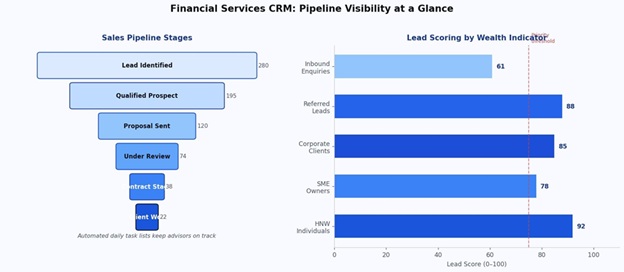
A centralised CRM gives financial teams full visibility across every client relationship, deal stage, and interaction.
Client pipeline management is where financial services ops most visibly breaks down. Advisors working off personal spreadsheets. Follow-up tasks that fall through the cracks. No shared visibility into where a deal stands or what a client was last told.
A purpose-built CRM changes that. But not all CRMs are built with the specific demands of financial services in mind. The sector needs data guardrails for regulatory accuracy, lead scoring based on wealth indicators and investment goals, and the ability to attach multiple contacts to a single deal — because in financial services, a client relationship often involves families, businesses, and multiple stakeholders.
This is the problem Pipeline CRM for financial services is designed to solve.It centralises client data, investment goals, and risk tolerances in one place, and scores leads based on wealth indicators, credit history, and investment goals — so advisors focus on the prospects most likely to convert.
The operational gains are real. Teams get a clear view of every account and project. Automated daily task lists are generated from deal statuses and deadlines. Communication history is logged against each client so anyone on the team can pick up a relationship without asking three colleagues for context.
For ops teams, the key benefit is integration. A financial services CRM should connect cleanly to your invoicing tools, email platform, and calendar. When that data flows automatically, your team stops doing data entry and starts doing the work that actually drives revenue.
Compliance Training Operations
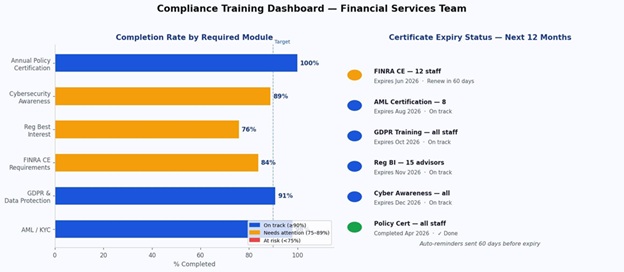
Compliance training in financial services is not optional — and managing it manually does not scale.
Compliance training is the least glamorous part of financial services operations. It is also one of the highest-risk areas if it is handled badly.
The regulatory burden is substantial. Financial firms must meet training obligations across a wide range of frameworks — FINRA Rule 1240 for registered persons at broker-dealers, annual certifications for RIA compliance programs, AML and customer due diligence training, and data protection requirements under GDPR and GLBA. Every regulated person on your team needs documented training records that can be produced on demand during an examination.
Running that in a spreadsheet or a general-purpose LMS creates problems fast. You lose visibility into who has completed what. Certificates expire without anyone noticing. When an auditor asks for records, someone spends two days pulling files together.
A Training Management System built for structured training delivery solves this operationally. EduAdmin is one example used by professional training providers to manage exactly this kind of workflow. It handles course scheduling, automatic enrolment, digital certificate issuance, and completion tracking in one system. For financial services firms delivering mandatory training across large or distributed teams, the ability to manage blended learning — combining self-paced compliance modules with live refresher sessions — is particularly valuable.
The operational benefit is not just audit readiness, though that matters enormously. It is about removing the manual burden from whoever currently manages training administration. Every hour spent chasing completions and generating certificates manually is an hour not spent on higher-value work.
The firms that handle compliance training well treat it as an ops function, not a paperwork exercise. The right training management system makes the difference between a programme that runs itself and one that requires constant intervention.
Automation and Integration
The CRM and the training system are the two pillars that carry the most operational weight. But a modern stack only delivers its full value when those tools are connected — to each other, and to the broader infrastructure your team runs on.
Automation is where this pays off most clearly. A connected stack makes things like this possible:
- A new client onboarded in your CRM automatically triggers a compliance training enrolment.
- Certificate expiry dates generate renewal reminders without anyone checking manually.
- Deal stage changes in the CRM trigger automated client communication sequences.
- Training completion data feeds into your HR or performance management system.
None of this requires custom development. Most modern CRMs and training management platforms offer API access and pre-built integrations with tools like Zapier, QuickBooks, and Outlook. The key is treating your ops stack as a system rather than a collection of individual tools. Each component should hand off cleanly to the next.
AI is accelerating this further. Broadridge's 2026 study found that 80% of financial firms are now actively using AI, up from just 31% one year ago. Those that have integrated AI into their ops workflows are seeing measurable productivity gains — and the firms that have not are beginning to feel the gap.
Where to Start
Most firms do not need to replace everything at once. The pressure to modernise the entire stack in one project is how transformation initiatives fail. Start with the two functions that carry the most compliance risk and the most manual overhead.
Ask yourself these questions first:
- Where is client data currently living, and who has access to it? If the answer involves personal spreadsheets or email threads, that is your first priority.
- How would you produce compliance training records if an auditor asked for them today? If the answer takes more than an hour, that is your second priority.
- Which manual tasks consume the most team time every week? These are the best candidates for automation once your core stack is in place.
Get a CRM built for your sector and a training management system that handles your mandatory obligations. Make those two systems clean, connected, and running without manual intervention. Then layer on automation and additional tools from a position of stability rather than chaos.
The Firms That Will Win
The financial services firms that will come out ahead over the next three years are not necessarily the ones with the biggest technology budgets. They are the ones that have made deliberate choices about their operational infrastructure.
A CRM that enforces data quality and gives every advisor a complete view of their pipeline. A training system that makes compliance automatic and audit-ready. Automation that connects them. These are not exotic capabilities. They are the baseline for any operation that wants to scale without adding headcount proportionally.
With 43% of firms planning a complete stack rebuild, the firms that delay are not standing still — they are falling behind.