
Autonomous SOC: Moving Toward Self-Driving Security Operations
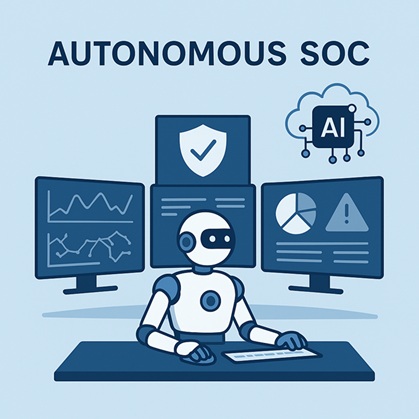
The idea of a fully autonomous security operations center (SOC) sparks fascination and skepticism in equal measure. Swimlane defines an autonomous SOC as a center that uses AI, machine learning and automation to handle a significant portion of security tasks, including threat detection, triage and even remediation, with minimal human intervention. The goal is to free analysts from repetitive tasks so they can focus on strategy and threat hunting. Although a completely self‑driving SOC remains aspirational, advances in hyperautomation, enterprise automation architectures and AI agents are bringing us closer.
What Makes an SOC Autonomous?
An autonomous SOC leverages AI and automation to perform routine tasks and investigations without manual input. Swimlane explains that AI and automation increase efficiency, improve response times and allow analysts to concentrate on complex work. Key elements include:
- Hyperautomation: A business‑driven approach that connects intelligent workflows, agentic AI and orchestration across tools to automate complex processes end‑to‑end. Hyperautomation enables faster, more consistent operations while analysts validate AI‑driven actions and manage exceptions.
- Enterprise-grade automation architecture: Scalable, reliable infrastructure that integrates telemetry from IT, OT, cloud and hybrid environments. Low‑code playbooks, case management and advanced orchestration allow organizations to deploy AI‑driven workflows quickly and adapt to evolving threats.
- AI-powered SOC agents: Adaptive agents that analyze records, summarize cases, recommend next steps and learn from prior incidents. These agents extend beyond rule‑based automation, delivering context‑aware decision‑making across the security lifecycle while humans provide oversight and refine recommendations.
The Role of Humans
Even as automation increases, humans remain essential. Swimlane emphasizes that a 100 % autonomous SOC is not realistic today; instead, humans focus on AI oversight, cybersecurity strategy and innovation. Analysts evolve from executing playbooks to training AI models, refining automation and making ethical decisions. Keeping humans in the loop is not about preventing job loss but about upskilling and expanding the capacity of security teams.
Comparing Autonomous and Traditional SOCs
Autonomous SOCs differ from traditional models in several ways:
|
Characteristic |
Traditional SOC |
Autonomous SOC |
|
Efficiency |
Analysts are overwhelmed by manual, repetitive tasks |
AI automation streamlines workflows and reduces manual overhead |
|
Scale |
Capacity limited by headcount and tool sprawl |
Automation expands capacity across more data sources and use cases |
|
Resilience |
High analyst fatigue and turnover risk |
Automated processes reduce burnout and improve continuity |
|
Decision-making |
Entirely human-driven |
AI augments human judgment with faster insights and recommendations |
Building Your Path to an Autonomous SOC
- Adopt hyperautomation gradually: Start by automating repetitive tasks such as alert triage, enrichment and case management. Use low‑code playbooks to orchestrate processes across tools.
- Invest in a scalable architecture: Integrate diverse telemetry sources and ensure reliability across IT, OT, cloud and hybrid environments.
- Deploy AI agents with human oversight: Implement AI agents capable of adaptive decision-making. Maintain human review and adjustment of AI recommendations to avoid bias or unintended consequences.
- Upskill analysts: Transition tier‑1 analysts into AI prompt engineers and automation designers. Provide training in machine learning fundamentals, data science and risk governance.
- Measure progress: Track metrics like mean time to detect (MTTD), mean time to respond (MTTR), analyst workload and false positive rates. Compare improvements as automation matures.
Autonomous Security Operations
Netenrich’s Autonomous Security Operations (ASO) reflects the real-world path toward an autonomous SOC. Rather than relying on generic AI or disconnected automation, ASO combines agentic AI with structured, engineering-led workflows built on Google Security Operations and enriched by Netenrich’s Resolution Intelligence Cloud (RIC) data fabric. This model improves detection fidelity, accelerates investigations, and ensures consistent, context-aware decision support while keeping humans in the loop through an AI Supervisor approach. Netenrich focuses on modernizing SecOps operations, not eliminating analysts but automating the known, discovering the unknown, and enabling analysts to guide and govern AI-driven processes. This human‑guided AI aligns with Swimlane’s vision of an autonomous SOC where analysts transition to overseeing and refining automation.
While platforms like Netenrich, Swimlane and others accelerate progress toward autonomy, CISOs must temper expectations: fully autonomous SOCs are a future goal rather than an imminent reality. In the meantime, incremental adoption of AI‑powered automation delivers substantial gains in efficiency and resilience.
Conclusion
An autonomous SOC is more than a buzzword, it represents an evolution toward hyperautomated, AI‑driven security operations that free analysts to focus on strategic tasks. Building such a SOC requires hyperautomation, scalable architecture, AI agents and continuous human oversight. Netenrich’s Autonomous Security Operations demonstrates how agentic AI and human expertise work together to deliver more consistent investigations, higher-quality detections, and structured, scalable security operations. Autonomous Security Operations uses automation to remove analyst toil while ensuring analysts guide and supervise every meaningful decision. By embracing automation responsibly and investing in skills and governance, organizations can set a course toward a more self‑driving, resilient security posture.