Operations | Monitoring | ITSM | DevOps | Cloud

Why Resilience, Not Just Visibility, Is the New Mandate

We’ve been in the war rooms. We’ve watched revenue, reputation, and trust erode in real time—not because we lacked telemetry, but because we lacked architecture. Modern enterprise systems fail because their data doesn’t think. Their tooling doesn’t remember. And their automation doesn’t know when to act—or when to stop. The answer is not more monitoring. It’s not dashboards with AI labels.

Service Dependency Mapping: The Hidden Framework of AIOps

According to McKinsey report, 70% of digital banking transformations exceed budget and timelines largely due to one core problem: underestimating system complexity. The current issue? Financial institutions are being blind —they’re unable to see how deeply intertwined their applications, services, and infrastructure really are. A recent study shows 45% of financial institutions face at least one major IT breakdown every quarter.

AI-Powered IT Resilience: Faster Recovery, Lower Costs

According to industry benchmarks, unplanned downtime costs enterprises an average of $5,600 per minute. For industries like fintech, e-commerce, and SaaS, where customer experience is a competitive differentiator, prolonged outages translate into customer churn, SLA penalties, and reputational damage.

Early Warning in AIOps from HEAL Software: The Key to Preventing Downtime

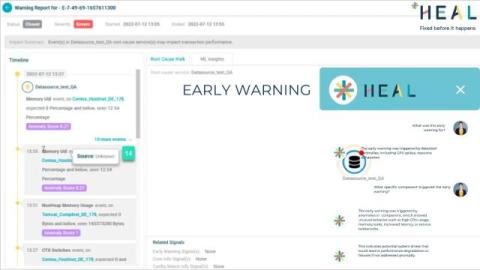
The answer is yes. But, as with any AI solution, the reality is more nuanced. At HEAL Software, we have spent years perfecting our Early Warning feature by analyzing anonymized data from thousands of global customers and collaborating with IT leaders across industries. AIOps isn’t just a buzzword—it’s a necessity for modern enterprises looking to minimize downtime and enhance operational efficiency.

How a Global Banking Leader Tackled Memory Overload with HEAL Software

In the financial sector, where system reliability directly impacts customer trust and revenue, even minor IT inefficiencies can spiral into costly crises. For one of the world’s largest banks—supporting 25 million customers, 2,000 branches, and 3,000 ATMs—a hidden challenge threatened its reputation: unpredictable memory consumption in critical applications.

How a Global Banking Leader Tackled Memory Overload with HEAL Software

In the financial sector, where system reliability directly impacts customer trust and revenue, even minor IT inefficiencies can spiral into costly crises. For one of the world’s largest banks—supporting 25 million customers, 2,000 branches, and 3,000 ATMs—a hidden challenge threatened its reputation: unpredictable memory consumption in critical applications.

How Overlooked Anomalies Can Lead to Enterprise Losses

Organizations invest heavily in robust systems, talented personnel, and sophisticated tools to ensure smooth operations. Yet, small anomalies often escape attention—minor glitches in applications, occasional lags in processes, or subtle irregularities in performance metrics. These may appear insignificant, but when left unaddressed, they can cascade into significant disruptions, leading to operational inefficiencies, financial losses, and reputational damage.

A unified journey through HEAL Software's innovation in IT operations management

Every year brings its own unique challenges and opportunities, and we’ve consistently embraced both resilience and innovation. Through our comprehensive platform, we’ve redefined how businesses approach root cause analysis, anomaly detection, automation, solution recommendations, and log monitoring, while also achieving significant improvements in Mean Time to Investigate (MTTI) and Mean Time to Repair (MTTR).

Observability to AIOps: Transforming Anomaly Detection for Modern Enterprises

As businesses increasingly digitize operations, IT systems are evolving into complex, distributed ecosystems. Applications run across multi-cloud environments, microservices power critical processes, and data flows in real time across countless touchpoints. While this transformation drives agility and scalability, it introduces significant challenges: hidden anomalies that can disrupt operations, frustrate users, and damage revenue.

HEAL AIOps and Chatbot Solve the Alert Flood Crisis

Every IT environment relies on multiple monitoring tools to ensure smooth and uninterrupted operations across various systems—network, databases, servers, applications, and more. These tools constantly scan for any performance anomalies to keep everything running smooth. However, when there’s a spike in performance metrics—such as CPU usage, network traffic, or database activity—each of these monitoring tools triggers its own alert for what might be the same underlying issue.