Operations | Monitoring | ITSM | DevOps | Cloud

Why DevOps isn't a level playing field for financial services and insurance

Redgate recently published the 2021 State of Database DevOps report which, for the last five years, has followed the rise in DevOps and the challenges organizations face when adopting it for both application and database development. Based on a survey of thousands of IT professionals from around the world, it also provides the opportunity to dive a little deeper into how those challenges vary sector by sector.

The four best features to look out for in SQL Monitor

I’m a Data Architect and I’ve been working with data and databases for years at companies like LA Fitness, Dell and now Kingston Technology in Fountain Valley, California. Over all of that time, I’ve used SQL Monitor. I loved it from the beginning and the latest updates to the global overview dashboard and other features have stepped it up another few notches.

The top three insights from the 2021 State of Database DevOps report

Last year was a year of unprecedented challenges for everyone in every part of the world and every industry, and it was also a year of big changes in the IT sector. The pandemic underscored the role of the IT department as an enabler and a critical part of the transition to remote working. While digitalization was well underway before 2020, no one could have predicted the acceleration the pandemic brought on.

Overcoming Database DevOps Challenges: Part 1

As part of our research for the 2021 State of Database DevOps report, we asked 3,000+ recipients what they consider to be the greatest challenge when integrating database changes into a DevOps process. According to the respondents, these are the most important challenges facing database professionals when introducing DevOps practices to database development.

The Role of the DBA Is Changing

For good or for ill, technology is constantly shifting and with it, the roles of those who manage that technology also shift. This is no different for a DBA than it is for a developer, an admin, or analyst. As new technology, like the adoption of the cloud, changes the role, people start to question whether or not there’s even a need for a DBA. The shortest possible answer to that question, in my opinion, is “Yes”.

The Future of Database DevOps

I work as Director at ThoughtWorks in the database and DevOps space. I’ve been here for 20+ years and I vaguely remember my first project at ThoughtWorks in 1999 when we had just started using Agile software development practices. The basic challenge we faced was how to move database changes at the same pace as application code and keep them in sync so that deployments would work. At the time, we had to invent all the tools, processes, and techniques that we needed.

Redgate's roadmap for cross-database DevOps

At Redgate, we strongly believe that all databases should be managed and orchestrated in the same way, with the same standards of security and quality in releases. For the past few years, we’ve been leading the adoption of database DevOps by focusing on the most challenging parts of the process like version control, continuous integration and making deployments consistent, predictable and repeatable.

The technology challenge of mergers and acquisitions in the insurance sector

Mergers and acquisitions are going on all over the market at the moment … and de-mergers as well, actually. Typically in a merger or acquisition, there’s some knowledge that it’s going to happen in advance. But until the Heads of Terms have been signed and there’s a Transition Service Agreement in place, people don’t really get moving with the activity needed to support the move, particularly on the technology side.

How database DevOps can enable the evolving insurance landscape

In 2020, Deloitte reported on The four trends that define insurance and showed that the future of the insurance marketplace is going to be significantly different. Life and Property and Casualty insurers, for example, estimated that 93% of their volume already came from propositions that were not offered five years ago. New propositions were expected to keep on rising, with nearly a quarter of investment spend in insurance allocated to new product development.

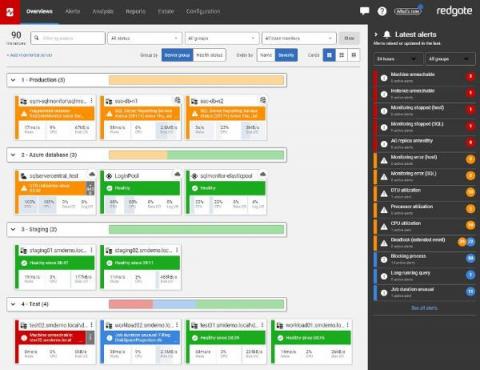
New SQL Monitor release gives organizations the opportunity to manage their on-premises and cloud databases from a single global dashboard

To help organizations explore and manage the advantages the cloud provides, the latest release of Redgate's popular database monitoring tool, SQL Monitor, now supports Amazon EC2 and RDS, and Azure SQL Database and Azure Managed Instances as well as on-premises SQL Server.