Operations | Monitoring | ITSM | DevOps | Cloud

Notion AI pricing: the real per-seat math for an organization-wide rollout

Notion AI comes with the Business plan at $20 per member per month and with Enterprise at custom pricing, per Notion's pricing page; the standalone $10 add-on was retired in May 2025, and Free and Plus get a limited AI trial. Custom Agents add metered Notion credits at $10 per 1,000 monthly. Yearly billing saves up to 20%.
AI budget season: 87% are raising it, 61% can't justify it

87% of finance leaders are raising their AI budget for FY2027, 45% of them by more than 20%, even though 61% already spend more on AI than they can justify. Most can't see where it goes: 54% can't break AI spend below a rough category, so budgets default to the total and keep climbing. The teams that allocate spend, tying each AI dollar to the team, product, or outcome behind it, are the ones who can defend the number to a board.

Harvey AI pricing in 2026: every reported number, and how to build the business case without a rate card

Harvey AI pricing is not published: every deal is sales-negotiated. Reported figures across procurement research converge on roughly $1,200 per lawyer per month at the base, 20-to-25-seat minimums, and 12-month terms, putting reported entry floors near $290,000 to $360,000 a year. Premium bundles run higher. No free tier, no monthly plan, no self-serve. Every figure on this page is labeled for what it is: disclosed by Harvey, reported by named research and journalists, or computed from those reports.

Webinar recap: FY2027 AI budgets and how finance leaders plan

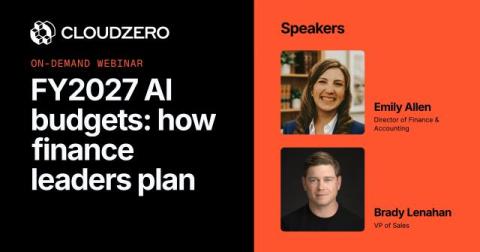
CloudZero's Emily Allen and Brady Lenahan talked through how finance capitalizes AI spend and sets limits on it after a year of companywide AI adoption. Picture your AI line item last fall. A few seats, one vendor, tucked inside the software budget. Now picture it today. That’s the year Emily Allen, director of finance and accounting at CloudZero, walked through in our 30-minute webinar FY2027 AI budgets: how finance leaders plan on October 29, 2026.

Shipped: Dimension descriptions, right where you pick them

Picking a dimension means choosing from a list of names. But names only tell users so much. “Product,” “Team,” and “Cost Center” mean different things in different orgs. If you’re building a report you have to guess which one fits the question you’re answering.

Can you see what your sales org did with $206,000 of AI last month?

Activity categorization classifies every AI request by the work it performs, such as meeting prep, code review or account research, then assigns that spend to the team, person, model and provider behind it. It turns a provider invoice that shows only totals by model and API key into a breakdown finance can allocate, charge back and budget from. CloudZero AI Signals does this as the spend happens.

Amazon told its engineers to stop chasing tokens

Amazon told its own engineers this week to stop tokenmaxxing. The memo circulated internally in September and Amazon published it on Tuesday, Oct. 27. Tokenmaxxing is the practice of using AI as heavily as possible with little regard for whether the output justifies the spend. The memo calls token usage, adoption rates, and code-change counts “deeply flawed” ways to measure a team.

Shipped: Fit more of your cost data on one screen

Most cost questions get answered the same way. You read a chart and the table under it together. Maybe you spot a jump on the chart, and then you go looking in the table for the service, account, or team that caused it. When you can see more of that table while the chart is still in view, the whole review goes faster. You’re also a lot less likely to lose your place halfway through.

Shipped: Log and track Insights from your AI assistant

Insights are how your team tracks interesting observations, analysis and optimization work in CloudZero. Each one records the opportunity and its status, so the work gets sized, assigned, and closed out. Teams now do a lot of this work in an AI assistant. For example, you can ask Claude which instances sat idle last month, and it will tell you. But if you have to switch to CloudZero and fill out a form to log that finding, some findings won’t get logged.

AI cost per customer: measure it and protect your margins

AI cost per customer is each customer's attributed share of your AI spend: API tokens, inference infrastructure, and per-seat AI tools, measured against that customer's revenue. It matters because AI usage is wildly uneven across customers, so healthy blended margins can hide individual customers you serve at a loss. It's cost to serve, not acquisition cost. Cost per customer is the metric CloudZero was built around.