Operations | Monitoring | ITSM | DevOps | Cloud

Prioritize security findings with the Datadog Runtime Prioritization Engine

If you run a cloud security program, two questions follow almost every security finding: Who owns this? And how important is it? Many security tools answer those questions with static metadata such as owner tags, business criticality labels, and manually maintained inventories of critical assets, known as crown jewels. But cloud environments aren’t static. Teams reorganize, services change hands, and dependencies evolve.

A practical guide to React error monitoring

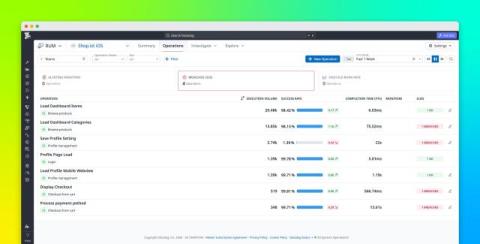
When designing effective error handling for React apps, the troubleshooting information you collect and display is critical. React errors can stem from a variety of causes, including user misconfiguration, backend and network issues, and mismatches in browser environments. Instrumenting your code to log critical context, including feature names, user data, and session activity, enables you to quickly identify where these errors originate.

Provision Datadog on Stripe Projects

Stripe Projects reduces the manual work of setting up, managing, and paying for third-party SaaS solutions. You can now use it to get started with Datadog in just two commands: If your Stripe account has a verified email address, running those commands in the Stripe CLI gives you a Datadog organization with a 14-day free trial and an automatically generated API key that is ready to use. You avoid email verification loops, tab-switching to copy an API key out of a dashboard, and lengthy sign-up forms.

AI gateway best practices: Model routing, reliability, and budget controls for production agents

Organizations are increasingly using multiple models to build AI agents in order to find the best balance of performance and cost for each agentic task and LLM call. As we discovered in the 2026 State of AI Engineering report, there isn’t currently a clear winner in terms of adoption among competing models and many organizations are keeping older models in flight despite frequent new releases.

From zero to traces: Choosing the right APM instrumentation method for your stack

Instrumenting a tech stack for distributed tracing is a complicated process that often takes weeks. For large fleets running services written in multiple languages, the timeline could be months. Every service needs a tracing library added, configured, and redeployed, and that work has to fit into each team’s release schedule. Datadog’s Single Step Instrumentation (SSI) cuts the time it takes to instrument your applications to send traces to Datadog APM down to minutes.

Use OpenTelemetry-native observability with Datadog from ingestion to investigation

The recent announcement that OpenTelemetry (OTel) has achieved CNCF graduation further reinforces OTel’s credibility as the industry standard for vendor-neutral telemetry. As organizations increasingly adopt the OpenTelemetry Protocol (OTLP), the OTel Collector, and OTel SDKs, they need an observability platform that supports OTel-native data without sacrificing flexibility or portability.

Answer any cost question faster with the Cloud Cost skill in Bits Chat

Managing cloud, AI, and SaaS costs means answering a steady stream of questions from finance, leadership, and engineering teams. What changed? Which team owns the spend? Was an increase expected? Are we still on track against the budget? When each answer requires moving between dashboards, filtering cost data by team or service, or manually correlating billing data with observability data, it can slow down investigations while costs continue to rise.

Datadog named Leader in 2026 Gartner Magic Quadrant for Observability Platforms

We are thrilled to announce that Datadog has been named a Leader in the 2026 Gartner Magic Quadrant for Observability Platforms, for the sixth consecutive year. We believe this recognition reflects our continued focus on helping customers observe, secure, and act on everything that matters across their technology stack. Datadog was positioned highest in Ability to Execute in the 2026 Gartner Magic Quadrant for Observability Platforms.

Making agentic token costs visible in production

In some organizations, high token counts have become a proxy for productivity. Some engineering teams are being pushed to max out context windows and wire in sprawling tool sets. More tokens can mean better agent reasoning and richer context during development, but token costs compound in production. Tokens accumulate across sessions, users, and tool calls in ways that are easy to overlook. Datadog’s 2026 State of AI Engineering report quantifies the scale of this problem.

Monitor your .NET MAUI apps with Datadog RUM

As.NET Multi-platform App UI (MAUI) becomes the default cross-platform UI framework in the Microsoft ecosystem, many teams are standardizing on it to build mobile applications for iOS and Android. However, observability has not kept pace with the shift in adoption. Developers often rely on unsupported community bindings or maintain their own wrappers around native iOS and Android SDKs, which introduces instability and ongoing maintenance.