Operations | Monitoring | ITSM | DevOps | Cloud

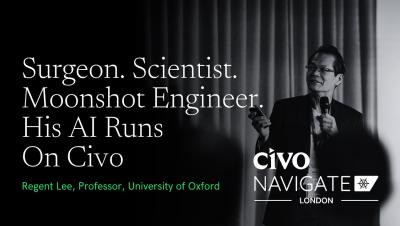
How generative AI solves healthcare's 1% carbon footprint

The healthcare industry accounts for 1% of the global carbon footprint, and a single PET CT scan can generate 60kg of CO₂! Regent Lee, Professor at the University of Oxford and moonshot engineer, reveals how Civo-powered Generative AI is transforming radiology. His team's solution eliminates pharmaceutical contrast injections, digitally displacing the pollution. This technology makes radiology safer, more efficient, and significantly greener for the environment. Sustainability in healthcare is non-negotiable.
Free cloud credits: Why your architecture gets lazy and bloated

This is the uncomfortable truth about cloud credits: Short-term savings mask crippling long-term costs. Taken from our recent webinar, Civo CCO Simon Hansford and Canopy Founder James Marks expose the primary concerns of the credit model. Credits act as a dangerous incentive for architectural laziness. When cost isn't a factor, you stop designing for efficiency, leading to bloated, inefficient infrastructure and the inevitable bill shock.

The AI Workload Punishes Bad Habits

The AI workload presents the ultimate challenge, highlighting the structural limitations of the traditional hyperscaler model. In this segment from a Civo Navigate London 2025 session, Kelsey Hightower explains exactly why AI adoption forces enterprises to confront flawed architecture and rising astronomical costs. When specialized hardware is scarce and rented GPUs sit idle at a premium, it’s clear that traditional cloud providers were not built for this era. Data that didn't move is forcing organizations to move compute back to where it lives.

The 3 AI Jobs That Didn't Exist 2 Years Ago!

People worry about AI taking jobs, but what about the new roles AI is creating? James Faure, CEO of Clairo AI, breaks down the three essential non-technical jobs that have emerged in the last two years: Prompt Engineers, Context Architects, and Evaluators. Learn the crucial skills needed to be highly employable in the future of AI.

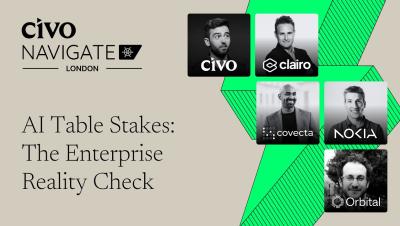
AI Table Stakes: The Enterprise Reality Check

This 5-minute critique pulls back the curtain on where AI is succeeding and where the biggest challenges remain. Experts expose the gap between market hype and reality: the failure to deploy fully autonomous production agents and the missing human-machine interface for non-developers. It’s a challenge to the entire industry.

How Hyperscalers Use Credits to Keep You Hooked!

The hyperscaler model is built on bait: generous cloud credits for years, especially if you're VC-backed. But there's a serious catch. In this clip, Canopy's James Marks talk about the expected consequence of taking those "free" credits. It's not just about attracting customers; it's about deepening reliance on proprietary platform-native tools. It’s the ultimate vendor lock-in strategy, making it costly and complicated to break away later.

How companies in India are using Civo to improve their cloud costs and data sovereignty

As the Indian cloud market continues to grow, businesses are increasingly looking for ways to manage their cloud costs effectively while ensuring data sovereignty. At Civo, we've seen firsthand how our cloud and AI platform can help companies achieve these goals. In this blog, we'll explore how three of our customers in India - KubeNine, BeezLabs, and OpsMx - have leveraged Civo to improve their cloud costs and data sovereignty.

Cloud Credits: The Hidden Lock-In Strategy Hyperscalers Use

In this 5-minute clip from our recent webinar, Canopy's James Marks exposes the most dangerous side-effect of the cloud credit model: the migration loop. Instead of building their product, companies spend months hopping between vendors to chase new credits, falling into a cycle of constant, costly re-architecting. Simon Hansford provides clear advice for the best companies: build your architecture for portability on day one. Restrict proprietary features to maintain optionality and avoid the "entrenched phase.".

Building smarter with AI: Why legacy infrastructure is the biggest bottleneck

Josh Mesout (Chief Innovation Officer at Civo) took the main stage at Civo Navigate London 2025 to deliver a critical message: The AI revolution isn't just coming, it's here, and the way companies are built is changing faster than ever before. His session cut through the hype, delivering hard data on what separates the companies that scale AI from the ones that sink money into failed prototypes. The takeaway is blunt: The biggest threat to your AI ambition isn't the model; it’s your infrastructure.

AI Eliminates Pollution Risk: Oxford's Digital Contrast, Powered by Civo.

The future of medicine is here: Oxford's digital contrast AI is powered by Civo! Watch as Regent Lee, Professor at the University of Oxford and moonshot engineer, reveals a revolutionary solution to healthcare’s biggest hidden problem. Radiology currently accounts for 1% of global carbon emissions, with a single PET CT scan generating up to 60 kg of carbon, while forcing patients to endure long waits and chemical injections. Old habits cause slow systems.

What we learnt about digital sovereignty at Civo Navigate London 2025

The concept of digital sovereignty has become increasingly important in today's technology-driven world. As organizations rely more heavily on cloud services and artificial intelligence (AI), they face new challenges in maintaining control over their data and IT resources. At Civo Navigate London, we brought together industry leaders to discuss the topic of digital sovereignty and its implications for the cloud industry.

Orbital Materials: WorldClass AI Models Built on CivoStack

Daniel Miodovnik, COO of Orbital Materials, explains how the CivoStack enables world‑class AI models that outperform the big‑tech giants. He outlines the power‑draw and cooling of megawatt‑scale GPU racks, the water‑ and CO₂‑intensity of today’s data centres, and why a sovereign, Civo‑based solution is the key to speed, and predictable costs.