
Top 5 Remote Workforce Equipment Return Solutions for Hassle-Free Hardware Returns
Your star developer quits on Friday, and by Monday she’s coding for a competitor while your laptop, monitor, and security tokens sit on her kitchen table. Sound familiar? In an off-boarding survey, 71 percent of HR teams said at least one remote employee failed to return company gear in the past year. Every missing device is a roaming data-breach risk and an avoidable expense. This guide compares five purpose-built platforms that make retrieval effortless—so you can stop chasing laptops and start closing tickets.
Why remote equipment returns are so painful
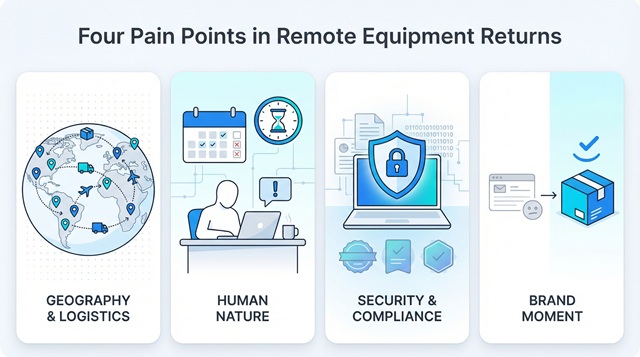
Remote work scattered company gear across kitchen tables, coworking lockers, and Airbnb desks worldwide. Each device now sits outside your firewall, turning a simple hand-off into a logistical puzzle.
First problem: geography. One team can span 12 time zones. Coordinating couriers, customs forms, and pickup windows for every departure keeps IT buried in spreadsheets instead of high-impact projects.
Second, human nature. Departing employees focus on their next job, not packing a laptop. Without a streamlined process, returns slide down their to-do list. The longer a device lingers, the greater the odds it’s lost, damaged, or wiped for a quick resale.
Next comes security. A misplaced computer isn’t “just hardware.” It holds credentials, client data, and cached VPN keys. One forgotten MacBook can open a backdoor no patch can close. Layer in compliance mandates such as GDPR, HIPAA, and SOC audits, and the risk jumps from irritating to existential.
Finally, think about the brand moment. Off-boarding is an employee’s last impression of your culture. A blunt “Please mail your stuff” email feels amateur, while a prepaid return kit on their doorstep shows professionalism to the end.
How we evaluated the top solutions
You need a ranking you can trust, not a vendor grab-bag. We built a scoring model that reflects the pain points above.
First, we asked one question: does the service get the laptop back quickly and reliably? That retrieval-success pillar carries 25 percent of the final score. Security came next. We looked for chain-of-custody tracking, remote-wipe options, and recognized compliance badges—another 25 percent.
Reach matters too. A tool that works in Boston but stalls in Bangkok is only half a solution, so global coverage and scalability weighed in at 20 percent. Integration and automation earned 15 percent because a direct HRIS trigger can save hours each month. The remaining 15 percent went to pricing transparency and flexibility; surprise fees destroy trust.
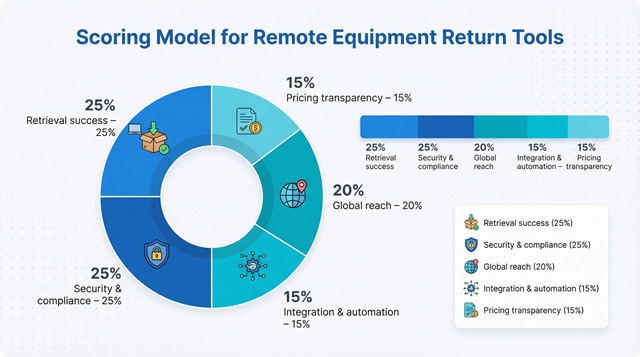
Each vendor received a one-to-ten rating in every category. We multiplied by the weights above, crunched the numbers, and let the math set the podium you’ll see next.
Quick comparison of the top solutions
Before we review each platform in detail, the table below shows where each one excels.
|
Criteria |
Allwhere |
GroWrk |
Firstbase |
Hofy |
Workwize |
|
Retrieval success & logistics |
9/10 – prepaid kits, automated reminders; 91 percent on-time returns |
9/10 – real-time tracking in 150+ countries |
8/10 – labels auto-sent at off-boarding |
7/10 – strong regional coverage, eco-focused flow |
8/10 – flexible pickup or drop-off options |
|
Security & compliance |
8/10 – chain of custody, GDPR aligned |
9/10 – certified wipe, 24/7 monitoring |
9/10 – SOC 2 logs, remote disable |
8/10 – data-destruction certificates |
9/10 – ISO 27001, GDPR |
|
Global reach & scale |
8/10 – partners on three continents |
10/10 – 150+ countries |
8/10 – broad but carrier-based |
6/10 – about 50 countries |
8/10 – multi-warehouse model |
|
Integration & automation |
7/10 – simple dashboard, growing API set |
8/10 – ITSM and Slack hooks |
10/10 – bi-directional HRIS/MDM sync |
6/10 – basic portal, APIs coming |
8/10 – Slack, Azure AD, SSO |
|
Pricing transparency & flexibility |
9/10 – clear fees up front |
7/10 – custom enterprise quotes |
7/10 – premium subscription |
7/10 – device-as-a-service model |
7/10 – regional quote flexibility |
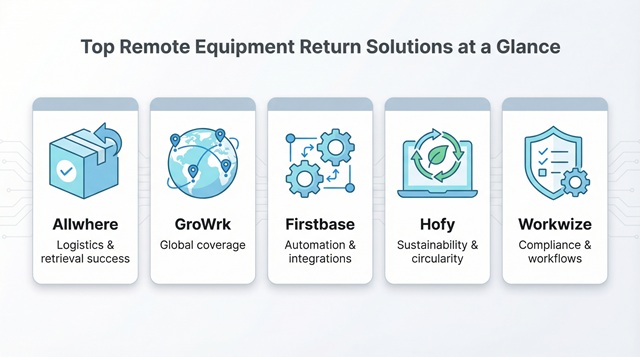
Allwhere and GroWrk lead on logistics, Firstbase dominates automation, Hofy carries the sustainability banner, and Workwize balances compliance with custom workflows.
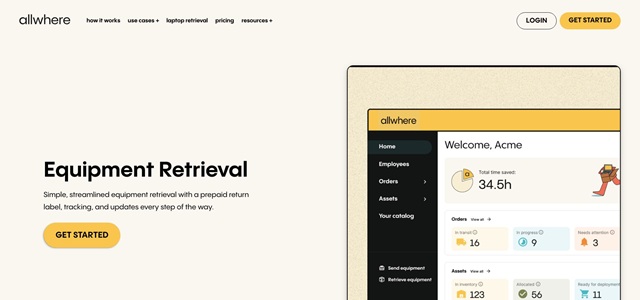
Allwhere equipment retrieval platform website screenshot
1. Allwhere: hassle-free global equipment retrieval
Allwhere tops the list for one reason: it almost always gets the laptop back. Customer data shows a 91 percent on-time retrieval rate, far ahead of teams juggling do-it-yourself shipping spreadsheets.
The process begins the moment you mark an employee as leaving. From a single dashboard you trigger a prepaid return kit that includes a padded box, label, and clear instructions—no printing, no expense reports, no excuses.
Once the package moves, real-time tracking keeps everyone informed. Automated reminders nudge the employee if the box sits idle, while IT sees status changes without refreshing Google Sheets.
Security stays tight throughout. Every hand-off is logged, and you can request a certified data wipe or route the device to your own depot for imaging. Because Allwhere partners with global couriers, the same workflow covers Boston, Berlin, and Bangalore.
Pricing is plain. Fees appear up front and cover customs paperwork, so finance never meets a surprise tariff. Need storage or redeployment? Turn those services on as needed and pay only when you use them.
For fast-growing distributed companies that want gear back without micromanaging, Allwhere is the clear starting point.
2. GroWrk: all-in-one IT asset management with global reach

GroWrk global IT asset management platform website screenshot
GroWrk wins on map coverage. Its logistics engine spans more than 150 countries, so the same workflow that retrieves a laptop in London also works in Lagos or Lima. That reach removes the usual “except for” caveats you hear when teams expand beyond major tech hubs.
GroWrk is more than a pickup service. You can buy, deploy, monitor, and eventually collect hardware from one interface. Think of it as an IT asset life-cycle highway with no exit ramps. Requests flow in from HR, devices ship out from regional warehouses, and when employment ends, the platform generates a return label, schedules a courier, and tracks every hand-off until the box is back in inventory.
Automation runs deep. AI routing selects the fastest carrier, and Slack alerts keep managers informed without another portal login. Near-perfect retrieval scores reflect that horsepower, though the full-stack convenience comes at enterprise pricing. For global organizations managing hundreds of endpoints across time zones, GroWrk’s breadth often justifies the premium.
3. Firstbase: automation that closes every loop
Firstbase is the workflow nerd’s dream. The platform connects to Workday, BambooHR, Okta, and your mobile-device manager, then fires tasks the moment HR marks an employee as leaving.
Return labels generate automatically. Off-boarded users get step-by-step emails, and IT sees a live countdown until the courier scans the box. With every touchpoint logged in one audit file, compliance reviews shrink from scavenger hunt to single PDF export.
Security runs deep. Two-factor admin access, SOC 2 reports, and the ability to remote-lock a device before it leaves the desk ship standard. Add bi-directional SCIM sync, and your asset list stays identical across HR, MDM, and Firstbase without manual updates.
Convenience has a price. Firstbase sits at the premium end of the market, especially for small teams. Yet when you weigh saved admin hours and avoided data gaps against cost per shipment, the math often favors the platform. For organizations targeting zero-touch off-boarding, this remains the benchmark.
4. Hofy: sustainability meets device returns
Hofy treats hardware like a circular-economy concierge. Every laptop, monitor, or dock it retrieves earns a second life through refurbishment, redeployment, or certified recycling. That green promise resonates with companies chasing ESG targets as seriously as quarterly numbers.
The return flow is familiar: prepaid label, step-by-step instructions, and live tracking. Post-return is where Hofy stands out. Devices are inspected, wiped, and graded. Good-as-new gear moves to warehouse shelves for the next hire. Units beyond repair get stripped for parts and recycled under strict no-landfill rules.
Coverage spans about 50 countries, with strong presence in Europe and North America and expansion underway. While that footprint trails GroWrk’s global web, depth in core regions delivers fast pickup windows and predictable customs handling.
Integrations are solid today—basic API hooks and a clean admin portal—though not as deep as Firstbase’s HRIS matrix. If you prioritize environmental impact over fully automated triggers, the trade-off feels reasonable.
Costs follow a device-as-a-service model. Monthly fees bundle provisioning, support, and eventual recovery. Finance might blink at the subscription line, but reclaimed hardware offsets new-device spend, and sustainability reports earn bonus points in board decks.
Bottom line: Hofy is the pick for teams that want gear back and the planet a bit healthier at the same time.
5. Workwize: compliance-first flexibility
Workwize positions itself as the policy specialist of the group. ISO 27001 certification, GDPR alignment, and detailed chain-of-custody logs give risk teams the paperwork they need before they sign a statement of work.
The platform covers the entire hardware cycle (procurement, deployment, return) yet treats each step as a modular service. You can start with retrieval only, then add storage or redeployment later without renegotiating your contract. Slack and Azure AD connectors push status alerts where admins already work, and single sign-on keeps access tight.
Workwize’s global footprint trails GroWrk yet still spans every continent through regional courier partnerships and multi-warehouse stock points. Custom rules are the real standout. Want a reminder cadence that moves from friendly nudge to finance-backed invoice? Build it in a few clicks. Need different return flows for employees in the EU versus APAC? Separate playbooks handle that without cloned spreadsheets.
Pricing is quote-based and usually lands mid-pack. You pay for flexibility, but the ability to mirror complex compliance requirements can save far more in avoided audit findings. If your legal team drives IT decisions, Workwize checks the boxes while still getting boxes back.
Buyer’s checklist and ROI tips
Choosing a retrieval partner is easier when you know the right questions. Use the quick audit below during vendor demos to uncover hidden costs before the contract ink dries.
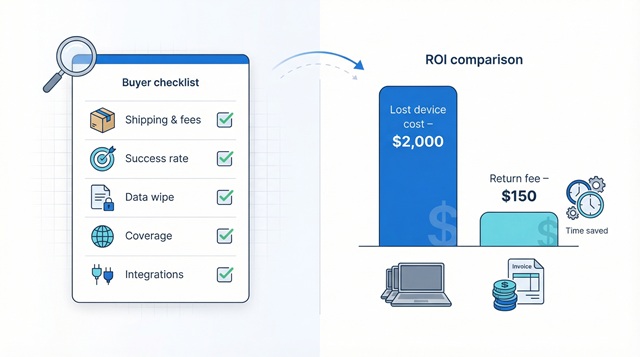
- Are prepaid kits and shipping fees included worldwide?
- What is the documented retrieval success rate?
- Do they provide certified data wipe or will your team handle it?
- How do integrations work—native apps, API, or slide-ware promises?
- Which countries are out of scope today?
- What happens if an employee ignores reminders?
- Can they collect monitors, docks, and chairs or only laptops?
- Are storage, redeployment, or recycling priced à la carte?
Now shift to savings. Replacing a lost MacBook can cost about $2,000 in hardware alone, not counting breach exposure or audit fines. If a platform charges $150 per successful return, you break even on the first device it rescues. Add the hours your team reclaims—no more chasing tracking numbers—and the payback period often shrinks to weeks, not months.
Smooth off-boarding is also brand protection. Former employees who breeze through returns speak well of you on LinkedIn, guarding recruiting pipelines and customer trust even if the benefit never appears in a spreadsheet.
Emerging trends to watch
Hardware retrieval is evolving fast, and three shifts could reshape your playbook over the next year.
First, automation keeps leveling up. AI now routes couriers, predicts late returns, and suggests deposit deductions before human eyes reach the ticket queue. What felt advanced last quarter will soon be standard.
Second, sustainability sells. Boards pursue ESG goals, and vendors respond with carbon-neutral shipping, refurbishment pipelines, and detailed e-waste reporting. Procurement teams will soon rank circular-economy credentials beside price and security.
Finally, the market itself is ballooning. Analysts value the IT asset disposition sector at more than $34 billion by 2031. That growth signals fresh funding, new entrants, and faster innovation for everyone involved.
Frequently asked questions
Can I just email a FedEx label instead of using a platform?
You can, but you will miss automated reminders, chain-of-custody logs, and success-rate analytics. At scale, the manual approach costs time and increases the chance a device never ships.
What if an employee ignores every reminder?
The services we reviewed escalate in stages: extra emails, SMS nudges, manager alerts, and finally an invoice or collections step that recovers costs while keeping HR within labor laws.
Do these tools handle monitors, docks, or office chairs?
Yes. Allwhere, GroWrk, and Workwize support multi-item kits out of the box, while Firstbase and Hofy focus on laptops plus small peripherals.
How long does a typical retrieval take?
Most vendors quote 3–7 business days from kit dispatch to warehouse check-in for domestic returns. International legs add transit and customs time.
Will my data be wiped before the device leaves the employee?
Firstbase and GroWrk can remote-lock or erase through MDM hooks. Others perform certified wipes on arrival at their facility. Choose the flow that best fits your compliance roadmap.
Conclusion
Keep these currents in mind when you lock in a multi-year contract today.