
Official Buyer's Guide to the Best Autonomous Pentesting Tools: An AppSec Lead's Field Guide

Image Source: depositphotos.com
When your engineering team pushes to production every afternoon, traditional security models break down rapidly. A pull request merges into the main branch, the CI pipeline turns green, and your new code goes live before tomorrow's morning stand-up. An annual penetration test or quarterly audit will never catch vulnerabilities introduced in daily deployments. In my experience working with security teams, I have seen how critical this coverage gap is for modern organizations, which is why AppSec leaders are aggressively evaluating autonomous pentesting platforms.
These automated tools probe applications on the exact same rapid cadence that your team deploys code. While dozens of software vendors now claim sophisticated autonomous capabilities, their real-world efficacy varies drastically in practice. In this comprehensive guide, I share an practical evaluation framework and analyze six top platforms based on hands-on deployment testing.
What is autonomous penetration testing?
In our modern security architecture, autonomous penetration testing delegates offensive engagements directly to specialized AI agents. Throughout current market discussions, you will frequently hear this capability referred to interchangeably as AI pentesting. Unlike static analysis tools or legacy vulnerability scanners that rely purely on basic signature matching, true autonomous agents execute the complete attacker kill chain across reconnaissance, application mapping, vulnerability research, exploit generation, payload chaining, and impact validation.
The crucial technical differentiator here is verified exploitation across the application layer. Rather than handing your triage engineers a massive list of potential issues, an autonomous tool attempts controlled exploitation to prove real-world risk clearly. For modern engineering leaders, the primary value lies in continuous coverage, firing comprehensive tests automatically on every build rather than waiting for scheduled annual audits.
What autonomous pentesting gives a team that ships daily
Throughout my operational experience integrating these tools into live production workflows, several distinct technical advantages emerge quite quickly for security leaders:
- Immediate attack feedback: Agents begin active reconnaissance within minutes of receiving scoping parameters, and they deliver thoroughly verified findings on the same day rather than weeks after a scheduled consultancy window.
- Per-commit security verification: By triggering deep assessments automatically through CI/CD pipelines, we effectively eliminate window-of-exposure risks between traditional audit cycles.
- Actionable, validated findings: Each finding arrives complete with step-by-step reproduction scripts alongside full proof-of-concept exploits, ending unproductive debates between security and engineering over alert validity.
- Substantial cost efficiency: Replacing or augmenting manual baseline testing with automated execution drops per-assessment costs dramatically, making continuous security verification economically viable for growing teams.
Where autonomous pentesting still falls short
While AI capabilities have advanced significantly, experienced security leaders know where current tools hit boundaries. In my evaluations, I closely monitor these limitations:
- Complex business logic constraints: AI agents still struggle with multi-step domain workflows and deep contextual nuances that a human researcher uncovers through creative intuition.
- Production guardrails and execution limits: Deploying autonomous agents against live environments without explicit rate limiting, strict scoping, and emergency kill switches creates unacceptable downtime risks.
- Verification overhead: While proof-of-exploit engines drastically cut down false positives, expert triage is still required for particularly nuanced findings before assigning remediation tasks to developers.
- Specialized surface coverage: Vendors specialize heavily; a tool with deep Active Directory pivoting capabilities may perform poorly on web application API business logic, and vice versa.
How to choose an autonomous pentesting tool
When evaluating platforms for our engineering teams, I weight vendors across six primary technical criteria before scheduling vendor demos:
- Validated exploitability: does the tool prove each finding with a working exploit and reproduction steps, or hand you a CVSS score to chase down?
- Business-logic depth: can it reason through broken access control and multi-step auth flows, past simple signature matches?
- Continuous coverage tied to deploys: will it trigger on every release through CI/CD, or run once and go quiet until you remember it?
- Remediation verification: after you patch, does it retest and confirm the fix held?
- Developer-native output: do fixes reach engineers where they actively work in the IDE or a pull request, or do they land as an unread PDF that nobody ever opens?
- Production safety and governance: does it ship a kill switch and an audit trail aligned to a standard like OWASP APTS?
Tips from the field
Over years of testing offensive tooling, the best teams have developed specific validation techniques to distinguish authentic autonomous exploitation engines from re-branded vulnerability scanners:
- Validate the retest mechanism: During proof-of-concept trials, apply a code fix for a confirmed vulnerability and observe the tool. Authentic platforms execute the exact exploit payload again to verify the fix rather than relying on basic version checks or signature re-scans.
- Evaluate developer workflow integration: Test how remediation guidance is delivered into your developers' preferred IDEs. I look for context-aware code suggestions that developers can review and merge with minimal manual modification.
- Pilot in a single non-critical service: Integrate the tool into one pipeline first. This allows you to evaluate signal-to-noise ratios, execution speed, and operational impact before wider organizational rollout.
- Audit the agent reasoning chain: Inspect the step-by-step decision telemetry. True agentic systems document their reasoning path from initial reconnaissance to final payload delivery, whereas basic wrappers only output standard CVE lists.
The 6 best autonomous pentesting platforms
These six platforms represent the leading contenders for autonomous penetration testing. I've ranked them by technical capability and alignment with modern CI/CD engineering workflows.
Astra Security for teams that ship to production daily
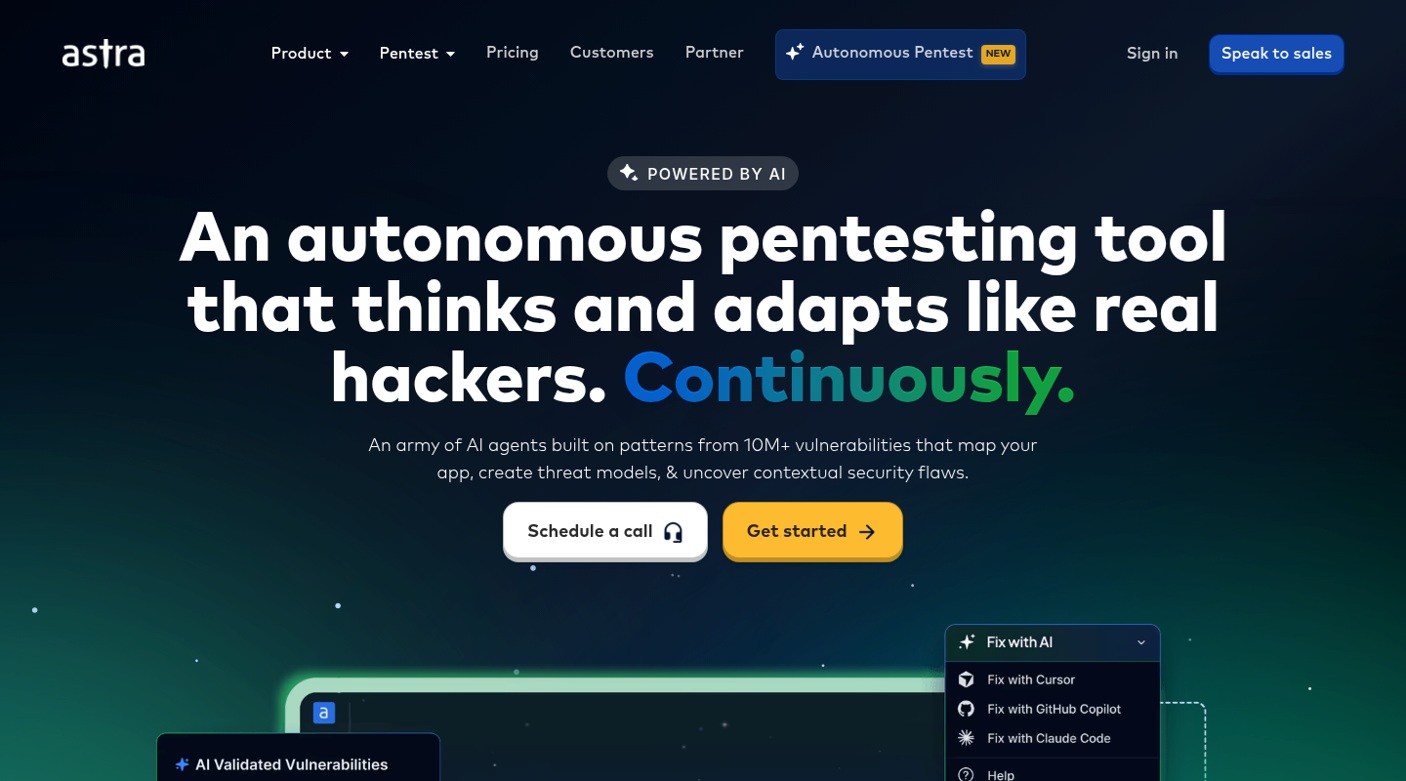
Astra runs autonomous pentesting as one layer of a continuous offensive security platform. It wires directly into the deployment pipeline through GitHub Actions, GitLab CI, Jenkins, and Bitbucket so that an assessment fires on every code deploy. Its specialized agents cover web applications as well as modern APIs, and each assessment includes a retest after code remediation to verify that the fix holds. Pentest Auto, which serves as the entry tier of the Astra Pentest platform, starts at $2,999 per year.
- Fixes delivered into the IDE: Once an agent proves a specific vulnerability, Astra writes an exact fix tailored to that codebase and hands it over as a ready-to-paste prompt inside IDE assistants like Cursor or GitHub Copilot via MCP.
- Independent validation before reporting: A dedicated AI Validator agent sits entirely apart from the initial discovery agents, independently confirming exploitability before any finding reaches your team's main dashboard. This verification process drives false positives down under 10% on Astra's internal benchmarks.
- Scope to weigh: The active agents thoroughly test web apps and APIs at present. Cloud infrastructure remains a future roadmap item, so any engineering team seeking autonomous cloud checks today will not receive them from these agents yet.
XBOW for autonomous web and API exploitation
XBOW operates as a pure autonomous security platform that thoroughly explores web applications and their backing APIs like a human attacker, proving exploitability before it ever surfaces a finding. Each individual test costs between $4,000 and $8,000. XBOW explicitly quotes continuous coverage rates based on your overall platform usage.
- Parallel specialized agents: under a single coordinator, hundreds of throwaway agents each work one attack vector, charting the attack surface and stitching weaknesses into chains before a deterministic validator signs off on every result.
- Release-gate API: engineers fire a pentest straight from the pipeline to gate a release, and XBOW packages each finding as a case file that carries the attack path plus a working exploit.
- Where it stops short: the tool holds to web and APIs, skips internal networks and cloud, and each black-box run drives a single credential set, which leaves BOLA and cross-role IDOR out of sight. XBOW caps you at one retest per 30-day cycle.
NodeZero (Horizon3.ai) for internal network and identity paths
For enterprise infrastructure testing, NodeZero draws significantly more citations than any other autonomous pentesting platform. It launches genuine simulated attacks against external and internal networks, Active Directory domains, and cloud accounts. Horizon3.ai provides custom pricing quotes on request, with external market estimates placing a typical mid-market deployment near $50,000 to $80,000 per year.
- Full kill-chain on infrastructure: the agent finds hosts, grabs credentials, pivots across the network, and links weaknesses into a demonstrated impact, then pairs every finding with proof of exploit plus a retest that runs in one click.
- Rapid response to known exploited bugs: it maps CISA KEV entries against your environment and flags exploitable exposure fast.
- Where it lags for app teams: its web and API pentesting still ships as early access and stays lightweight next to a specialist app scanner, and because NodeZero produces no automated code fixes, developers write each patch themselves.
Aikido Security for all-in-one AppSec coverage
Aikido tucks autonomous pentesting into a wider code-to-runtime AppSec platform where Aikido Attack drives the AI pentesting and Aikido Infinite launches a fresh pentest whenever code ships. Pricing is public, from a free tier up to about $1,050 per month for the platform, with AI pentests around $4,000.
- White-box reasoning: Agents read application source code, execute grey-box and black-box security tests, and re-exploit targets to confirm findings while AutoFix automatically opens remediation pull requests.
- One console for many scans: Penetration test results sit directly alongside SAST, SCA, secrets detection, and DAST output in a unified dashboard, which strongly suits engineering teams that prefer operating fewer distinct tools.
- Where depth thins out: reviewers point out that the AI pentest works as one piece of a wider stack instead of the flagship, and each run halts at a confirmed finding unless you change the default, so a person has to trigger any deeper chained exploitation.
Pentera for enterprise security validation
Pentera runs automated security validation, emulating real attacks against production to test whether exposures and controls hold. It leans toward the enterprise, with quote-only pricing that third-party estimates place around $50,000 to $150,000 per year.
- Deep network and identity emulation: a mature attack engine carries an AI layer that reshapes payloads to reach external and internal networks, cloud, and Active Directory, and it mimics ransomware behavior inside controlled conditions.
- Findings routed to remediation: Pentera Resolve turns results into assigned, re-checked tasks with a replay trail.
- Where web teams feel the gap: its deterministic core can't turn up novel paths outside the playbook, and it skips deep business-logic testing on authenticated web and API surfaces, which leaves app-heavy teams with less value than network teams see.
Penligent for natural-language tool orchestration
Penligent seamlessly orchestrates over 200 distinct security tools through natural-language tasking, driving a complete assessment from initial asset discovery all the way to final report generation. Pricing is fully public, offering a accessible free tier alongside a Pro plan starting at $49.90 per month on a usage credit model.
- One prompt, many tools: The platform wires together foundational security utilities like Nmap, Metasploit, Burp Suite, and SQLMap end-to-end before generating a functional proof of concept with a single click.
- Human checkpoints in the loop: A designated human operator explicitly approves key strategic decisions throughout the process, ensuring all final generated reports emerge fully compliance-ready.
- Where maturity shows: The underlying platform is still relatively new with a somewhat thin set of enterprise-scale case studies. Its CLI-first workflow asks considerably more technical expertise from less experienced users.
Choosing the best autonomous pentesting tools for a team that ships daily
Selecting the right autonomous penetration testing platform ultimately comes down to seamless workflow integration and verified exploitation. For modern engineering teams shipping continuous updates, the primary deciding factor is how smoothly security testing embeds into existing developer loops. While robust platforms like NodeZero and Pentera excel in deep network and infrastructure validation, specialized web and API platforms such as Astra, XBOW, and Aikido deliver significantly greater value for application environments.
Astra consistently stands out for its tight workflow integration, delivering validated proof-of-concept findings alongside IDE-native remediation guidance. Based on widely recognized industry benchmarks like Astra's State of Pentesting 2026 research, which detected critical vulnerabilities every 48 seconds, implementing continuous and automated offensive verification is absolutely essential for securing modern release cycles.
Choosing an autonomous pentesting tool: key questions
How do you add autonomous pentesting to a CI/CD pipeline?
Most modern platforms ship a native plugin or an API endpoint that you can easily integrate into your pipeline so that a test triggers whenever code merges. Wire it into a single non-critical service first to gauge its signal-to-noise ratio before rolling it out across your entire organization. You can configure the run to actively gate a release, or you can allow it to report findings passively while your team tunes alert thresholds. Direct all output to the issue tracker your engineers already use daily so that a verified finding opens a ticket with the full attack path attached. Begin testing in staging environments first, then promote the automated check to production once your security team gains full confidence in the tool.
How soon does an autonomous pentest return its first finding?
You will typically see initial findings delivered on the exact same day testing begins. Automated agents start moving within minutes of receiving authorization, delivering early results in hours rather than the weeks a booked manual engagement takes to commence. Achieving deeper coverage takes additional time, since chaining a full multi-stage attack path and validating it runs well past the first surface hit. Treat any vendor's speed claims as hypotheses to test on a target environment similar to yours, and always ask what the vendor counts as a valid finding. For an engineering team shipping code daily, that rapid head start decides whether you remediate a critical vulnerability during this release cycle or discover it next year.
What is the difference between authenticated and black-box autonomous testing?
Black-box testing starts with no credentials and probes the exposed application surface an anonymous attacker sees. Authenticated testing signs in using one or more configured roles and reaches the deep business logic behind the login screen where broken access control and IDOR vulnerabilities reside. A black-box pass exercises one login context at a time, meaning that complex role-to-role flaws like BOLA remain hidden until you supply valid accounts for each persona. For real application coverage, provide the agents with active test accounts corresponding to each role your system supports. The main login page hides the vast majority of critical vulnerabilities, making authenticated depth the area where an autonomous pentest truly earns its keep.
Does autonomous pentesting run on-premises or only as SaaS?
Both operational deployment models exist, and choosing the right one depends entirely on your organizational constraints. Most app-focused testing platforms run as SaaS, since their agents reach web targets over the internet in the exact manner an external attacker would. A network testing engine that evaluates internal environments needs a physical or virtual presence inside your network, so it typically ships as a container or virtual appliance that you host locally. Strictly regulated enterprises often prefer having the entire software stack hosted on-premises for compliance. Be sure to ask where the agent code executes, whether a self-hosted build is supported, and how the vendor isolates customer data before making a commitment.
How do autonomous pentesting tools confirm that a fix worked?
The most effective autonomous platforms actively retest your application to confirm remediation. After your development team deploys a patch, an automated validation step re-runs the exact original exploit payload against the updated code to verify that the fix holds before closing the ticket. Astra handles this verification process using a separate validation agent, and it delivers the remediation guidance directly into the developer's IDE via MCP.
Where do autonomous pentesting platforms store test data and results?
Storage locations vary significantly across different vendors, making it essential to review data handling terms before initiating a trial. Detailed findings, proof-of-exploit captures, and harvested credentials reside in the platform's secure cloud tenant for most SaaS solutions, whereas self-hosted deployments keep all sensitive data within your local infrastructure. Inquire about how long the vendor retains test results, which internal personnel can access them, and whether you can export or purge data on demand. For compliance-regulated data, confirm the exact geographic region where storage servers reside. Astra maintains findings within your private dashboard alongside re-playable reproduction steps, ensuring all generated reports align with standard audit frameworks.
How does autonomous pentesting fit with an exposure management program?
Exposure management maintains a continuous inventory of your overall attack surface while ranking assets based on exposure risk. Autonomous pentesting takes the next logical step on critical assets by proving which exposures an attacker can actively reach and exploit in practice. Exposure tools show you what is open, whereas autonomous pentesting demonstrates what is actually breakable. Feed your exposure tool's asset inventory directly into the pentest engine so testing prioritizes genuine risk, then route verified exploit findings back to set developer remediation priorities. Astra executes continuous autonomous testing across web and API surfaces, transforming raw exposure data into validated proof rather than an unmanageable worklist.
Does autonomous pentesting replace a bug bounty program?
No, these two security approaches address distinctly different operational needs. A bug bounty program incentivizes external security researchers to report vulnerabilities they discover independently on their own timelines. Autonomous pentesting operates on your specified schedule, systematically testing the application surface and delivering reproduction proof on every deployment. Bug bounties excel at finding highly creative, one-off business logic flaws that human researchers discover over time. Deploy autonomous agents for consistent coverage between release cycles, while maintaining an open bug bounty to catch edge cases that automated schedules might miss.
Author Bio:
Neville Naidoo is a technology journalist covering AI, startups, and the digital economy, with a focus on how emerging technologies are constantly evolving and shaping everyday life.