
Is Crypto Day Trading More Profitable Than Forex for Beginners? 5 Facts
You’ve seen the screenshots—overnight Bitcoin wins and same-day flips on EUR/USD. So where’s the real money for a first-year trader: crypto or forex?
The blunt math says most newcomers lose. According to a 2025 industry survey, 84% of first-year crypto traders finish in the red. Public filings from top EU forex brokers show roughly 72% of new retail accounts lose capital in their first twelve months. The market you pick isn’t a shortcut; beating those odds requires skill, discipline, and a plan.
That’s exactly what this guide delivers. We’ll break down five data-backed facts—failure rates, volatility, liquidity and costs, leverage limits, plus trading hours and security—and flag the tactical moves that tilt probability in your favor.
Quick tip: treat education as prepaid profit. Run at least 30 demo trades and complete a structured course before risking real dollars; you’ll understand why a stop-loss belongs on every ticket.
Ready? Let’s tackle the hardest truth first: why most beginners never see a profit.
Fact 1 – Most beginners don’t profit without proper training
We need to face the math before we chase the money.
Industry data shows 84 percent of first-year retail crypto traders finish in the red. Disclosures filed with the European Securities and Markets Authority in Q3 2025 report that about 72 percent of new retail forex accounts lose capital within twelve months.
Why the brutal attrition?
Most rookies jump in with scalp-happy fingers and no playbook.
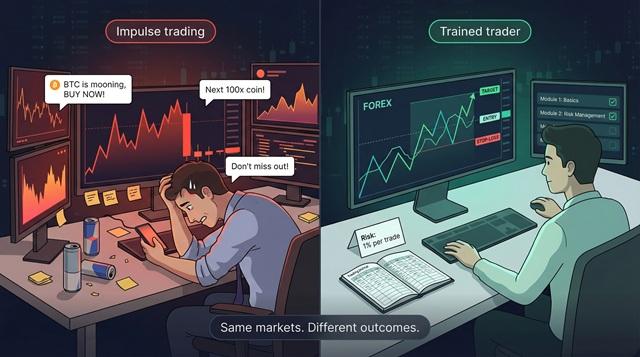
In crypto, fear of missing out sparks impulse buys at the top of a spike.
In forex, novices dial margin power up to 30:1 without grasping how a tiny 0.5 percent move can wipe them out.
Different markets, same outcome: unmanaged risk that tilts hard toward loss.
The deeper issue isn’t the asset class; it’s the skills gap.
Chart reading, position sizing, and stop placement are learnable, yet many beginners lean on social-media tips instead of structured practice.
Brokers that route new clients through mandatory training modules report far fewer early blow-ups than “click-to-trade” platforms.
The 2025 FAQ from N P Financials (NPF) details an 18-hour cryptocurrency-trading curriculum that includes 24 one-on-one coaching sessions before students risk real money. Its Trader Development Program records 93.7 percent client satisfaction, clear evidence that structured instruction slashes early account fatalities.
Here’s the profitable mindset.
Before funding a live account, complete at least thirty risk-free demo trades and track every entry, exit, and emotion.
Treat a reputable course as tuition so you understand why a stop-loss belongs on every ticket.
When your journal shows steady discipline, step up to micro-lots or the smallest crypto contract available.
Capital preservation is win number one; profits follow competence.
Bottom line: education isn’t optional.
Skip the classroom and the market will teach you at full retail.
Fact 2 – Volatility: crypto hands you bigger swings, forex lets you sleep at night
Volatility is the heartbeat of trading.
In crypto that pulse races, tossing prices three to five percent on an average day and sometimes ten percent before lunch. The same morning move in a major forex pair, such as EUR/USD, barely grazes one percent. Picture two weather systems: crypto feels like a tropical storm, while forex is a steady breeze.
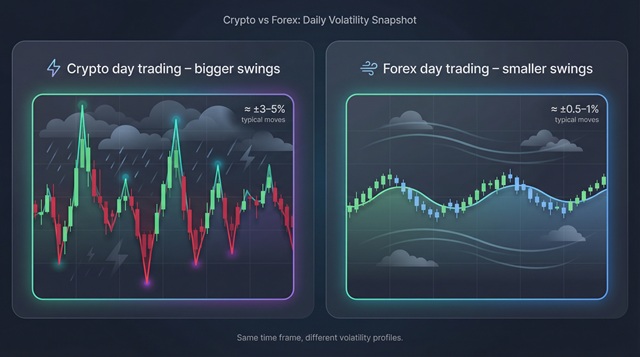
The storm can blow cash straight into your account.
A one-thousand-dollar crypto position that captures a quick five percent pop yields fifty dollars in minutes. Try the same trade in forex during a routine half-percent wiggle and you pocket five. These numbers fuel every YouTube thumbnail claiming “10 X in a day.”
But the storm cuts both ways.
The five percent rally that excites your profits can reverse without warning, handing back those gains plus interest. Flash crashes slice twenty percent off thinly traded alt-coins before most beginners can hit the close button. In calmer forex waters you would need extreme margin to lose that much in a single move.
The human factor matters too.
Big swings pump up adrenaline, and adrenaline kills discipline. Traders who swear they will exit at a two percent stop often freeze when the candle turns red. Forex’s slower tempo offers room to breathe, scan a headline, and act rationally.
So where is the edge for a newcomer?
If you enjoy fast action and can stomach wide unrealized swings, crypto’s volatility offers clear opportunity—just enforce tight position sizing, pre-set stops, and a no-revenge-trades rule. Prefer a market that teaches through gentle nudges instead of knockout punches? Start with forex, master the craft, then step up to the bigger waves.
Remember, volatility is neutral energy.
Handled with a plan it powers gains; ignored it erases accounts. Choose the climate that fits your temperament, then respect the weather every session.
Fact 3 – Liquidity and costs: forex keeps the tap open and the fees low
Picture a fire hose next to a garden hose.
That image sums up daily turnover. According to the Bank for International Settlements’ 2025 survey, forex moves about seven trillion dollars each day, so even a micro-lot slips into the flow without a ripple. The combined spot market for crypto, based on CoinMarketCap aggregates, often reaches 100 billion dollars on a busy day—ample for casual orders, yet thin enough that one chunky sell can drag price lower before your ticket fills.
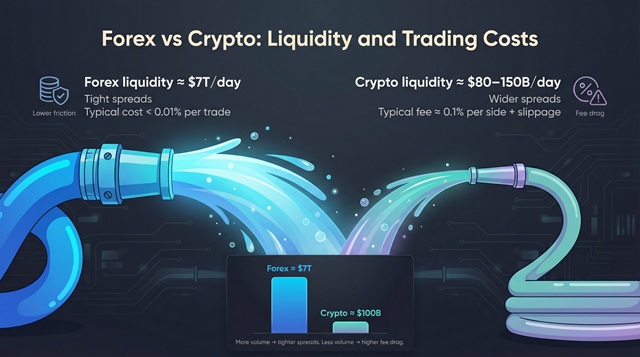
High volume means tight spreads.
Major forex pairs trade inside spreads measured in fractions of a cent. Many brokers quote one pip or less and add a small commission. Total cost per round trip often sits below one hundredth of one percent.
Crypto is pricier.
Spot exchanges typically charge about one tenth of one percent per side, before slippage. When volatility spikes, spreads widen and order books thin. Place ten intraday trades on a small account and fees alone can consume a full percent of capital. In forex the same activity costs pocket change.
Execution quality follows the money.
Press buy in EUR/USD and you usually receive the price shown. Press buy on a mid-cap token and the fill can land several tenths of a percent away. For short-term strategies that gap decides whether a trade finishes green or red.
What does this mean for you?
If you plan to trade frequently, forex’s lower friction keeps more profit in your account instead of the broker’s ledger. Crypto favours patience, with fewer, well-timed trades aimed at larger moves that dwarf the fee drag. Match your style to the market’s plumbing and you keep more of what you earn.
Fact 4 – Margin: the accelerator pedal that wrecks more cars than it wins races
Margin can feel like a cheat code.
Click one button and a modest two-hundred-dollar stake controls six-thousand dollars in EUR/USD. In crypto futures the offers climb higher; some venues allow fifty or even one-hundred times borrowing power on Bitcoin.
The math looks magical.
A one percent move in your favour at three-to-one margin triples what you would earn un-geared. Push that to one-hundred-to-one and the same move becomes a potential windfall.
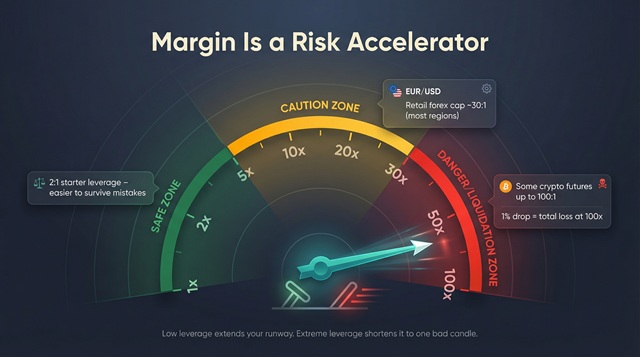
Now flip the chart.
At one-hundred-to-one a single one percent drop can liquidate the entire position. During Bitcoin’s fourteen percent slide in March 2024, exchanges closed out more than a billion dollars in margined contracts within hours. Those traders did not lose some money—they lost all of it.
Forex traders face guardrails.
Most regulated brokers cap retail margin at thirty-to-one on major pairs. Risk is still magnified, yet the underlying pair rarely swings several percent in a single session. Crypto combines higher borrowing power with wilder price moves, creating a minefield that beginners often cross unprepared.
Survival is easy to outline, hard to execute.
- Treat margin as seasoning, not the meal. Begin at two-to-one and move up only after a hundred logged trades prove real edge.
- Place a hard stop-loss on every order. A stop you plan “to decide later” is fiction.
- Calculate liquidation price before entering, then assume the market will target it.
Used responsibly, margin can free capital for diversification and keep fees low. Abused, it turns the market into a casino where physics, not luck, favours the house. Decide which side you prefer before submitting your next ticket.
Fact 5 – Market hours and safety nets: crypto never sleeps, forex lets you
Crypto trades around the clock.
Sunday brunch, Christmas Eve, three a.m. on a random Wednesday—the order book is live. That access feels liberating at first. You can squeeze a trade between meetings or chase an overnight breakout while most of Wall Street sleeps.
Freedom carries a hidden cost: constant vigilance.
Prices can lurch double digits while you shower. Many new crypto traders keep phones glued to their palms and sleep lighter than the currency itself. Fatigue creeps in, decision quality slips, and profits leak away through impulsive clicks.
Forex enforces a healthier cadence.
The global session opens Monday morning in Sydney and closes Friday evening in New York. Weekends off give charts time to breathe and your brain time to recharge. Yes, gaps can appear at the Monday open, but they rarely rival the twenty-four-hour swings common in alt-coins.
Safety nets add another layer of contrast.
Regulated forex brokers must segregate client funds, offer negative-balance protection, and file regular audits. If a firm collapses, government compensation schemes may step in. Crypto exchanges operate under a patchwork of rules. Some are reliable, others vanish overnight, taking user balances with them. Hackers stole about 1.7 billion dollars from exchanges in 2023.
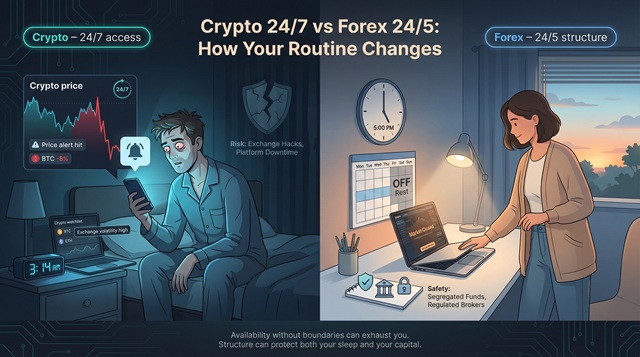
So how do we play it smart?
Use crypto’s 24/7 window for strategic entries, not insomnia-driven scalps. Automate risk with limit orders and price alerts, then log off. If you crave structure, forex’s five-day rhythm can build discipline without demanding midnight screen time. Whatever lane you choose, remember: the money you keep is the money you can withdraw. Protect it with reputable platforms, two-factor authentication, and the discipline to close the laptop when your plan says “done.”
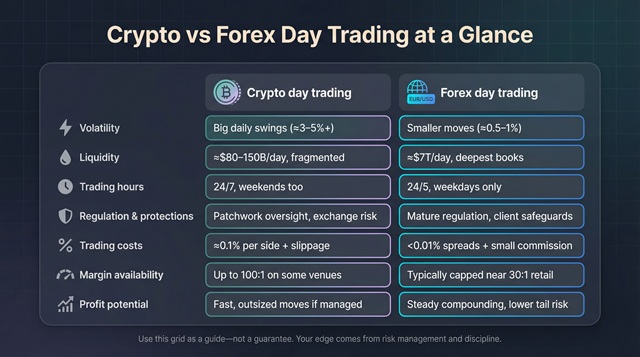
Crypto vs. forex at a glance
Numbers tell their own story, so let’s place them side by side.
Scan the table, spot the contrasts, then note what they mean for your daily trading routine.
|
Factor |
Crypto day trading |
Forex day trading |
|
Typical daily volatility |
3–5 percent for major coins; 10 percent plus swings common |
0.5–1 percent for major pairs; above 2 percent rare |
|
Market liquidity |
≈ 80–150 billion USD daily; fragmented across exchanges |
≈ 7 trillion USD daily; deepest order books worldwide |
|
Trading hours |
24 / 7, including weekends |
24 / 5, Monday–Friday sessions |
|
Regulation & protections |
Patchwork oversight; exchange risk exists |
Mature regulation, client-fund safeguards |
|
Typical transaction costs |
≈ 0.1 percent per side plus possible slippage |
< 0.01 percent spread; small commission |
|
Margin availability |
Up to 100 : 1 on some venues |
Capped near 30 : 1 for retail in most regions |
|
Profit potential |
Fast, outsized moves if managed well |
Steady compounding with lower tail risk |
Use the grid as a quick-reference guide.
High volatility and round-the-clock access sit in crypto’s column; tight costs and regulatory cushions sit in forex’s. Your task is to choose the mix of speed, structure, and safety that fits your personality and schedule.